A Treasure Chest with a Questionable Lock
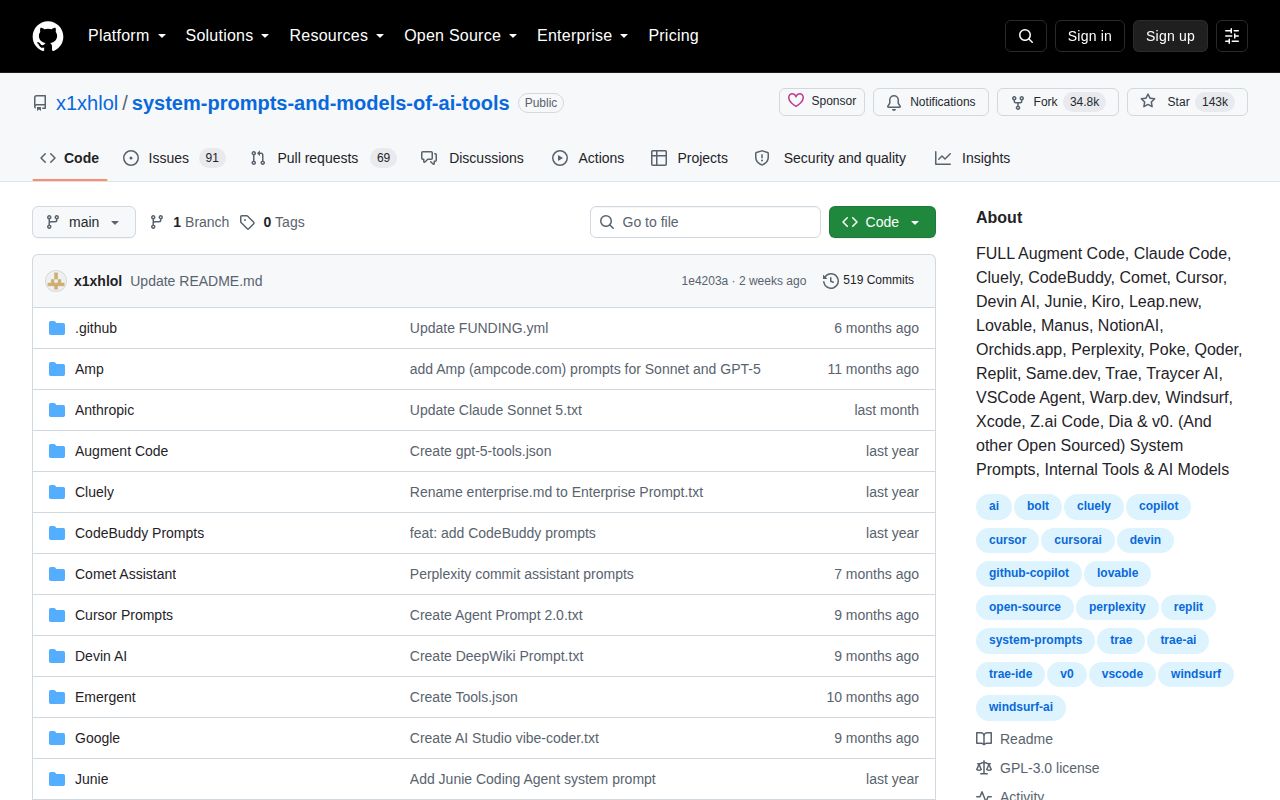
The system-prompts-and-models-of-ai-tools repository is one of the most popular AI-related projects on GitHub, and for good reason. It promises something tantalizing: a peek behind the curtain at the secret sauce of major AI products. It's not an application or a library, but a raw collection of text files, each containing the system prompt, the core set of instructions given to a large language model, for a specific tool or service. For anyone in the field, this is like a chef getting their hands on the secret recipe book from a Michelin-starred restaurant. The problem? It feels like the book was stolen.
This collection solves a genuine problem for AI developers and researchers. Crafting a robust, secure, and effective system prompt is a black art. Seeing how multi-billion dollar companies have solved it is an invaluable shortcut. It provides concrete examples of how to structure instructions, define output formats, handle edge cases, and instill a specific persona in an AI. The educational value here is immense.
The README Tells Its Own Story
Unfortunately, any sense of academic curiosity is immediately soured by the repository's README file. Instead of explaining the collection's structure, its origins, or how to contribute, the document is a masterclass in aggressive monetization. The first thing you see isn't a project description, but a Discord badge and a trend-tracking widget. This is followed by a "Security Notice" that reads less like a helpful warning and more like a scare-tactic advertisement for a service called ZeroLeaks, which, unsurprisingly, is designed to solve the very problem this repository capitalizes on: leaked prompts.
Below that, the monetization efforts become even more direct. There are crypto wallet addresses for Bitcoin, Litecoin, and Ethereum, alongside links to Patreon and Ko-fi. Then comes a section soliciting sponsors. Finally, after scrolling past all the commercial appeals, you find a barebones roadmap that simply says "Open an issue" and contact information for the owner. This aggressive commercialization, coupled with the name of the associated Discord server ("LeaksLab"), casts a cynical shadow over the entire project. It positions itself not as a community-driven open-source effort, but as a business venture built on sharing other companies' intellectual property.
Strengths and Weaknesses
The primary strength of this repository is the data itself. Assuming the prompts are authentic, they represent thousands of hours of research and development from leading AI labs. For a prompt engineer, studying these files can reveal sophisticated techniques for model control that aren't covered in standard tutorials. It's a practical, real-world dataset that can accelerate learning and inspire new approaches to building AI systems.
The weaknesses, however, are significant and systemic. There is no formal project structure. There are no versioned releases, meaning the collection could change unpredictably at any time. There is no documentation explaining the provenance of each prompt, how it was obtained, or how accurate it is. The 157 open issues suggest some community engagement, but without a clear contribution process or active maintenance from the owner, it's unclear if this is a healthy dialogue or a backlog of unanswered questions and bug reports.
The project's maturity is low because it isn't software. It's a dataset presented as a Git repository. There are no guarantees of stability, accuracy, or legal compliance. Using these prompts directly in a commercial product would be an enormous legal and ethical risk.
How It Fits in a Real Stack
This repository has no place in a production stack. You would never import it as a dependency or build a system that relies on its contents directly. Its role is strictly in the research and development phase, used as a reference or educational tool.
A developer or a team would clone this repository to a local machine for study. They might analyze the structure of a prompt from a service similar to one they're building. They could borrow concepts, like how to format outputs as JSON, how to handle refusals, or how to define complex tool-use scenarios, and then adapt those ideas to create their own, original system prompts. It's a source of inspiration, not a library of ready-to-use components. The value is in the knowledge you can extract from it, not the files themselves.