The guide is a map of methods, papers, and examples
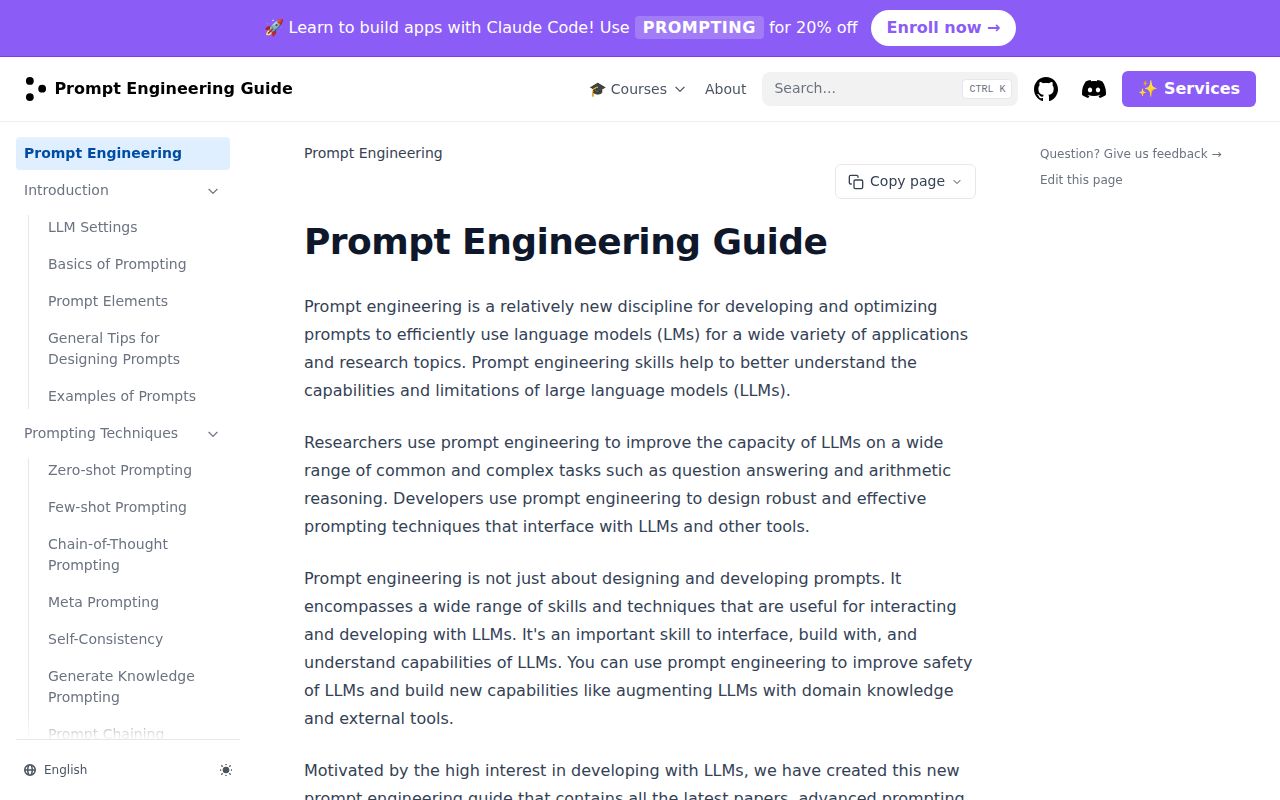
Prompt Engineering Guide collects the vocabulary that surrounds language-model prompting. Its sections cover basic prompt elements, zero-shot and few-shot examples, chain-of-thought, self-consistency, prompt chaining, tree of thoughts, retrieval-augmented generation, ReAct, program-aided methods, and multimodal techniques. Separate areas link to applications, model notes, risks, papers, tools, notebooks, and datasets.
That breadth is useful when a developer knows a prompt is failing but does not know what families of techniques to investigate. The guide can provide a name, a plain explanation, and a paper or example to start from. It is less useful as a recipe book copied straight into production because model behavior, data, evaluation criteria, and provider instructions differ.
The website is more current than the repository README
The README repeatedly directs readers to promptingguide.ai for the most up-to-date guides. It also says the project supports 13 languages and links a one-hour lecture, notebook, and slides. The GitHub repository is still useful for pull requests, translations, source files, and citations, while the web version is the intended reading interface.
Commercial material sits beside the free guide. The README promotes DAIR.AI Academy courses, corporate services, and a 20 percent discount code. That does not invalidate the technical content, but readers should know they are entering a resource that also markets paid instruction. Follow cited papers and provider documentation when a claim affects an architecture or budget.
What happened when we ran it
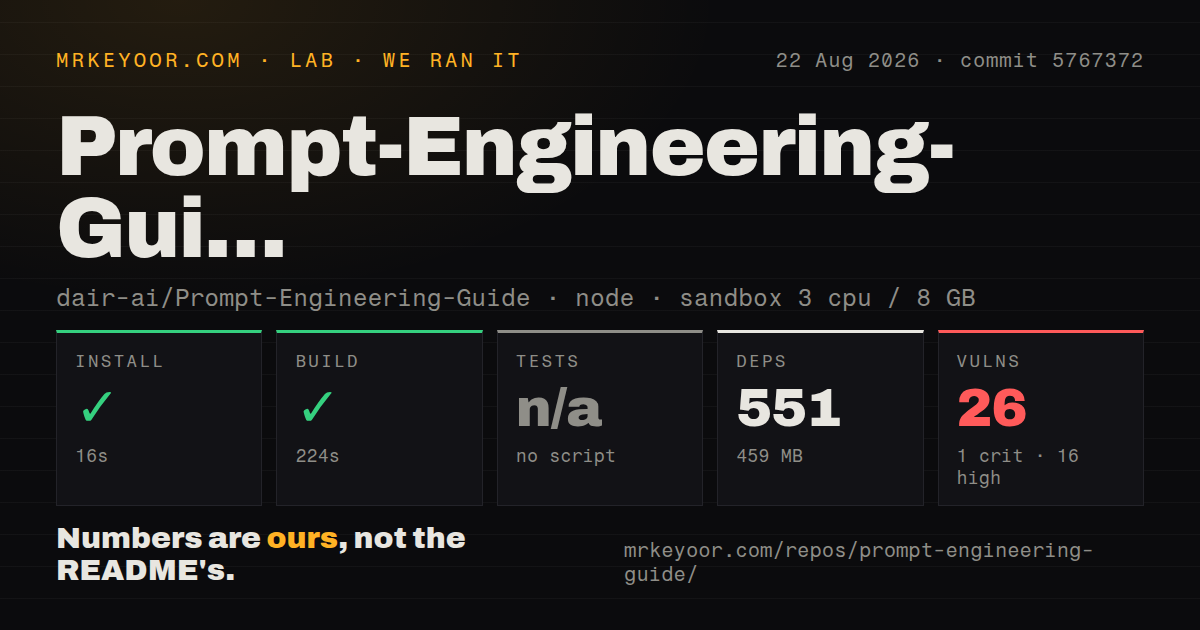
Our sandbox installed 551 pnpm packages in 16 seconds and consumed 459 MB on disk. The static documentation build succeeded in 224 seconds. We ran commit 5767372 in a fresh unprivileged Debian container with Node 22, 3 CPUs, 8 GB of RAM, and no secrets. Npm audit reported 26 known vulnerabilities: 1 critical, 16 high, 7 moderate, and 2 low.
The repository had no test script or target, so the lab skipped tests. It also had no tests directory. Two CI workflow files were present, and there was no Dockerfile. The checkout contained 1,559 files, about 1,815 lines counted as source, and 79.9 MB of content before installation. Much of the project's value is prose, notebooks, PDFs, and links rather than application code.
A passing 224-second build means the documentation generator completed in our environment. It does not show that every external link works, every code cell runs, or every prompt produces the described behavior on a current model. The audit result also deserves a dependency review before hosting a fork. Content-only readers can avoid that local JavaScript surface by using the published website.
Local contribution needs Node 18, pnpm, and Nextra
The README asks for Node 18 or newer and pnpm. Its local instructions install Next, React, React DOM, Nextra, and the Nextra docs theme, then start a development server at port 3000. That is enough for editing a page or checking a translation. No model API key is required to render the documentation.
Reproducing prompt examples is a separate job. A notebook or model-specific page may need provider credentials, packages, datasets, and a chosen model version. The repository build does not execute those experiments as one suite. Contributors should state the model, date, settings, and evaluation data when adding results so later readers can tell a historical example from a current guarantee.
Named techniques are starting points for experiments
The technique catalog is the strongest part of the project. A developer can compare few-shot prompting with retrieval, inspect a ReAct pattern, or trace an idea back to a paper. The risks section also covers adversarial prompting, factuality, and bias, which keeps the material from presenting prompt wording as a cure for model limitations.
Still, method names can create false confidence. Chain-of-thought, self-consistency, or tree-of-thoughts describes an approach, not a measured improvement on every task. Production teams need held-out examples, scoring rules, latency and cost limits, and regression checks on the exact model endpoint they use. The guide helps choose candidates for that evaluation; it does not perform the evaluation.
March activity is recent enough to watch, not enough to assume freshness
GitHub showed 77,809 stars and 278 combined issues and pull requests when fetched. The last push was March 11, 2026, about five months before this review. There is no published GitHub release. Those facts do not establish abandonment, especially for a documentation project whose site is presented as the current version, but they do make dated model pages worth checking against provider sources.
A large star count reflects reach rather than editorial verification. The open count includes pull requests, not only defects. For a learning resource, useful health signals are whether links and translations receive maintenance, whether papers have clear citations, and whether model-specific pages state when they were tested. Readers should use the guide's references rather than popularity as the authority.
Use it to design an evaluation, not replace one
Prompt Engineering Guide is a good first stop for terminology and reading lists. The MIT license, 13-language claim, public source, and broad set of methods make it accessible to students and working developers. The local 16-second install is manageable, although a 459 MB dependency tree and 26 audit findings are unnecessary if you only want to read.
Choose a technique from the guide, write a small task-specific dataset, and compare it with a simpler baseline. Record model and settings, then rerun the set when either changes. That workflow turns a useful catalog into evidence for your application without confusing a documentation build with proof that the prompts work.