LangChain earns its keep when providers and tools keep changing
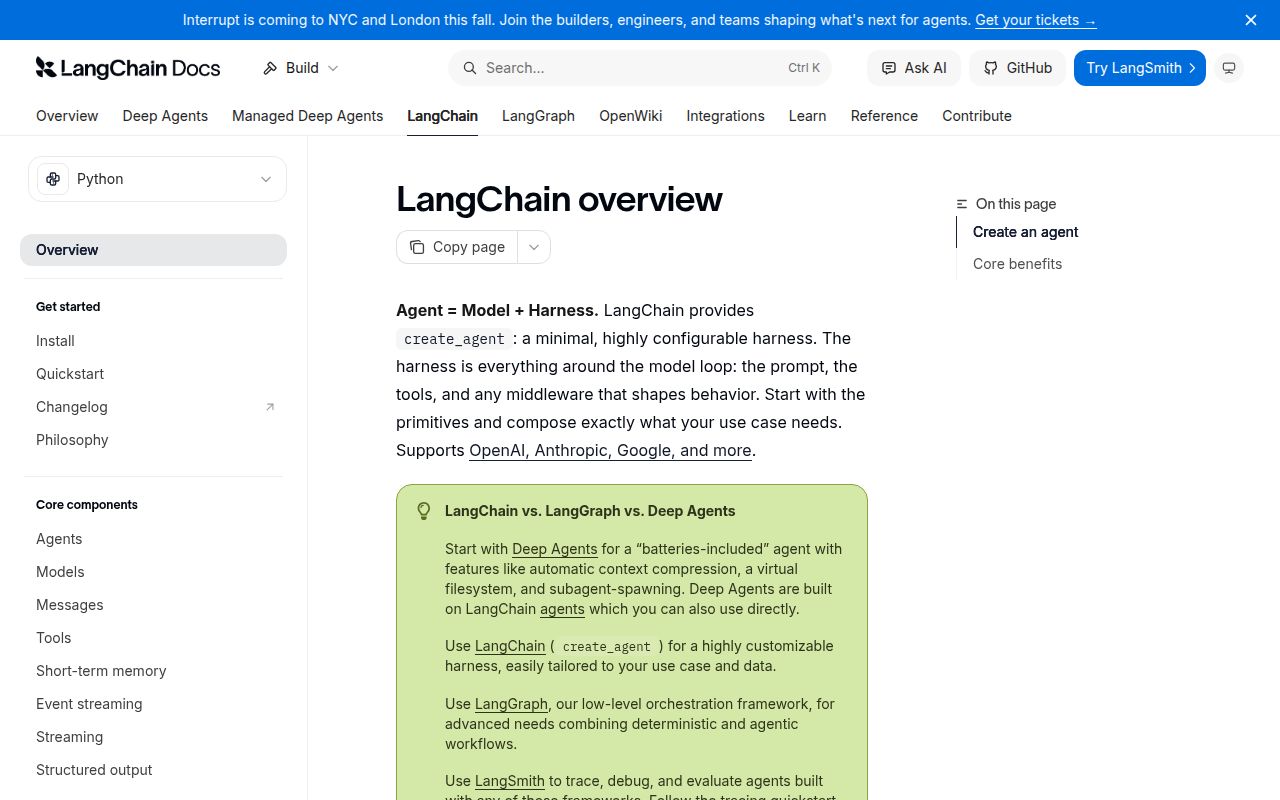
LangChain gives Python applications shared interfaces for chat models, embeddings, vector stores, tools, messages, and agent behavior. The README's smallest example installs langchain, initializes a named model, and invokes it. That looks almost too simple, but the benefit appears when the second provider or retrieval backend arrives. Application code can keep a familiar shape while integration packages handle many vendor differences.
The repository is much larger than that quickstart suggests: our checkout contained 3,039 files and roughly 402,059 lines of source. The main framework now sits within a family that includes LangGraph for lower-level workflow control, Deep Agents for batteries-included agent behavior, and LangSmith for evaluation and tracing. That range is helpful once a prototype grows, though newcomers must learn which layer owns which job.
The abstraction saves adapter work and creates framework work
A common model initializer is useful when a team actively compares providers. The same is true for normalized messages, tool schemas, streaming events, and structured outputs. LangChain also gives integrations a shared home, which is easier to search than a private directory full of one-off wrappers. A team can spend its time on application behavior instead of repeatedly translating message types.
The tradeoff is visible in the 424 open issues and pull requests reported by GitHub on August 25, 2026. That number is not a bug count, but it reflects the surface area maintained across core code and outside services. Provider APIs change, model response formats differ, and a unifying layer has to catch up. Current reports include missing Anthropic response metadata and Perplexity usage fields merging incorrectly.
Those problems matter most when an application depends on the exact provider response. LangChain's normalized result is convenient until billing data, cache counts, stop reasons, or a new beta header becomes operationally important. Teams should retain integration tests against every model they use and inspect the raw metadata they care about. A shared interface reduces adapter code; it does not make providers identical.
What happened when we ran it
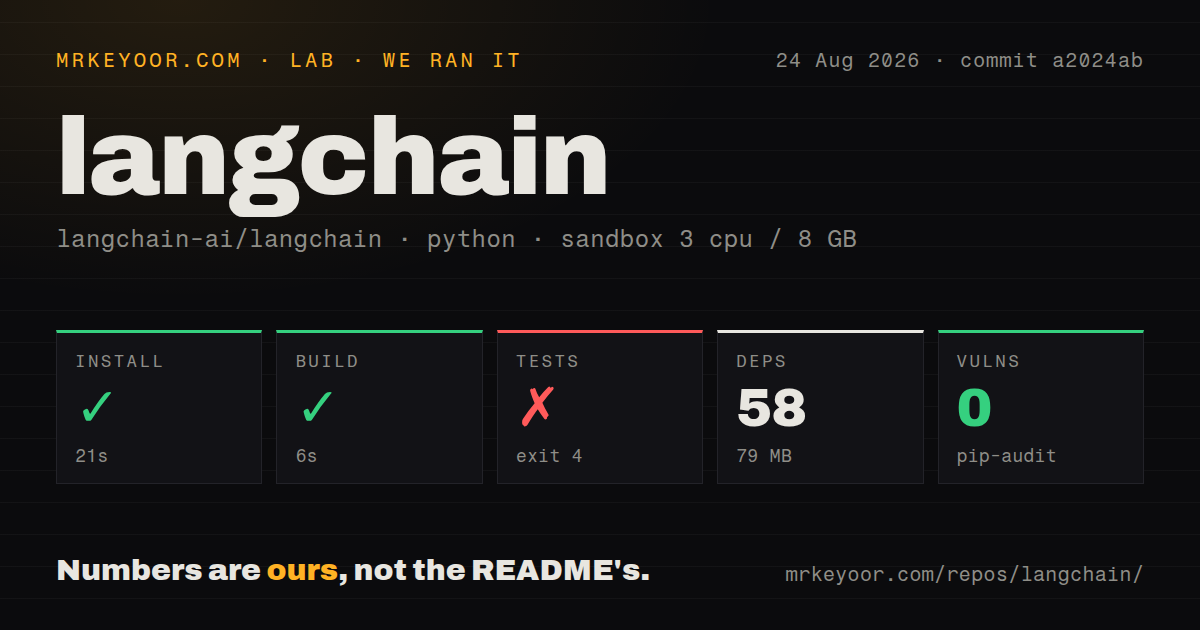
In our sandbox, installing the core project took 21 seconds, pulled 58 packages, and occupied 79 MB. Building it succeeded in another 6 seconds. That is a reasonable footprint for the foundational library, especially compared with agent projects that bundle browsers, model weights, or several service clients. pip-audit reported 0 known vulnerabilities in the installed dependency set.
The configured test run did not reach test execution. After 9 seconds, pytest exited with code 4 and said it did not recognize --snapshot-warn-unused, an argument supplied through libs/core/pyproject.toml. The log establishes the unsupported argument and nothing more, so we cannot say whether the suite itself would pass after the environment is adjusted.
This was commit a2024ab inside a fresh Python 3.12 Debian container with 3 CPUs, 8 GB of RAM, no secrets, and no elevated privileges. We worked in libs/core, not every package in the monorepo. The repository had 27 CI workflow files and a tests directory, but no Dockerfile, so contributors should follow the project-specific development setup rather than expect one canonical container.
The README starts the install, while the application owns the services
uv add langchain installs the framework, not a working agent system. The quickstart selects an OpenAI model, which means the application must add the matching integration and supply credentials. Retrieval introduces an embedding model and usually a vector database. Tools may add web services, databases, or local processes with their own authentication and failure modes. None of that is hidden by the common call interface.
The main README is a map rather than a full operating manual. It links to conceptual guides, an API reference, integrations, courses, and contribution documentation. That split makes sense for a codebase with about 402,059 source lines, but it also means a developer will leave the repository page quickly. Teams should document the exact subset they use instead of treating the whole ecosystem as their architecture.
Open defects make regression tests part of adoption
Provider metadata is only one live edge. An open LangChain report says heterogeneous middleware can collapse inferred agent state to the base schema. Another says JSON parsing errors in invalid tool calls are not handled by create_agent. A core issue reports that the Markdown list parser drops items beginning with +. These are specific failures in useful abstractions, and each can change application behavior without a network outage.
The response should be narrow tests, not fear of the entire project. Pin package versions, cover tool errors, assert structured output, and record the provider metadata used for cost or control decisions. The latest core release, published August 19, 2026, contains fixes for strict tool schemas, serialization, Windows test portability, and model exception types. The August 25 push and same-day issue activity show maintainers are working, while the release notes also show how often boundary cases need attention.
Choose it for changing systems, skip it for one direct call
LangChain is strongest when an application has several models, tools, or retrieval choices and the team wants one vocabulary across them. It is also a sensible route into LangGraph when agent state and execution need tighter control later. The MIT license, active release work, and broad documentation reduce adoption risk for teams willing to own framework upgrades.
A single-model utility gains less. Calling one provider SDK directly leaves fewer layers to debug and exposes new API features sooner. Our 21-second install shows LangChain core is not physically heavy, but its conceptual surface is large. Adopt the parts that remove repeated adapter work, pin them, and keep provider-level tests where exact behavior affects money or correctness.