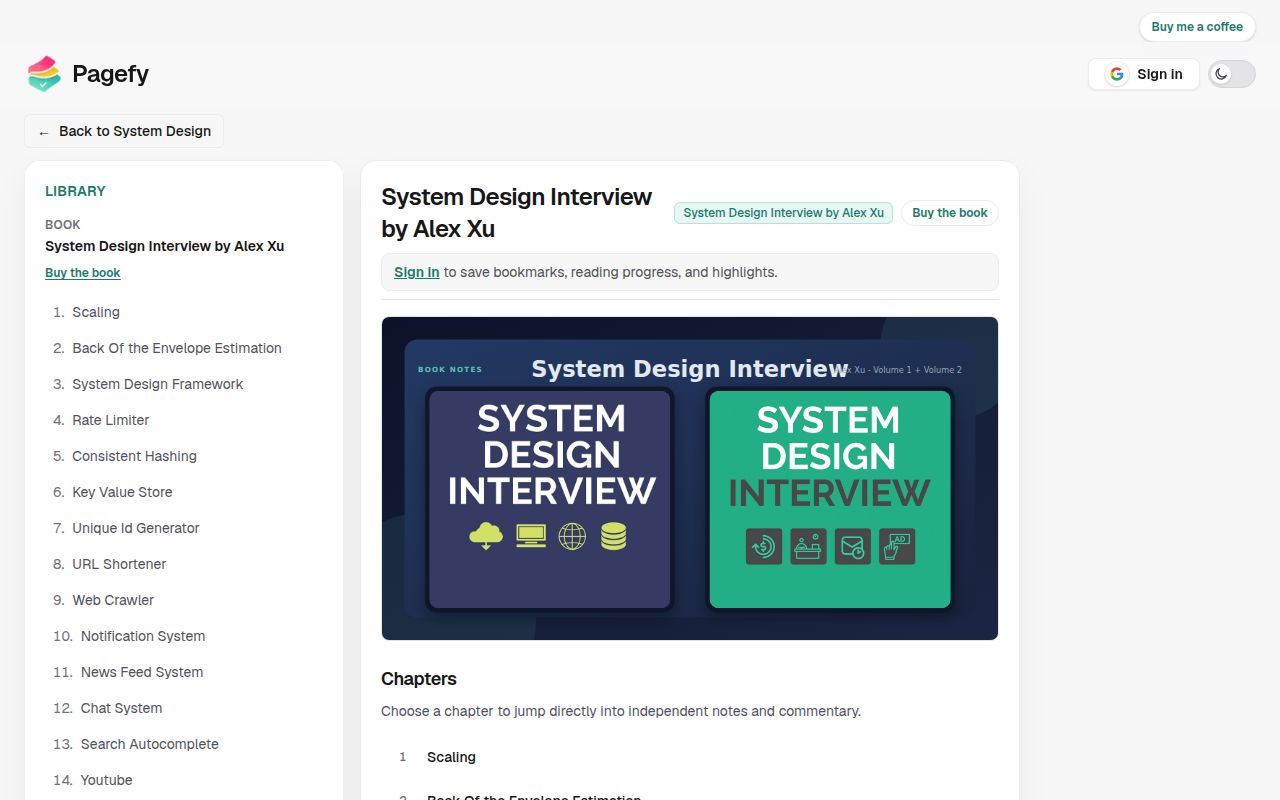
It is a companion to 2 books, not a new system design course
System-design-notes turns material from volumes 1 and 2 of Alex Xu's System Design Interview books into public chapter notes. A reader can jump from scaling and estimation to exercises such as a rate limiter, URL shortener, notification service, or payment system. The README states the relationship to the books and labels the notes as a work in progress. This is useful beside the source books, not as proof that their full explanations have been replaced.
The breadth is the immediate appeal. The index spans 28 chapters, beginning with scaling from zero to millions of users and ending with a stock exchange. Between them are familiar interview systems such as a key-value store, web crawler, news feed, chat, search autocomplete, video service, cloud drive, nearby-friends feature, maps, message queue, monitoring platform, hotel booking service, object storage, wallet, and leaderboard.
The external reading list is the strongest part
The additional resources keep the notes from being merely a table of contents. For consistent hashing, the README points toward academic material, Cassandra, Discord's scaling account, and Google Maglev. The key-value-store section connects readers to Dynamo, Bigtable, Cassandra architecture, and talks about DynamoDB internals. Across 2 book volumes, those links create a valuable bridge from interview shorthand to papers and engineering write-ups.
The selection also reflects useful implementation concerns. Rate limiting includes circuit breakers and an Uber limiter; unique IDs include Flickr's ticket servers and Snowflake; video design branches into transcoding, broadcasting, and encoding; file synchronization points to differential synchronization and Dropbox scaling. Still, the excerpt does not show how deeply each of the 28 directories treats trade-offs, failure modes, calculations, or alternatives, so the index should not be mistaken for uniform depth.
What happened when we ran it
We cloned commit 9d83887 into our fresh Debian sandbox on 2026-09-09, with 3 CPUs and 8 GB of RAM. We did not run an install, build, or test command because the repository had no supported language ecosystem and no Dockerfile. There was therefore no timing, test count, or benchmark to report. This is not a failed application build: it shows that the repository behaves like documents rather than packaged software. Anyone expecting a service or local web app should reset that expectation.
Our run also means we cannot validate the hosted presentation from a local build, nor claim that every link or rendered chapter works offline. The README provides hosted reading links, but the measured metadata supplies no reproducible renderer. Cloning and opening Markdown may be enough for ordinary use. The absence of a documented 1-command preview path leaves repeatable publishing unclear.
Strong coverage comes with unfinished edges
The chapter ordering is sensible for interview study. It places estimation and a design framework before 25-plus applied scenarios, then ranges from common building blocks to domain-heavy designs such as payments, wallets, and stock exchanges. That encourages readers to reuse ideas instead of treating every prompt as unrelated. A topic can be found in seconds without learning a custom documentation system.
The rough edges are equally plain. The project calls itself a work in progress, has no listed release, and exposes no release cadence for readers who want a stable edition. The supplied metadata reports the license as unknown, constraining companies that hope to copy, adapt, or redistribute the notes. Small README defects, including “Additonal” and “System Desgin,” weaken editorial confidence. There are also 2 different hosted-note addresses in the supplied information, making the canonical destination unclear.
Healthy attention does not guarantee editorial support
The repository has 17,262 stars and appeared in the supplied GitHub Trending item, so it has attracted substantial interest. Its last push was 2026-08-12, less than a month before this review, and it has 5 open issues. Together, those signals look active rather than abandoned. Without issue response times or maintainer discussions, however, we cannot say how quickly corrections are reviewed. The absence of releases is less alarming for notes than for a library.
Popularity should still be interpreted carefully. A star records attention, not accuracy, completion, or permission to reuse the material. System design guidance can age as vendor architectures and terminology change, even when foundational papers remain useful. Readers should cross-check claims against linked papers and engineering posts. The 2026 push date improves confidence that somebody still touches the repository, but it does not turn unfinished notes into an edited textbook.
It belongs in a study stack, not a production stack
Use this repository as the middle layer of a 3-part workflow: read the book chapter, scan these notes to recover the structure, then open the cited paper or engineering case study to test the simplified answer. It also works as a checklist for mock interviews. Because it contains no service, library, or executable workflow, it has no place in an application's runtime architecture. Its value is faster recall and better-directed reading.
The best fit is an engineer with a deadline who understands that system design answers are discussions of constraints and trade-offs, not templates to copy. Beginners may prefer a standalone primer, while experienced engineers may get more from Awesome Scalability's wider case-study index. For the right reader, these 28 chapters are a convenient map. Keep the source books and linked material nearby, and treat unclear licensing as a stop sign before republishing any portion.