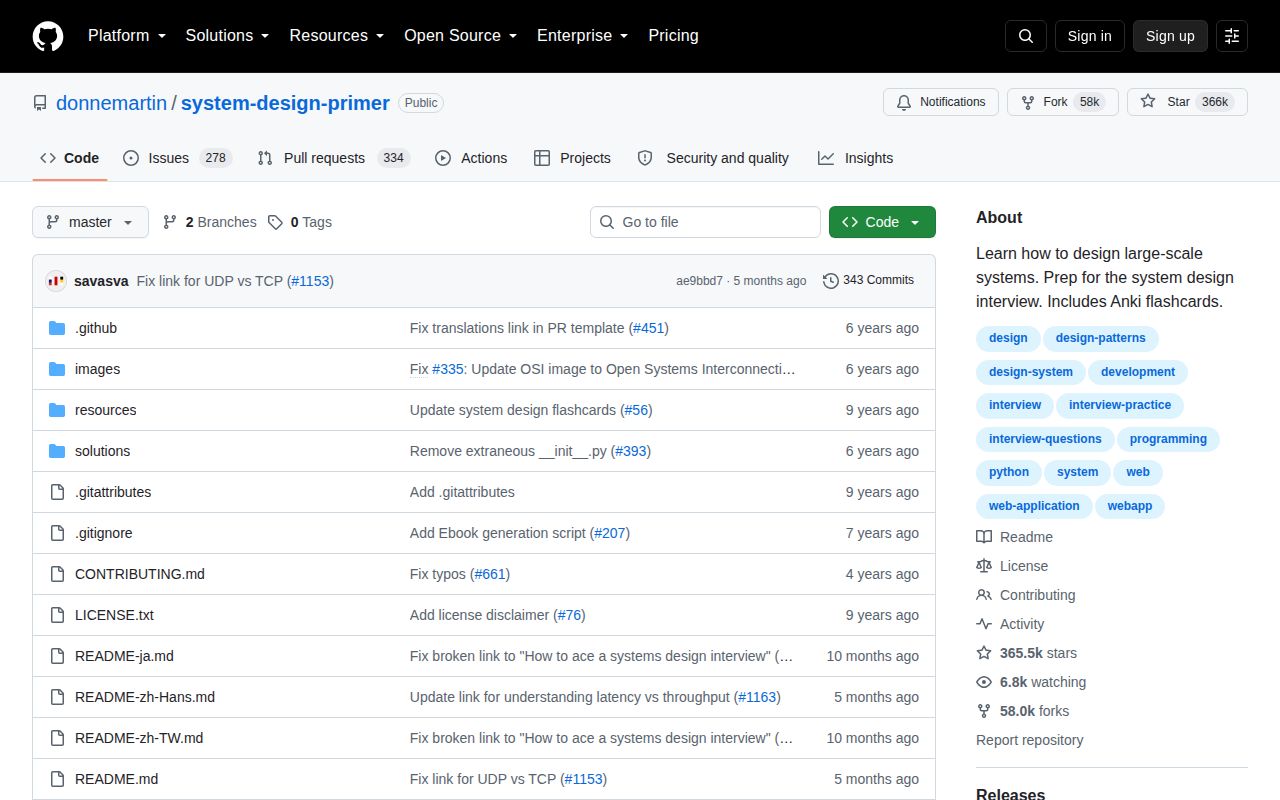
With over 360,000 stars on GitHub, donnemartin/system-design-primer isn't just a popular repository; it's a foundational institution for a generation of software engineers. For years, it has served as the de facto, free-to-access bible for preparing for the system design interview, that abstract, high-stakes conversation that stands between a developer and a job at a top tech company. It promises to take the scattered, chaotic world of distributed systems knowledge and wrangle it into an organized, digestible curriculum. For the most part, it succeeds spectacularly.
The Curriculum You Wish You Had
The Primer's greatest strength is its structure. It's not just a collection of links; it's a thoughtfully laid out course. It begins with the absolute fundamentals: the trade-offs between performance and scalability, latency and throughput, and the ever-present CAP theorem. This grounding is crucial, as the repository constantly reinforces the core idea that in system design, "everything is a trade-off."
From there, it systematically dissects the components of a modern, large-scale web service. You learn about DNS, CDNs, Load Balancers, Reverse Proxies, and the application layer itself. Each section provides a concise summary, outlines pros and cons of different approaches (e.g., Layer 4 vs. Layer 7 load balancing), and links out to more in-depth resources for those who want to dig deeper. The coverage of databases is particularly strong, giving a solid overview of both SQL (replication, sharding, federation) and NoSQL (key-value, document, graph) paradigms, and, crucially, guidance on when to choose one over the other. Caching, asynchronism via message queues, and communication protocols are all given similar, thorough treatments.
Beyond the theoretical components, the Primer delivers on its promise of interview prep. It provides a framework for approaching an open-ended design question, followed by a collection of common problems, like "Design Twitter" or "Design a URL Shortener", complete with sample solutions, discussions, and diagrams. The inclusion of Anki flashcard decks is a standout feature, providing a practical tool for spaced repetition to help cement these complex concepts, perfect for studying on the go.
An Encyclopedia, Not a Weekend Read
While its comprehensiveness is a strength, it is also the project's main weakness. The sheer volume of information can be paralyzing for newcomers. The main README.md is a sprawling document that can feel endless, and it's easy to get lost in the dozens of external links. This is not a resource you can skim in an afternoon; it requires a dedicated, methodical approach, likely spanning weeks or months.
The project's nature as a living document in a Git repository has its downsides. With 578 open issues and no formal release cycle, it feels more like a sprawling, community-tended garden than a polished, versioned textbook. Many issues are suggestions for improvement, typo fixes, or translation requests, but their high number suggests a maintenance bottleneck. A user clicking through today might encounter broken links or sections marked "under development" that have been that way for a long time. The license being listed as NOASSERTION is also a minor but notable bit of untidiness, reflecting a lack of formal governance that's common in personal-turned-monolithic projects.
How It Fits in Your Toolkit
It's important to understand that the System Design Primer is not a software tool to be installed or a library to be integrated into a tech stack. It is a pure knowledge resource for the humans who build that stack. Its primary role is as a free, self-service bootcamp for interview preparation. It competes directly with paid courses like "Grokking the System Design Interview" on Educative.io and books like Alex Xu's popular series.
Where the Primer excels against these paid alternatives is its cost (free) and its breadth. While a paid course might offer a more polished, interactive experience, none can match the sheer volume of curated information in the Primer. In a real-world study plan, an engineer would be wise to use the Primer as their foundational text and then supplement it with more visual or interactive resources like ByteByteGo videos or by working through a paid course to practice in a different medium. For engineering teams, it's an excellent, no-cost onboarding resource to ensure all new hires share a common vocabulary and understanding of architectural principles.