Choose it for editable explainers, with a human reviewing the result
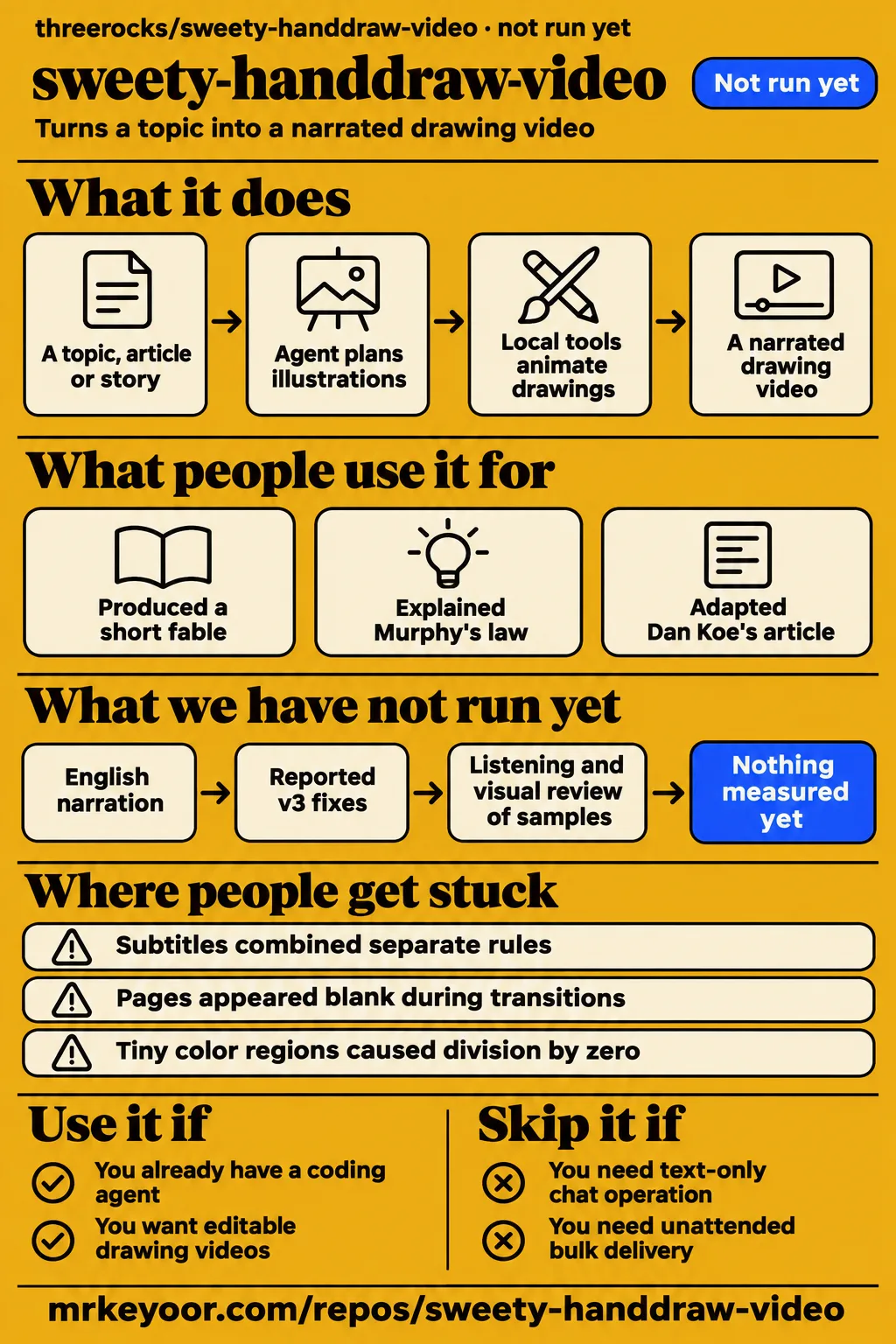
Use sweety-handdraw-video if you already work with a coding agent and want to revise illustrations, speech and subtitles separately. Skip it if you need an ordinary chat window to deliver a finished video without arranging image generation, narration and local rendering. Our sandbox evaluation stopped at the prerequisite stage because the harness had no supported execution path for this Python repository and found no Dockerfile.
The useful distinction is how the video gets made. An agent plans the explanation and illustrations, then local tools animate drawing paths and combine the result with speech. The independent Mycelium Protocol review describes editable intermediate files rather than an external image-to-video model making the final footage. That gives a creator somewhere specific to intervene when a caption or drawing is wrong.
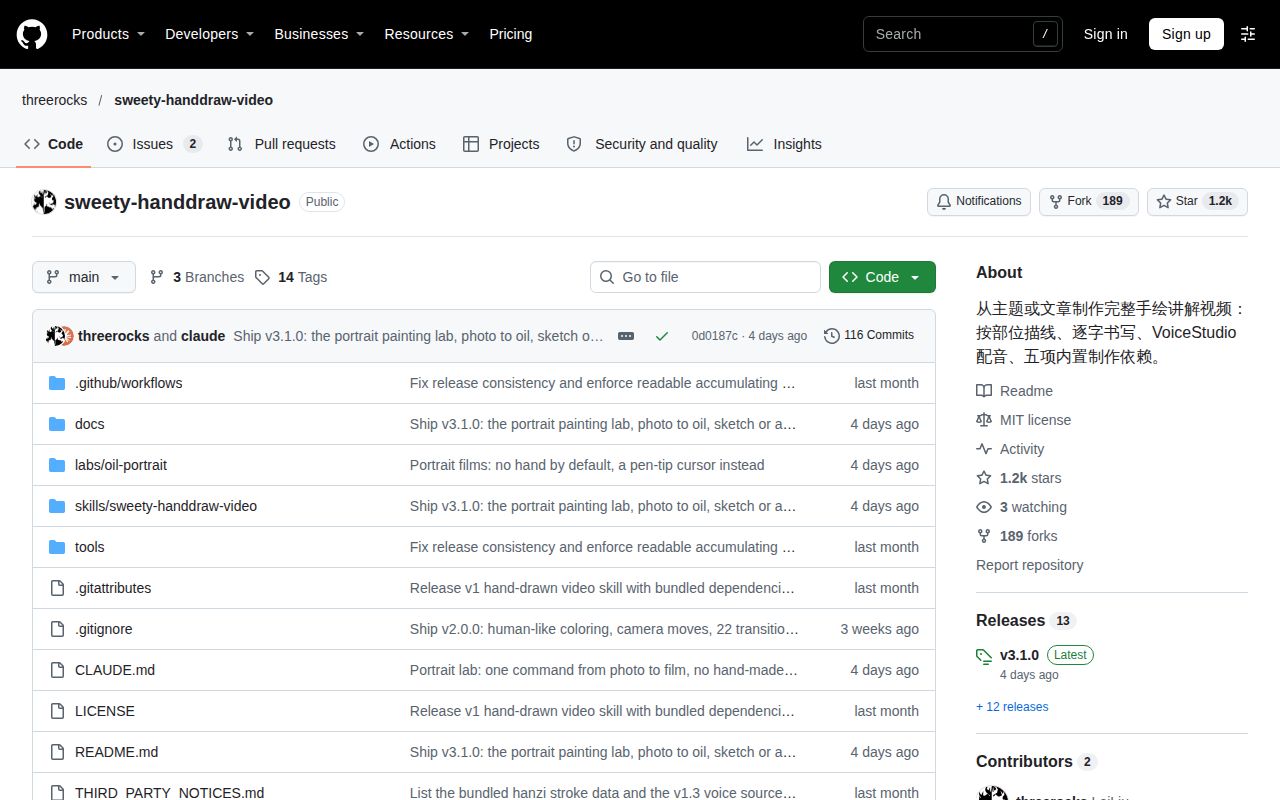
GitHub's public API recorded 1,218 stars on November 15, 2026. The author supplies finished examples, while the independent review documents an older runtime fixture. The issue tracker supplies a more specific reason to inspect the output: a subtitle bug could join the end of one instruction to the beginning of another, changing the rule a viewer would take away. Repository metadata
What people use sweety-handdraw-video for
The author reports finished fables and article adaptations; a community user reports adapting the skill for WorkBuddy. These examples show concrete subjects and workflow choices. They also give a prospective creator different starting points: a short story with a clear causal sequence, a concept with several illustrated steps, or an article whose argument must survive adaptation into narration and pictures.
| Who used it | What they made or tried | What the source reports |
|---|---|---|
| Project author | A snake-and-saw fable about anger | A 49-second sample with pale narrative illustrations, a brush hand and narration. Author documentation |
| Project author | A Murphy's law explainer | A historical v1.0.0 sample, about 2 minutes 5 seconds, with eight pictures and 24 narration segments. Author documentation |
| Project author | An interpretation of Dan Koe's article | A 3-minute-8-second v2 sample in 2:3 portrait format, using the realistic male voice. Author's October article |
| Project author | An interpretation of a Zhihu answer | A 1-minute-33-second sample identifying the original author and source. Author's October article |
| @Zhibin992 on X | A modified WorkBuddy workflow | The user reports modifying the skill so a topic entered in WorkBuddy could produce a video. Community report |
The author says the Dan Koe and Zhihu pieces restated arguments in the creator's own words and named the source in narration and cover art. For a publication, that is a useful production habit: carry attribution into the deliverable, where the audience can see it, instead of leaving it in a prompt or project folder. It also makes the adaptation's relationship to the original work explicit.
The Mycelium Protocol reviewer inspected a pinned v1.2.3 checkout in a temporary Mac Python 3.12 environment. It reports that all 59 unmodified upstream regression tests passed and that a shapes-and-test-tones fixture rendered and decoded at 960×540 and 24fps. Its checks rejected the fixture as a finished deliverable and rejected reuse of old approval records after the job changed. Independent fixture results
What happened when we ran it
Our November 15, 2026 sandbox evaluation of commit 0d0187c was NOT RUN: the harness had no supported ecosystem for this Python repository and found no Dockerfile. Our run recorded an allocation of 3 CPUs and 8 GB RAM, with image listed as n/a. These are the recorded sandbox settings; the measurement block supplies the execution outcome below.
| Recorded item | Result | What it means |
|---|---|---|
| Supported ecosystem | None for this Python project | The harness stopped before its normal installation, build and test path. |
| Dockerfile | Absent in the supplied measurement | The harness had no Dockerfile fallback. |
| Sandbox allocation | 3 CPUs, 8 GB RAM; image n/a | The record describes the configured allocation. |
| Compose safety step | FAILED: no compose.yaml, compose.yml, docker-compose.yaml or docker-compose.yml | The hands-on deployment path stopped at its prerequisite check. |
| Teardown | ok | The teardown entry reports completion. |
The Compose prerequisite log calls the repository unsafe because its deployment rule requires a Compose file. That label belongs to the lab's policy. The project's README instead documents a local setup script and agent workflow. The teardown entry records only teardown: ok, which describes cleanup after the attempted deployment path.
A generic deployment entry says the project was deployed with its own Docker Compose on November 15, 2026, with every port bound to 127.0.0.1. That conflicts with the failed Compose prerequisite and the authoritative NOT RUN measurement. The recorded outcome for this review is the prerequisite stop; the generic entry does not supply a successful application result.
Where people get stuck: captions can change the instruction
Issue #24 reports subtitles joining clauses across semicolons and colons, pairing parts of separate rules incorrectly. The maintainer reports a v3.0.0 fix that stops combining captions after those punctuation marks. The reported fragment involved amend or reset and a clause about having pushed. Joining the wrong halves can change the procedure a viewer understands, even when the individual words are present. Subtitle meaning defect, issue #24
| Reported problem | What the maintainer says changed | What to inspect in your output |
|---|---|---|
| Subtitles combined separate rules | v3.0.0 stops joining after semicolons and colons. Issue #24 | Whether each condition stays attached to its action. |
| Recognition timestamps bunched together; 13 characters appeared for 0.83 seconds | v3.0.0 redistributes time using pauses and character counts when reading rates within a segment differ by more than 2.5 times. Issue #25 | Whether the complete caption stays visible long enough to read. |
| Motion-only pages appeared blank in two sliding transitions, each about 0.75 seconds | v3.0.0 moves screen layers with the page and shows the incoming page's transition-end state. Issue #22 | Whether the explanation stays visible during the transition. |
| Tiny color regions, such as 7×7 pixels, had no strokes and caused division by zero | v3.0.0 adds minimum stroke durations and fallback positions or edges. Issue #29 | Small colored details in a representative scene. |
| Kinetic-title words shared one emphasis color | v3.0.0 adds per-keyword colors. Issue #27 | Whether a color word visually contradicts its meaning. |
Two further reports concern explanatory diagrams. In issue #26, timelines and map routes froze before their animations finished; the reported fix allows duration for the form's own animation rhythm. In issue #21, nearby place names overlapped, short routes occupied too little of the globe, and routes crossing the date line rotated incorrectly. The maintainer reports label avoidance, automatic zoom and corrected rotation in v3.0.0.
Longer scripts hurt when the artwork exceeds the narration budget
The author reports four blocked checks when rebuilding a 1.4 project under v2: 12.9 seconds without a new picture, two pictures each carrying too many narration sentences, and one picture exceeding its drawing time. The author says revising the flagged sections allowed the film to render, while larger pictures and new camera moves required rearranging the layout. Author's migration account
That account makes the budget constraint concrete. The independent review describes a complete narration master whose timestamps determine when drawings appear. If an illustration needs more drawing time than its passage provides, simpler composition or revised planning gives the scene a workable allocation. A dense article therefore needs editorial selection before illustration, especially when each scene must communicate a cause, a change or a comparison. Narration and visual timing
The current README says a series can reuse style recipes, character anchors and accepted materials, with inspection of each film for drift. Start with one mechanism you understand well, then inspect its hardest scene before committing a long script. A community suggestion from @zengge1984 similarly recommends a familiar professional knowledge point. That gives the creator an explanation against which to compare the resulting narration, captions and pictures. Series workflow, community starting question
Local rendering leaves image services and voice rights to you
The project renders locally, while the agent and image-generation service can still run elsewhere. The independent review makes that separation explicit. If your source article or reference image is confidential, decide which service will receive it before production begins. Keeping the final MP4 on your machine says nothing about where the illustration prompt was processed. Workflow boundaries
The author's documentation says the main code and documentation use MIT, while bundled projects retain their own licenses. Generated hand assets and reference audio do not grant rights to a real person's identity or third-party content. Public users must import suitable originals for the two realistic voice presets. The sample-film excerpts are listening previews and cannot serve as the original cloning references. Rights and voice references
For a commercial explainer, keep source permissions alongside the project: article rights, artwork and consent for a reference voice. The current README says image privacy cleaning now uses Python, replacing the older Bun and ExifTool route. It also describes AI-generation metadata in the output and tells creators to follow the publishing platform's disclosure rules. Those requirements belong in the production checklist alongside visual and audio review. Current README
Chinese documentation and defaults need deliberate English choices
The main README is Chinese, while the author's October article and the independent Mycelium Protocol review provide English explanations. The author's article identifies sweety-handdraw-video, handdraw-video and 手绘口播 as names for the same project. An English-language reader can use those explanations to understand the workflow while referring to the main README for its current installation instructions and production options. Author's bilingual overview
The current README defaults to Simplified Chinese and portrait output at 1280×1920, a 2:3 aspect ratio, and 30fps. Specify the intended audience, narration language and output format in the initial brief, then inspect the actual words and layout. Font coverage also has a concrete consequence: the README says a missing glyph stops the build and produces a list of missing characters and attempted fonts. Current defaults and font handling
sweety-handdraw-video vs Excalidraw, Manim and image-to-video tools
Choose sweety-handdraw-video for narration-led drawing sequences, Excalidraw for editable diagrams, or Manim for programmatically specified mathematical animation. The decision turns on the deliverable: a drawing that unfolds alongside speech, a diagram someone can revise, or animated mathematical objects controlled through code. The table separates those jobs from the catalog's whiteboard-video skill and the external image-to-video route discussed by the independent reviewer.
| Option | Why choose it | Decision boundary |
|---|---|---|
| sweety-handdraw-video | Coordinate narration, illustrations and drawing paths, with saved intermediate assets. | Choose it when watching the picture emerge helps explain the script. Independent workflow review |
| Excalidraw | Make editable hand-drawn-style diagrams with PNG and SVG export. | Choose it when the diagram itself is the deliverable. Excalidraw README |
| Manim Community | Specify precise explanatory mathematical animations programmatically. | Choose it when mathematical objects and transformations need explicit control in code. Manim README |
| Opuskill's Excalidraw-oriented whiteboard video skill | Its catalog comparison emphasizes diagrams and publishing materials. | This is the catalog editor's positioning. Opuskill comparison |
| External image-to-video generation | A different route from the local illustration-and-path renderer. | Choose according to whether you need generated footage or revisions to drawing assets and timing. Workflow comparison |
Excalidraw itself is an open-source virtual whiteboard with a hand-drawn style. Its README lists PNG and SVG export, plus an editable .excalidraw JSON format. The application and the catalog's whiteboard-video skill are separate things. An educator who needs a reusable diagram can therefore make that decision before assembling narration, drawing paths and a video timeline. Excalidraw
Manim is an animation engine for explanatory math videos, with precise animations specified programmatically. The community edition is maintained separately from Grant Sanderson's original repository, and its README warns readers to follow the installation instructions for their chosen edition. Choose Manim Community when equations and geometric transformations need explicit control in code and that is how you want to author the explanation. Manim Community
Voice choices sit inside the video workflow. VoxCPM2, a compatible VoiceStudio service and existing narration are alternative audio paths. The author retained VoiceStudio for an existing working service and introduced VoxCPM2 to improve long-form naturalness. Reusing an accepted recording avoids another synthesis pass and lets the creator arrange the visuals around the supplied audio and timestamps. Author's audio options
What the other reviews get wrong
The project documents an executing agent and local rendering environment; ordinary ChatGPT operation is unsupported, and stroke-order and offline-packaging advice require version boundaries. CSDN instead claims direct operation in ChatGPT Code Interpreter without a local environment. The project's explicit requirements provide the installation path used here: a host that reads the skill and executes commands, image-generation capability and rendering dependencies. CSDN claim, project requirements
HotRepo's stroke-order description needs a version attached. The supplied v1.2.3 documentation says glyph-outline drawing does not guarantee standard calligraphic stroke order. The current README says GB2312 Chinese characters use stroke-order data, with other characters traced by outline. An installation guide should attach each description to its documented version so the reader knows which behavior to expect. Historical documentation, current stroke-order documentation
The author's October 28 article identifies v2.0.2 as current, while issue #19 records the subsequent v3.0.0 release. GitHub's latest-release metadata lists v3.1.0, published November 11, 2026. The v3.1.0 release notes say the handdraw skill is unchanged from v3.0.2 and the portrait-painting lab runs from the repository rather than the skill package. Latest release
Hysenlabs describes offline use after installation without a first-use asset download. The v1.2 rules instead downloaded public hand and voice assets on demand from Release attachments. The current README says hand assets, style previews and listening samples have shipped in the package since v1.3. Netlify hosting had stopped after its quota was exhausted; the current documentation describes mirrors for repairing missing or damaged assets. Original realistic-voice references remain separate imports. Historical asset rules, current packaging
Questions people ask
sweety-handdraw-video runs through an executing agent host, with image assets, rendering dependencies and a narration source. Installation therefore involves more than adding a prompt to a chat window. The questions below cover the documented setup path, commercial use, narration timing and the subtitle defects that affect whether the finished film communicates the intended explanation. Project requirements
How do I install sweety-handdraw-video and check that its dependencies are ready?
The README provides an installer for Codex and Claude Code and a separate setup script for rendering dependencies. The commands below are upstream instructions. The installer fetches current public content; for the exact v3.1.0 package, the README points to the release ZIP and its checksum file. Replace the whole skill directory when updating, then read its VERSION file. Installation instructions
npx skills add threerocks/sweety-handdraw-video --skill sweety-handdraw-video --agent claude-code codex --global --copy --yes
bash ~/.claude/skills/sweety-handdraw-video/scripts/setup.sh
bash ~/.claude/skills/sweety-handdraw-video/scripts/setup.sh --check
Can I run it directly in an ordinary chat window?
The documented host must read the skill, execute local commands and generate or obtain illustrations. The current README names Codex and Claude Code on macOS and Linux. Codex can supply built-in image generation; Claude Code needs a connected image tool or MCP, or illustrations supplied by the user. Those capabilities explain why adding the skill's text to an ordinary conversation is insufficient. Host requirements
Can I use sweety-handdraw-video commercially?
The main code and documentation are MIT-licensed; bundled projects and third-party content retain separate rights. Hysenlabs describes commercial software use subject to retaining copyright and license notices. For the finished video, keep the permissions for its article, pictures and reference voice alongside the project. A software license and permission to reproduce someone's content or voice answer different production questions. License explanation, author's rights boundary
Why does the workflow prepare complete narration before arranging pictures?
The narration master supplies the timing for pictures and captions. The independent review explains that semantic segments can be edited into that master, while page boundaries act as markers on the audio. Missing, repeated or truncated words require repairing the audio before rebuilding the visuals. This keeps an unfinished drawing from dictating arbitrary cuts in speech or mechanically extended pauses. Narration contract
Does it write Chinese in standard stroke order, and does it support eraser transitions?
The current README says GB2312 Chinese characters use standard stroke order, other characters follow glyph outlines, and eraser transitions are supported. The v1.2.3 documentation instead described outline tracing and treated eraser transitions as a suggestion. Match the answer to the installed VERSION file and tag, especially when following a tutorial written for the older package. Current behavior, historical documentation
Why must I check narration for noise when I have not added background music?
Reference audio can contain music or noise, and speech synthesis can introduce artifacts. The author separates listening acceptance from program metrics and speech recognition. Listen to the actual narration master before spending effort arranging drawings around it, checking the complete words, pauses and background sound. This review step concerns the synthesized or supplied voice track itself, regardless of whether another music track is mixed in. Author's audio warning
Does passing automated verification mean the video explains the subject correctly?
Automated checks bind approval records to current files and can reject a runtime fixture as a finished deliverable. The independent review distinguishes those checks from observing whether a character holds the correct prop, a causal result is visible or a voice sounds natural. The review records therefore need to describe actual looking and listening, with affected material checked again after revision. Independent review
Is sweety-handdraw-video still maintained?
GitHub records a last push on November 11, 2026, and the supplied release metadata lists v3.1.0. The sampled issue threads also contain maintainer replies reporting v3.0.0 fixes for specific defects. These dated records give the reader a concrete activity history to consult alongside the installed version, rather than relying on a catalog's relative phrase such as "three days ago." Repository activity, release record
Which professional topic would make a useful first hand-drawn explainer?
The independent review proposes a narrow starting brief about why a backup needs a restoration test. A community X question similarly asks which familiar professional knowledge point would make a useful first film. Choose a mechanism whose explanation you already understand, then compare its script, pictures and captions against that explanation. This gives the first production task a concrete standard for review. Starting brief, community question
How can I prevent subtitles from combining clauses into the wrong rule?
Issue #24 reports a v3.0.0 fix that stops joining subtitles after semicolons and colons. Use a version carrying that change, then compare each displayed caption with the script's condition and action. The reported failure paired parts of separate rules incorrectly, so review the meaning of the complete displayed instruction as well as its individual words and synchronization. Issue #24
How can I keep subtitles readable when recognition timestamps bunch together?
Issue #25 reports a v3.0.0 fallback that allocates caption time from pauses and character counts when reading rates within a segment differ by more than 2.5 times. The reported example displayed 13 characters for 0.83 seconds. Inspect that kind of passage in the rendered film for reading time, especially where the recognized word timestamps compress the end of a sentence. Issue #25
What we have not tested yet
Our lab has no completed article-to-narrated-video run for commit 0d0187c. Installation time, build performance, test results and production resource consumption are unassessed; the 3-CPU, 8-GB allocation supplies no minimum hardware specification. The image label supplies no runtime or operating-system version. The corrected installation example above was not executed in this evaluation, and the Compose policy failure supplies no finding of a software security defect.
We have not reproduced the reported v3 fixes, evaluated English narration or completed structured listening and visual review of the supplied samples. The independent v1.2.3 shapes-and-test-tones fixture covers a different task from narrated production. Comparative rendering speed, voice quality across backends, reliable unattended batch production and the privacy behavior of a complete configured agent-and-image workflow also remain outside our completed evaluation. These gaps are why the four editorial ratings remain unassessed.
The supplied X post from @vvcanvaslab announces an RTX 4090 experiment with Qwen image and speech models and says results will follow. It contains no completed compatibility result. The documented MLX VoxCPM2 adapter targets Apple Silicon. The author's documentation also retains the realistic female voice provisionally, with listening quality still needing adjustment. A completed evaluation should use the intended host, voice and language and inspect a conditional instruction like the Git example that exposed the subtitle defect. Experiment announcement, adapter requirements, voice status