
Twenty Chinese skills cover 26 coding tools
superpowers-zh packages a development method for AI coding agents, written primarily for Chinese-speaking developers. Its README counts 20 skills: 14 translations from obra/superpowers, 4 original Chinese additions, and 2 upstream skills that this fork kept after their removal. The subjects include requirements discussion, planning, test-driven development, debugging, code review, worktrees, and verification before completion. This is instruction content for an agent, not a model or coding service.
The larger distinction is distribution. The project documents 26 agent tools and editors, ranging from Claude Code and Codex to Cursor, Windsurf, OpenCode, Qwen Code, and several China-focused products. One npx superpowers-zh command detects supported project markers and writes each tool's expected skill layout. That saves repeated path hunting when a team uses several assistants, though a long compatibility table also creates more surfaces that can drift.
The installer writes skills, bootstrap files, and hooks
The recommended npm route installs at project level by default. Version 1.7.0 added a global mode for tools with documented user directories, such as Claude Code's user skills and Codex's .agents/skills path. The installer may also generate files such as CLAUDE.md, GEMINI.md, or tool-specific rules. You should review the diff after running it in an existing repository because these files influence every later agent session.
Several guardrails are documented. Since v1.2.1, project installation refuses to run from the home directory by default, and generated additions use sentinel comments so the uninstaller can remove its own sections. The README also warns against installing the Claude Code package twice through npm and the plugin marketplace. Manual copying is described as a reduced mode because it omits bootstrap generation and hooks, leaving users to invoke skills themselves.
What happened when we ran it
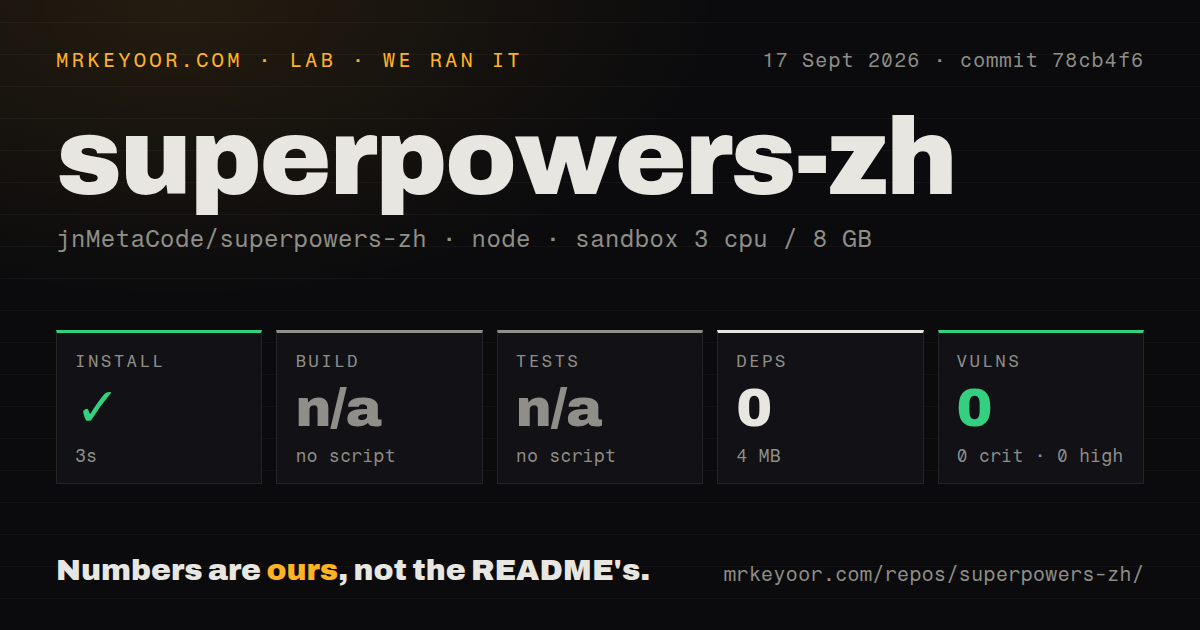
Our sandbox installed commit 78cb4f6 in 3 seconds. Npm added 0 packages and the result occupied 4 MB, so trying the repository itself is cheap. The checkout was 2 MB with 212 files and about 13,714 lines of source. Npm audit reported 0 known vulnerabilities: 0 critical, 0 high, 0 moderate, and 0 low in the dependency state we measured.
There was no build script or target, so we skipped the build rather than inventing a command. The repository also declared no test script or target, and our test step was skipped even though the checkout contains a tests directory. That distinction matters. Three CI workflow files show that the maintainers automate checks, but a contributor cannot infer a standard local test command from the npm scripts our harness inspected. No Dockerfile was present, which is unsurprising for an installer and skill collection.
OpenCode's v1.18.31 mapping shows the cost of 26 adapters
Open issue 131 gives the clearest maintenance warning. The reporter tested OpenCode v1.18.31 and found that the injected mapping tells an agent to use @mention for subagents. In that interface, @mention is a user-side control rather than a callable model tool; the report says the agent should receive task with a subagent type. It also traces the corrected behavior to upstream changes that had not reached the fork's OpenCode plugin and documentation.
Other rough spots are narrower but relevant to the fork's promise. Issue 116 says files produced by the subagent-driven-development skill came out in English instead of Chinese. Issue 129 says Codex's native plugin marketplace cannot discover this repository because a marketplace file is absent, although npx superpowers-zh --global --tool codex remains available. The README's v1.7.12 notes also describe 32 broken cross-skill references fixed for Claude Code plugin users, evidence that adapter behavior needs regression checks.
English covers the upstream, while 6 fork-specific skills stay Chinese
The README offers an English link to obra/superpowers rather than a parallel English edition of all 20 skills. That works for the 14 translated skills because readers can consult their original source. It does not give English-only teams the same path through the 4 China-specific skills or the 2 retained upstream skills as maintained here. This language choice is sensible for the audience, but it is a real boundary, not a cosmetic translation setting.
Those additions are the reason to choose the fork. They cover Chinese code-review tone, Git platforms, technical writing, and commit conventions, while the retained material includes an MCP builder and a YAML workflow runner. The four China-specific skills require explicit invocation, according to the README, which keeps them from firing inside unrelated work. Teams should sample their own pull requests and agent transcripts before making the package a shared default, especially when prompts cross Chinese and English.
A September 17 push matters more than the July release tag
GitHub recorded 8,142 stars, 14 combined open issues and pull requests, and a last push on September 17, 2026. The latest GitHub release was v1.7.1 from July 17, while the README already described v1.7.12 changes and the open Codex request mentioned v1.7.13. That mismatch does not show abandonment. It says the GitHub release page is a poor sole source for choosing the current npm package version.
Use superpowers-zh when the working language is Chinese and the same development habits need to follow people across several agent tools. The 3-second install and zero installed dependencies make a trial easy. The missing declared test target and current adapter reports make a fleet-wide unpinned install harder to defend. Start in one repository, inspect every generated file, run a real task in the chosen agent, and promote the exact version that produced acceptable behavior.