Our sandbox installed SuperJinX in 6 seconds and built it in 1 second, but the later service trial stopped at a missing-Compose safety check. Consider it if you want the maintainer's preset Railway reseller setup and can take responsibility for the supplied default accounts and stored customer data. Choose another route if your business requires unrestricted white-label reuse: the project's license restricts rebranding, reselling or republishing its files as your own work.
What you can do with SuperJinX
Super JinX bundles PasarGuard, Xray and nginx into one Railway service, according to the Super JinX README. PasarGuard manages proxy accounts, Xray handles connections, and nginx routes incoming requests. Super JinX adds the preset configuration and subscription page around those components. Its documented workflow connects creating the hosted service with issuing a customer's subscription, using the supplied groups, sales templates and reseller role.
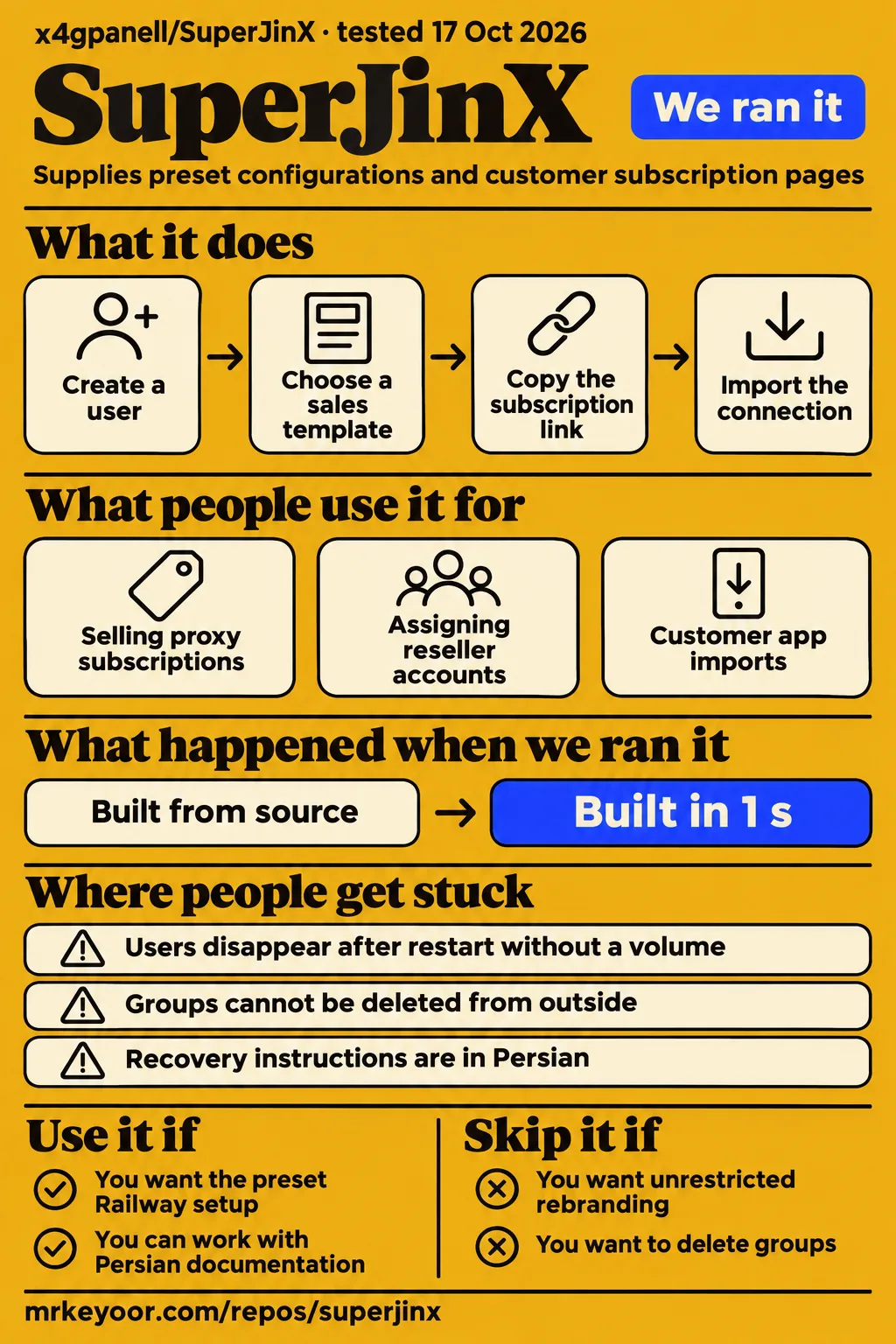
The documented workflow starts with creating a user, selecting a sales template and copying the subscription link. The English summary lists VLESS, Trojan and VMess configurations over WebSocket and HTTPUpgrade. The customer then opens the subscription page and imports the connection into an app listed by the maintainer. For an operator, the appeal is having those account and connection choices supplied together rather than assembling each part separately.
Super JinX also makes administration decisions for you. The README says groups, hosts, cores, nodes and roles are locked against deletion from outside. That suits an operator whose priority is preserving the supplied setup against accidental changes. It is a reason to look elsewhere if changing that structure is part of normal operation. Read the protected-object description before investing in a customized deployment, because the wrapper's managed configuration is central to its documented workflow.
What people use SuperJinX for
The maintainer documents selling proxy subscriptions, assigning reseller accounts and distributing customer connection links. These uses share the same preset account model: an owner operates the panel, a reseller receives a traffic allowance, and a customer receives a subscription. The useful adoption question is whether that arrangement matches the service you intend to run, including who creates users and who handles customer connection problems.
For selling subscriptions through sales templates, the README tells the operator to create a user, choose a template and copy the resulting subscription link. This keeps traffic allowances, expiration and connection configuration in the documented sales workflow. An operator choosing this approach should first decide whether the supplied templates and groups match the subscriptions they intend to distribute.
For delegating account creation to resellers, the owner adds an administrator with the reseller role and a traffic allowance. The documentation says that reseller sees only their own users and creates users through templates. For customer app imports, the JINX PASS page supplies Persian and English text, QR codes and import controls. These are concrete reasons to investigate the preset workflow when the owner, reseller and customer each need a different interface.
What happened when we ran it
The November 13 hands-on attempt stopped at its safety step because the runner required a Compose file and found none. The recorded error names compose.yaml, compose.yml, docker-compose.yaml and docker-compose.yml. The runner labelled the repository unsafe under that rule. The failed step identifies the runner's deployment requirement and the missing files.
The run summary says it was deployed with its own Docker Compose on our lab server, with ports bound to 127.0.0.1. That conflicts with the specific failed safety step. We classify the attempt as blocked because the detailed step reports a refusal to proceed. The teardown record says teardown: ok.
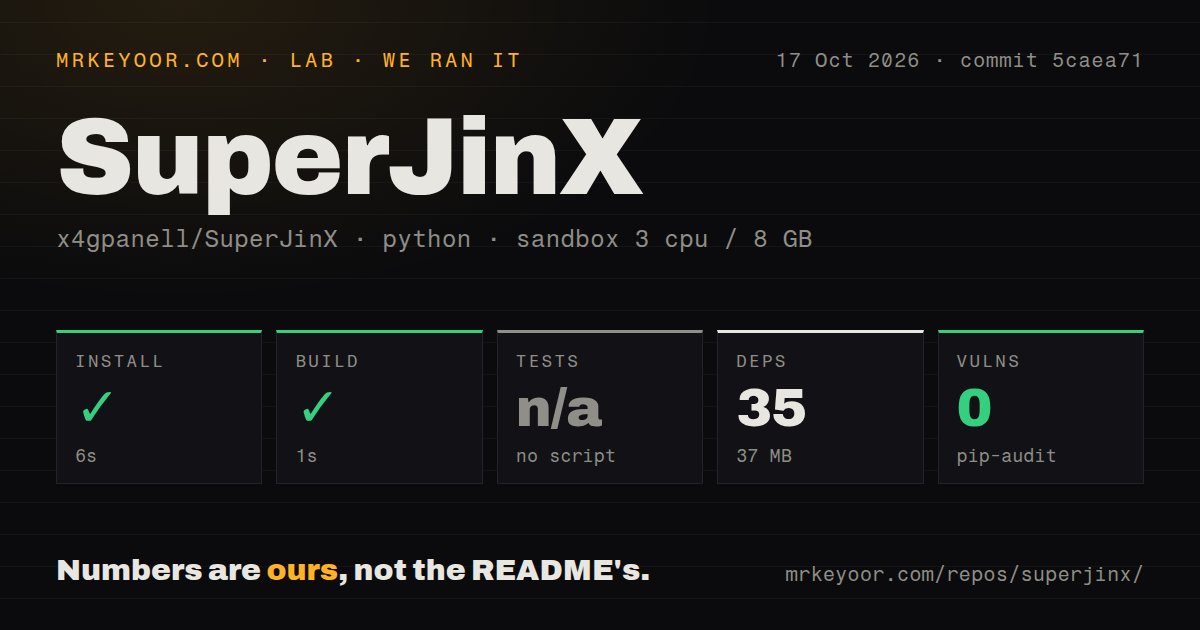
The earlier source checks completed. Our October 17, 2026 sandbox run used commit 5caea71, with 3 CPUs and 8 GB of configured RAM. Its image label was ghcr.io/astral-sh/uv:python3.12-bookworm. The recorded checkout contained 43 files, about 1,395 source lines and 0.5 MB on disk. These measurements describe the source checkout and its recorded install and build steps, separately from the November deployment attempt.
| Recorded source check | Result | What it tells an operator |
|---|---|---|
| Install | Succeeded in 6 seconds | The recorded dependency step completed |
| Dependencies | 35 recorded, 37 MB on disk | This was the measured dependency footprint |
| Build | Succeeded in 1 second | The recorded build step completed |
| Tests | Skipped, no test script or target | There is no passing test-suite result |
| pip-audit | 0 known vulnerabilities; harness audit.packages is 0; no explicit scannedPackages evidence | The output establishes no dependency coverage |
| Repository scan | 43 files, about 1,395 source lines, 0.5 MB checked out | The measured checkout was small |
| Automation signals | 0 CI workflow files; Dockerfile present; no tests directory | The scan found a container recipe but no automated-test scaffolding |
The 37 MB figure is the recorded dependency footprint, and the 1-second figure is the recorded source build duration. Keeping those labels attached makes the results useful when inspecting this checkout. The November record answers a separate operational question: the service trial stopped before proceeding through the runner's required Compose route. The README instead directs operators through Railway's GitHub deployment workflow and the project's Dockerfile.
Where people get stuck: storage and the domain come first
The README warns that users and settings disappear after a restart without a volume mounted at /var/lib/pasarguard. Treat that mount as part of the service's data design. Put the volume in place before adding customer accounts, then follow the documented domain and redeployment steps. The storage warning explains why reaching the login page is only one step in preparing the hosted service for customer data.
The maintainer's README troubleshooting table connects specific symptoms to configuration checks. The domain's target port, the order of domain creation and deployment, and the volume mount each have a prescribed action. Keep those checks close to the deployment instructions so the person operating Railway can follow the documented route when an initial setup produces an error.
| Symptom in the README | Maintainer's prescribed action |
|---|---|
Application failed to respond |
Set the generated domain's port to 8080 |
| Connection configurations do not connect | Redeploy after creating the domain |
| Users disappear after deployment | Check the volume mount at /var/lib/pasarguard |
Incorrect username or password |
Allow the service to finish starting |
The missing-Compose error in our trial belongs to the runner's deployment policy. The documented route uses Railway's GitHub integration and a Dockerfile, while the runner demanded a Compose file. The next service evaluation should use tooling that supports that route. Keeping the two workflows distinct avoids sending an operator toward an undocumented Compose setup merely to reproduce the runner's expectations.
Default accounts need attention before customers arrive
The README documents admin / admin for the first owner login and reseller / reseller for the sample reseller account. It explicitly tells the operator to change the owner password and change or remove the sample reseller account. Put those actions ahead of sharing subscription links. The supplied credentials are a starting point for setup, followed by an explicit account-management task for the person exposing the service.
The English instructions place password changes under Settings. The Persian guide also describes owner recovery through an OWNER KEY log entry after restarting the service. That makes access to the hosting account and its logs part of the documented recovery path. Limit that access to the people responsible for recovering ownership, and make sure the designated operator can find the recovery instructions before an account problem occurs.
The README's immediate account-security instructions are concrete: replace the owner credentials and decide whether the demonstration reseller should remain in the service. Both actions concern accounts supplied by the setup itself. Assign responsibility for them alongside the volume and domain tasks so that the initial deployment has a clear owner before customer subscriptions are distributed.
English readers get a summary inside Persian documentation
The README is primarily Persian and includes an English section covering deployment, first login, configurations and the subscription page. An English-speaking operator can identify the essential Railway route from that summary. The longer walkthroughs, recovery instructions and much of the troubleshooting material are in Persian, so the team responsible for operating the service should arrange translation for the detailed instructions it will rely on.
The maintainer describes the customer subscription page as bilingual in Persian and English. Customer-facing language and operator documentation serve different tasks: a customer needs to import a subscription, while an administrator may need to recover access or repair a deployment. Have the person responsible for recovery read the detailed instructions before the account is needed, including the guidance below the initial installation steps.
The license limits white-label reuse
The project license permits use and deployment for yourself or your customers, while restricting rebranding, reselling or republishing the files as your own work. Keep those terms separate when assessing a reseller product. Selling access through the documented panel and repackaging the project's files under your own identity are different activities in its stated terms.
The license also requires keeping its notice and credit in every copy, and says PasarGuard and Xray are licensed separately. For an operator who wants the supplied branded panel, these are the terms to assess before deployment. A company requiring an unrestricted branded fork should choose software whose terms support that requirement. The project's free software price does not replace the decision about permitted reuse.
Updates can change the components underneath your panel
The README says each redeployment also retrieves the latest PasarGuard and Xray versions. That makes the wrapper's commit only part of a deployment description. Record the upstream component versions or image identities used by a working deployment before changing it. Those records give the operator something concrete to compare when a later redeployment changes the behavior of the hosted service.
The same documentation describes automatic repair of configuration and subscription components. That maintenance model matters when planning customization because the wrapper manages settings as part of its normal operation. Start by identifying which supplied decisions you intend to keep and which you intend to change. Super JinX's documented reason for use is its preset configuration, so customization should account for the settings its automation is designed to preserve.
Search results mix this repository with unrelated names
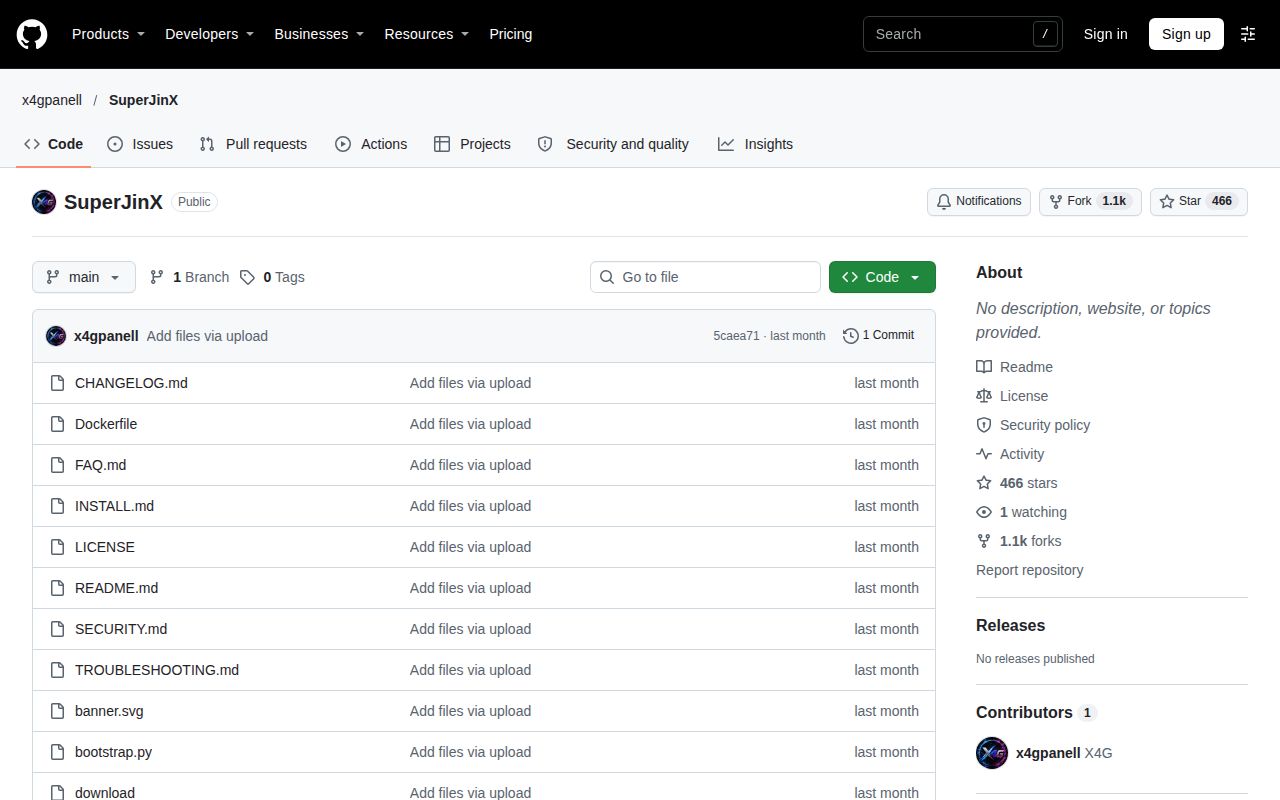
The project reviewed here is x4gpanell/SuperJinX, whose README identifies it as a PasarGuard-based reseller panel. The supplied repository explorer instead displays the placeholder Repository description goes here. alongside a tree-truncation warning. Use the project's README for its purpose and the measured checkout for the source-scan figures. Explorer record.
A separate result is the GitHub profile Zooeyii, whose display name includes SuperJinX. It is a profile page, rather than documentation for x4gpanell/SuperJinX. Search with the full owner and repository name when looking for support, and check that a proposed fix refers to this panel before applying it. The repository identity gives an operator a concrete way to sort similarly named results. Profile record.
SuperJinX vs PasarGuard and Marzban
PasarGuard is the underlying panel used by Super JinX; Marzban is a separate Xray-based proxy-management project. Their documented workflows provide useful starting points for choosing what to evaluate. Super JinX supplies a Railway wrapper and preset reseller configuration, while the alternatives' READMEs describe their own account-management and subscription features. Choose the starting point that matches how much configuration your team intends to own.
| Project | Documented scope | When to choose it |
|---|---|---|
| Super JinX | PasarGuard, Xray and nginx in one Railway service with preset reseller configuration | The supplied Railway setup and protected configuration match the intended service |
| PasarGuard | Proxy management with a web UI, REST API and multi-node support | The underlying panel is the starting point you want to configure yourself |
| Marzban | Xray-based proxy management with traffic and expiry limits | Its documented account controls and subscription workflow match your requirements |
PasarGuard's README lists a web dashboard, REST API and multi-node support. Marzban's README describes traffic and expiry limits as well as subscription links. Those documented controls help an operator identify a suitable workflow. Write down the required account roles, subscription behavior and hosting route before choosing which project to evaluate against the service your customers need.
Questions people ask
The software is free under its stated reuse restrictions, password recovery uses Railway logs, and the managed groups are protected against external deletion. These answers come from the project's README and license. For an operator, they connect three practical decisions: budgeting for hosting, retaining access to account recovery and accepting the supplied configuration structure. The questions below cover those documented topics with links to the relevant instructions.
Does SuperJinX cost money?
The README says the project is free to use and the operator pays Railway according to their hosting plan. Separate the software price from the bill for running it. The license adds conditions on reuse of the project files, so a zero software price leaves a separate licensing decision for anyone planning a branded fork. README cost FAQ.
What if I forget the password?
The README directs the owner to restart the Railway service, take the owner key from the OWNER KEY log entry and use the owner-access control on the login page. Read the full recovery instructions while you still have access to the hosting account. The documented route makes that account important to recovery, even when day-to-day administration happens through the panel. README recovery instructions.
Can someone delete the groups?
The maintainer says groups, hosts, cores, nodes and roles can be read but cannot be deleted from outside. Its FAQ presents this protection as a guard against accidental damage. For an operator, the same protection is a constraint on customization. Choose Super JinX because you want to keep its managed structure, and consider the underlying panel when your requirement is to change it. README English summary.
What we have not tested yet
The recorded service attempt stopped before live Railway operation, customer traffic, app imports, reseller isolation, recovery, restart persistence, automatic repair or upgrade rollback. There is no measured throughput, concurrent-user limit or sustained memory result here, and the alternatives received no side-by-side service trial. The supplied research also contains no attributable customer deployment or support-response history for this repository. The troubleshooting symptoms above are the maintainer's guidance, rather than errors reproduced by our run.
The audit output reports 0 known vulnerabilities, but the harness field audit.packages is 0 and explicit scannedPackages evidence is absent. That metadata does not establish an audited-package count or dependency coverage, so the output provides no basis for a dependency-security conclusion. Actual runtime versions require the raw toolchain logs; the sandbox image label alone supplies neither the Python version nor the operating-system version.
The current README's feature descriptions are not exact-version proof for measured commit 5caea71. The source scan classified the checkout as Python, while current GitHub metadata classifies the repository as HTML; those labels describe different observations. The contradictory November summary supplies no successful-service result beyond the failed safety step and recorded teardown. A future evaluation needs to follow the documented Railway route and retain its deployment and client logs.
All four score cards are unassessed. Source timings do not rate the complete service setup, and reading the documentation does not demonstrate its deployment or recovery instructions. The evidence supplies neither operating history for a maturity judgment nor support-response history for a community judgment. The next useful service result is a persisted customer account surviving a restart, followed by a subscription working in an actual client; neither outcome appears in the supplied run records.