The README directs new users away from this extension
Superdesign's README opens by identifying this repository as the original IDE extension and saying it is no longer actively maintained. That warning changes the recommendation before any generated screen appears. The current product is a web app, and a separate repository supplies the coding-agent skill. If you're choosing a design tool for new work, start with those current options rather than assuming this code powers the product shown on the website.
Our checkout was small: 89 files, about 14,881 source lines, and 2.1 MB on disk. That makes the extension plausible to inspect or fork, but it doesn't make its maintenance your problem for free. I'd consider it for someone studying an editor-integrated design workflow or preserving an existing setup. I'd pass on it as a fresh team standard unless someone explicitly owns the fork.
What happened when we ran it
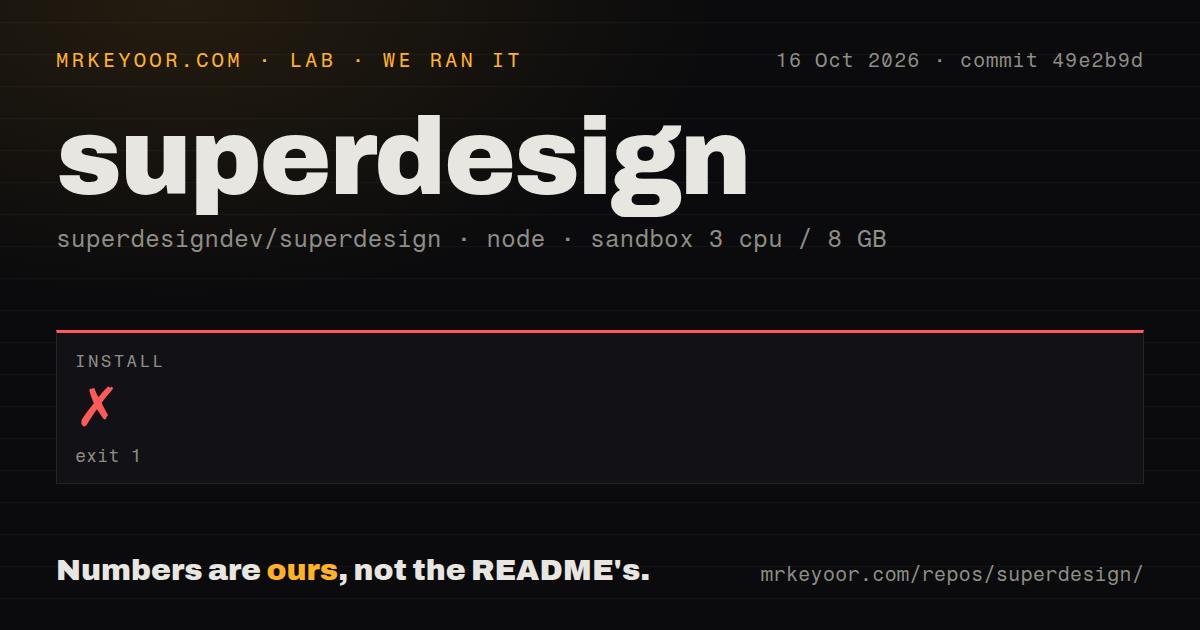
Our run failed to install Superdesign after 23 seconds with exit code 1. We used commit 49e2b9d on October 16, 2026, in an unprivileged Debian container running the lab-node:22 image with 3 CPUs and 8 GB of RAM. The log reported ERR_PNPM_IGNORED_BUILDS and named ignored build scripts for @anthropic-ai/claude-code@1.0.33 and esbuild@0.25.5. That is the setup result to budget around.
The log suggested pnpm approve-builds to choose which dependencies could run scripts. It also said the lockfile passed supply-chain policies, which did not make the installation succeed. Those messages describe different checks. We have no successful build or test result to report, and the supplied record contains no vulnerability audit result. The failure doesn't establish a design-generation defect, because installation stopped before that behavior was exercised.
The lab found 1 CI workflow file, no Dockerfile, and no tests directory. Together with the failed install, that leaves little measured reassurance for a developer expecting a ready-made container or a verified local development path. Reviewing the named scripts and choosing approvals is a reasonable next investigation. It is not a fix we ran, and we cannot claim that approval alone makes the extension work.
The canvas keeps design drafts beside your code
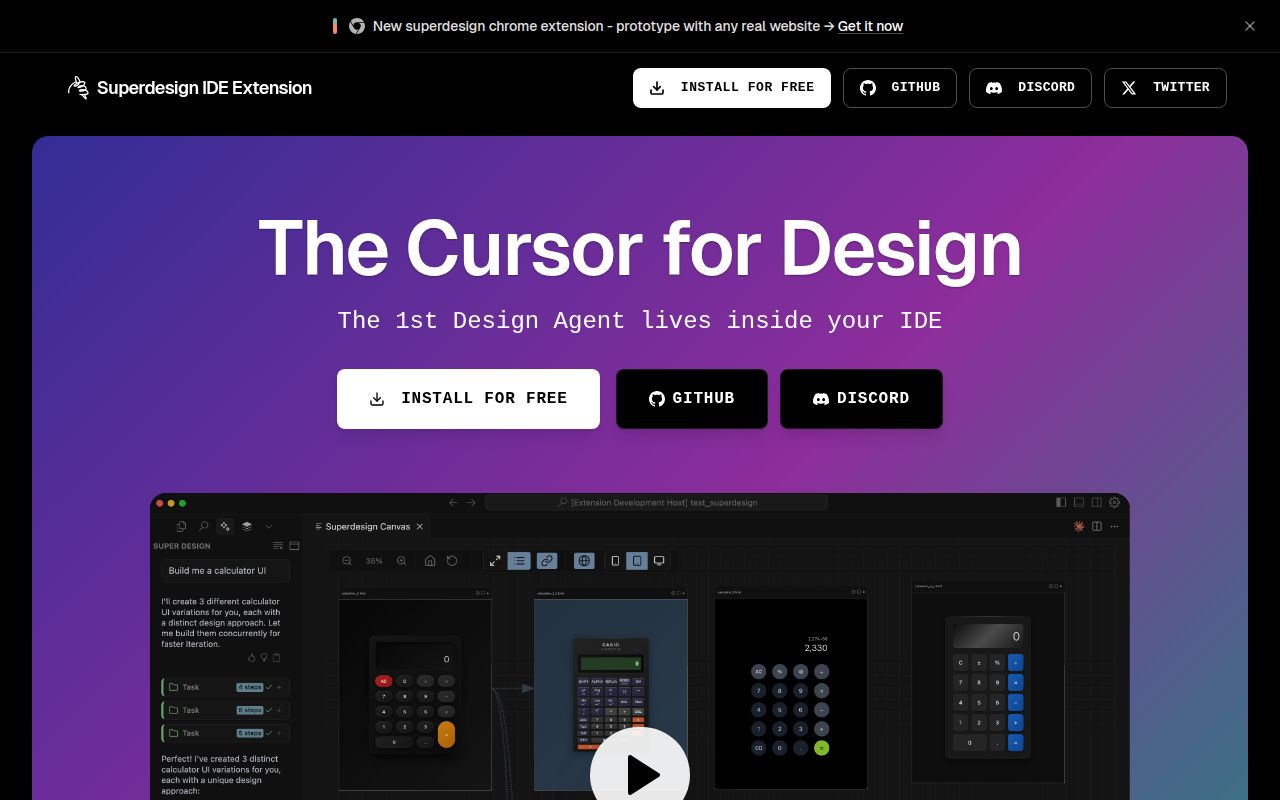
The extension's documented workflow is straightforward: open its sidebar, describe a screen, inspect the canvas, and iterate on a draft. Designs live under .superdesign/ in the workspace. Initializing the project can also add editor-agent rules. That arrangement suits a developer who wants design artifacts next to the implementation and is willing to inspect what the agent produces before copying it into an application.
The 2.1 MB checkout contains more opinion than its size suggests. The agent source tells generation to favor Flowbite unless the user asks otherwise, and its instructions use CDN scripts for styling and icons. Those are useful defaults for previewing ideas. They are not evidence that a generated page already follows your component library, asset policy, or production packaging conventions.
Local draft storage does not decide where prompts go
The extension manifest exposes provider keys, configurable endpoints, and a local Claude Code binary path. Its agent service uses Helicone proxy addresses as defaults for the Anthropic and OpenAI routes, while allowing custom URLs. A team with a direct-provider-only policy should examine that path before supplying credentials. The fact that generated files remain in the workspace doesn't settle the route taken by model requests.
Our 23-second installation failure happened in a sandbox with no secrets, so it provides no evidence about authenticated generation or provider availability. The README documents an OpenAI-compatible local-server option, but operating that server is separate from opening the canvas. Existing Claude Code or Cursor users can follow the documented agent workflow. Neither option turns the historical extension into the current hosted product, and neither was validated by this lab run.
The license includes a commercial-file exception
The license file describes most of the project as AGPLv3 and reserves separate commercial terms for files carrying an Enterprise marker. That is more specific than the README's invitation to fork and remix. Before shipping a fork, identify the files you need and read the terms attached to them. The top-level GitHub license label alone won't answer that question.
A 1-workflow repository can still be useful source material, but workflow presence doesn't settle redistribution or maintenance. The better case for a fork is a narrow extension change you can keep working yourself. If the goal is simply to compare screen ideas with colleagues, taking on provider routing, extension compatibility, and licensing review is a substantial detour from the design task.
June activity and the maintenance notice tell the same story
The last push was June 29, 2026. GitHub showed 75 open issues and PRs on October 16, and the latest-release endpoint returned no release. Newer reports still arrive, but some concern the web app or newer CLI. Issue 87 explicitly describes designs stuck loading in the VS Code canvas, making it relevant to this extension. It remains a user report, not a failure reproduced in our run.
The current Superdesign skill is the better starting point for the maintained agent product, with its own service and account requirements. Penpot fits a team wanting a collaborative design application instead of this editor extension. Keep the old repository when you have a specific reason to own its code. For new design work, the README has already given you the more useful destination.