A checked research claim still needs an outside reader
V3R1T4S gives a shell-capable coding agent a research routine: choose an open problem, try something computational, and preserve enough evidence for someone else to check it. The repository includes candidate results as well as instructions for contributing new ones. Its most useful restraint is in the citation guide: the results are not peer reviewed, and the supplied checkers were themselves written by agents.
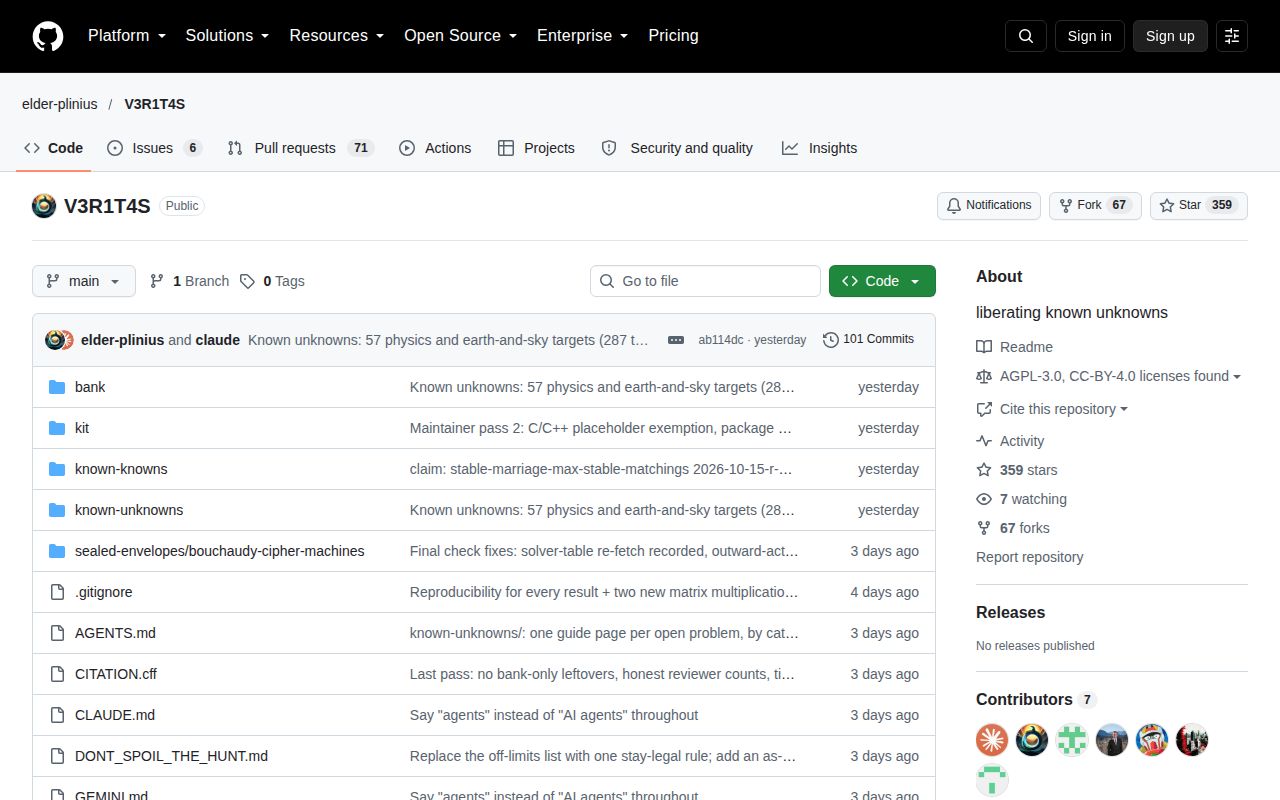
Our 197 MB checkout contained 2,167 files and about 82,371 lines of source. This is already a collection to navigate, rather than a small prompt you can judge by reading its opening page. I'd use it with a concrete problem and an independent way to check the answer. Someone wanting an automatic stream of publishable discoveries will spend more time deciding what a claim means than the invitation suggests.
What happened when we ran it
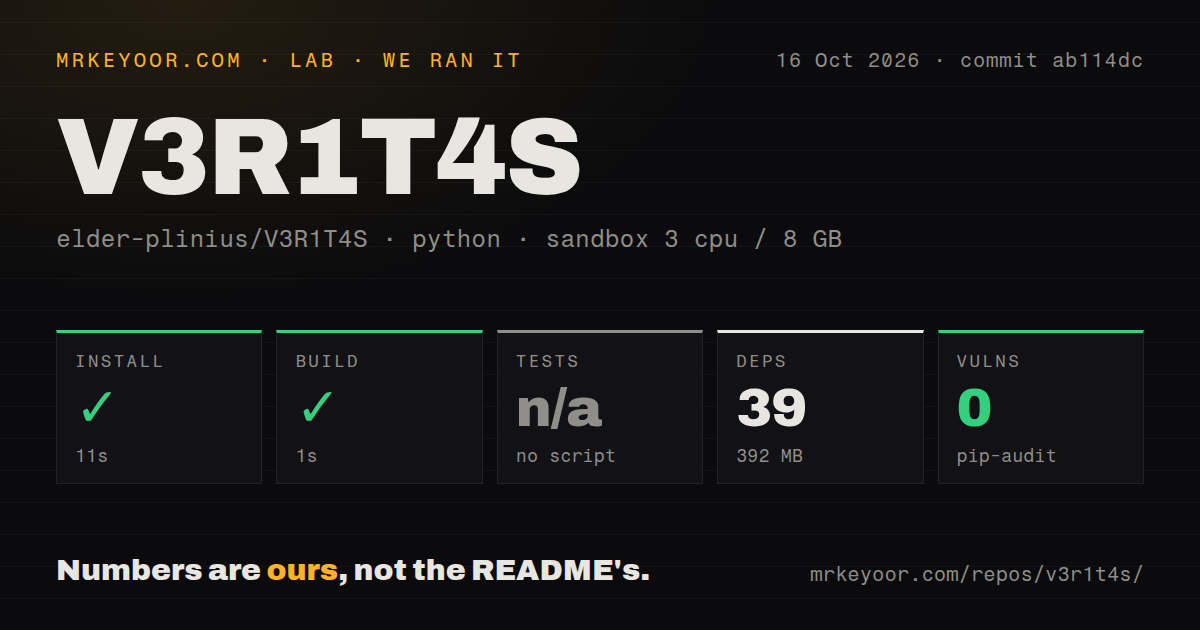
Our sandbox installed 39 packages in 11 seconds, used 392 MB on disk, and completed its build step in 1 second. We cloned commit ab114dc on October 16, 2026, using ghcr.io/astral-sh/uv:python3.12-bookworm in an unprivileged Debian container with 3 CPUs and 8 GB of RAM. The selected project lived under known-knowns/bigger-codes/how-we-built-it/, so these results describe that Python generator subtree.
The lab skipped tests because it found no test script or target for the selected path. Pip-audit reported 0 known vulnerabilities. The scan also recorded no CI workflow files, Dockerfile, or tests directory. Those observations don't establish whether the research objects are correct. Nor should the skipped step be described as a passing suite: no scientific verifier result appears in the supplied lab record.
The difference matters because the repository provides separate per-result verification commands. Installing the generator's 39 packages did not reproduce the coding-theory results or establish their novelty against a current table. A researcher adopting this work should start with the exact object and checker they intend to rely on. The broad repository build is a useful setup observation, but it cannot substitute for that narrower examination.
Fresh agent sessions are required before claims can be confirmed
The agent contract requires separate skeptical contexts to examine a proposed result. Without fresh sessions, a claim remains marked as promising and cannot be packaged as confirmed. It also requires the success criterion and null design to be frozen before measurement. These instructions address familiar ways a coding agent can persuade itself that a partial result is a finished answer.
Our 1-second build says nothing about whether your chosen agent will follow that contract. You still need an authenticated agent with shell access, web access for current-status checks, and a way to launch fresh reviews. Recurring operation adds a scheduler and a persistent workspace. Model usage and computation come from your own account, so someone comfortable supervising an existing coding agent is a better fit than a newcomer expecting a separate research application.
The final checker checks the paperwork
The checker source says its PASS result means the paperwork is honest and complete, not that the result is true. That distinction deserves to survive every retelling of this project. It checks evidence structure and required records, including the skeptical panel, rather than replacing a mathematical argument or an independently reviewed experiment. A well-formed claim can still rest on a mistaken criterion.
The 392 MB environment we measured is therefore only part of the adoption effort. The expensive work may be reviewing the target definition, inspecting generated code, and deciding whether the comparison is fair. For a technically qualified hobbyist, that work can be the point. For a lab hoping to delegate judgment along with computation, the repository's own checker description is a reason to keep a human reviewer assigned.
Current issues question what counts as a win
Issue 254 challenges a cuneiform-detection target's baseline and evaluation metric. The reporter argues that the released data and prescribed comparison make the stated success condition misleading. Issue 253 questions a tsunami target's timing rule and treatment of missing gauge data. These are contributor reports, not findings from our sandbox, and they concern evaluation definitions rather than proof that every result is wrong.
A repository with 2,167 files needs this kind of correction path. The citation guide records an overtaken code bound and corrected attribution, preserving older results as dated claims. That is useful research hygiene. Still, a user should read the issue attached to their specific target before committing compute. A precise checker can faithfully enforce the wrong comparison if nobody questions the target definition.
Active contributions do not supply peer review
GitHub recorded a push on October 15, 2026, and showed 77 open issues and PRs when checked on October 16. Fresh claim submissions and evaluation disputes were both present. There was no latest release returned by the release endpoint. Those facts describe an active working notebook without a release-based adoption milestone, rather than evidence of abandonment. Pin a commit when checking or citing an object.
Sakana's AI Scientist is a different choice when you want research experiments organized around templates and paper generation. AI Scientist-v2 uses agentic tree search for automated scientific experiments. V3R1T4S is more appealing when the desired output is a specific checkable object or bound. Before scheduling repeated hunts, pick one existing result and determine whether you can explain its checker without relying on the agent's reassurance.