StyleX 0.19 turns object styles into atomic CSS at build time
StyleX lets developers write CSS properties in JavaScript objects beside their components. Its compiler replaces those objects with atomic class names and emits static CSS. Repeated declarations can reuse the same class, while stylex.props decides which declaration wins when several style objects reach one element. The package README says the generated sheet usually stays small enough to load as one file across routes. That is a design goal, not a performance result from our sandbox.
The system favors local reasoning over normal CSS selectors. Styles on an element should come from classes on that element, apart from inheritance. Pseudo-classes, media queries, pseudo-elements, keyframes, fallbacks, and CSS variables have object-based APIs. A component can accept a typed style prop and restrict properties such as margin or position. For a shared component library, those contracts are more useful than passing an unrestricted class string and hoping its selector order behaves.
Two core functions keep authoring small, while the compiler does the hard work
The architecture document reduces normal use to 2 functions: stylex.create defines styles and stylex.props applies them. Conditional styles use ordinary booleans, ternaries, arrays, and object lookups. When styles are defined and consumed in one file, the compiler can remove both calls. Cross-file composition leaves a small mapping and runs props at runtime. We did not benchmark either path, so Meta's low-cost claim should be tested in the application that will ship it.
Theming uses defineVars and createTheme, with variables exported from .stylex.js or .stylex.ts modules. StyleX 0.19 also added an atoms package for one-off declarations at the call site, while compiling them to the same output as create. TypeScript and Flow definitions ship with the runtime. This makes the project strongest when a design system controls both tokens and component props, rather than when unrelated pages merely need a few isolated classes.
What happened when we ran it
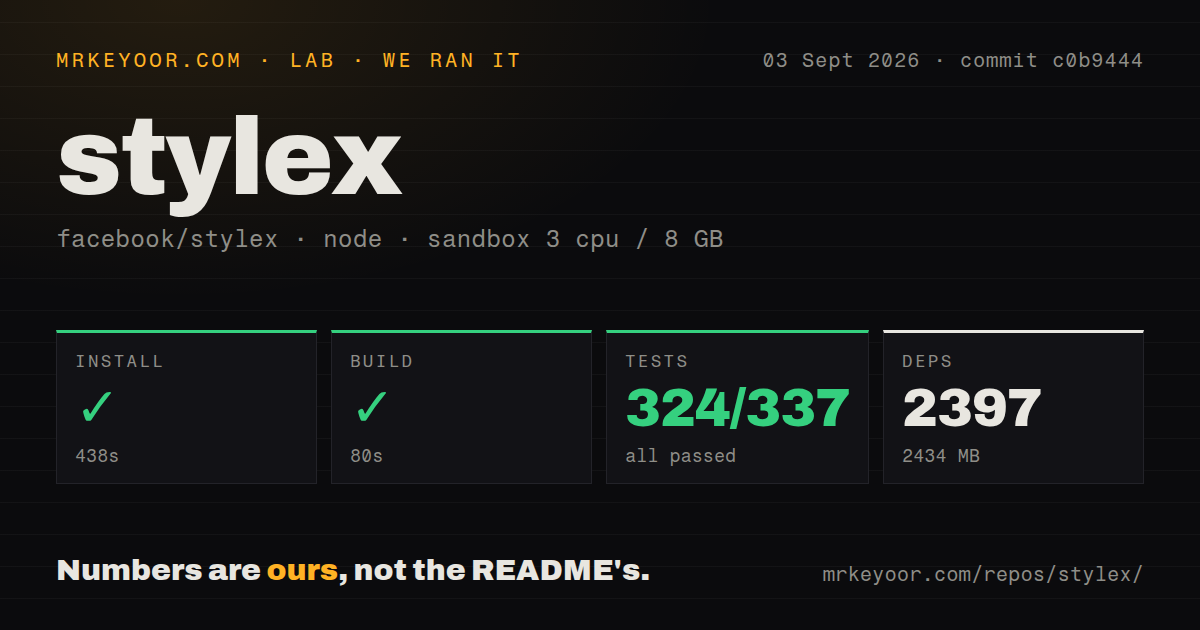
Our sandbox cloned commit c0b9444 and installed 2,397 packages in 438 seconds. Dependencies occupied 2,434 MB. The build succeeded in 80 seconds, and Jest completed in 250 seconds with 324 passed, 0 failed, and 13 skipped out of 337 tests. The unprivileged container had 3 CPUs, 8 GB of RAM, no secrets, and the lab's Node 22 image. These are repository-development costs, not the size of adding one runtime package to an app.
The checkout contained 1,080 files, about 182,825 source lines, and 15.6 MB before installation. It is a workspace monorepo with 2 CI workflow files. Our scan found no Dockerfile and no top-level tests directory, although the declared Jest command ran and passed. The successful build and test run give contributors useful evidence for commit c0b9444. They do not measure browser rendering, CSS bundle size, style recalculation, or migration effort.
Static analysis rejects object spreads and ordinary imported values
StyleX gets its predictable output by limiting what can appear inside a raw style object. The documentation permits literals, constants, simple expressions, selected built-in methods, and arrow functions for dynamic styles. It rejects ordinary function calls, object spreads, and imported values other than StyleX variables from designated files. Dynamic functions must return an object literal, and the compiler represents their unknown values with CSS variables at runtime. Existing styling helpers may need rewriting rather than a new import statement.
The installation guide offers 8 named routes: Next.js, Bun, Vite, Webpack, Rspack, esbuild, the CLI, and PostCSS. The recommended Babel and PostCSS path requires both transform metadata and one @stylex declaration in a global stylesheet. React is the best-supported target. The architecture says other JavaScript frameworks may work, but they can need an adapter because props returns React-shaped className and style values. Check the exact framework example before promising a migration.
Version 0.19.0 still has Vite and playground edge cases
Open issue 1836 reports a concrete Vite adapter problem in @stylexjs/unplugin 0.19.0: under Vitest, a repeating timer can keep the process alive and add a 10-second close timeout. The reporter provides a reproduction and a Babel-based workaround. Another issue filed September 3 says the public playground fails when its example uses stylex.when. Neither report invalidates the passing core suite, but both show why integration tests must cover the chosen bundler and test runner.
StyleX's constraints can also conflict with established CSS habits. Descendant selectors are intentionally restricted, source objects are more verbose than utility classes, and imported constants follow special rules. Deterministic precedence is useful only after the team learns when longhand properties beat shorthands and how conditional values need a default branch. A pilot should include responsive states, component overrides, server rendering, hot reload, and the production CSS output, not just a static button example.
The September 3 push matters more than the January GitHub release tag
GitHub recorded 10,090 stars, 226 combined open issues and pull requests, and a last push on September 3, 2026. The latest GitHub release endpoint still returns 0.17.5 from January 21, while the package manifest and project blog document 0.19.0 in June. That mismatch is an inconvenience for release discovery, not evidence that work stopped. Fresh issues, recently closed bug reports, current commits, and 2 CI workflows point to active maintenance.
The repository is a serious choice for teams willing to standardize authoring and builds. Our 324 passing tests support confidence in the measured commit, while the 2,434 MB checkout install and current Vite reports set a real adoption price. StyleX is easiest to defend in a component platform where type-safe overrides and cross-package composition repay that price. For a small site or a stack hostile to compiler plugins, its rules become extra infrastructure with little return.