Stremio Core supplies client logic; the interface remains yours
Stremio Core owns the shared behavior behind Stremio apps. Its models cover profiles, installed addons, the library, notifications, playback state, calendars, deep links, and the streaming-server connection. A platform interface sends actions into the runtime and receives changed state or notable events back. That makes the repository useful to a client developer who wants Stremio behavior without copying it separately into each app. It does not provide the finished screen an end user launches.
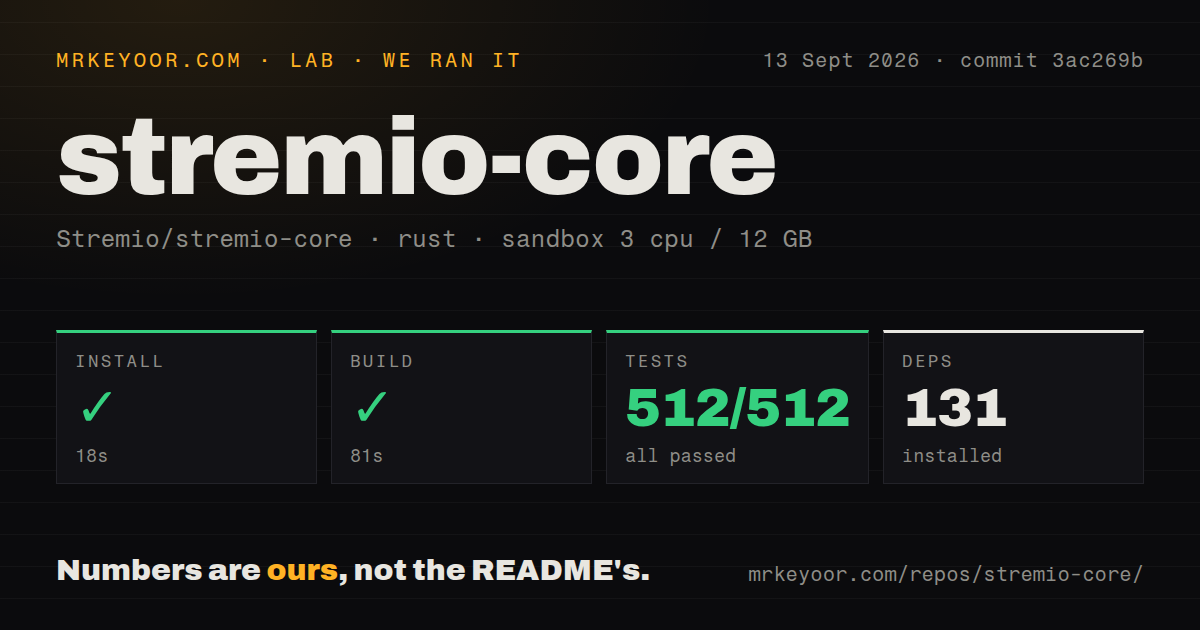
The scope is substantial despite the small checkout. Our lab counted 271 files and roughly 40,536 lines of source in 1.7 MB at commit 3ac269b. The main crate sits beside a derive macro, a compact watched-state crate, and the web bridge. You can import only the shared types for addon work, or use the full Ctx model as the center of an app. That choice matters because the full model brings Stremio's product assumptions along with its useful code.
Every platform must supply HTTP, storage, tasks, and time
The architecture sends each UI action through a runtime into a model. A model updates its state and returns descriptions of work for the platform to perform. The Env trait is the seam: a host supplies network fetching, persistent storage, task execution, and time. Side effects return messages to the same loop, while the UI observes new state and events. This one-way flow is easier to reason about than callbacks scattered across a client.
That boundary is also the integration bill. The 131 packages from our clean install give you the engine, not an operating app shell. A new target still needs an Env implementation, a UI adapter, account and addon wiring, and decisions about how platform playback works. The env-future-send flag adds Send bounds for hosts that need them, but the README says it is incompatible with WASM. Teams should prototype that boundary before treating the crate as a shortcut to a new client.
What happened when we ran it
Our sandbox installed Stremio Core in 18 seconds, adding 131 packages. The Rust build completed successfully in 81 seconds. Cargo test then finished in 49 seconds with 512 passed and 0 failed out of 512. We used commit 3ac269b in an unprivileged container with 3 CPUs, 12 GB of RAM, and no secrets. This run checks whether the supplied code installs, compiles, and passes its suite under those conditions.
The checkout had 6 CI workflow files, no Dockerfile, and no tests directory. The lack of a separate tests folder did not mean a missing suite: Cargo still found and passed 512 tests, which Rust projects can keep beside their modules. A Dockerfile would add little to a library whose host differs by platform. The passing result says nothing about playback quality, addon availability, network behavior, or a particular device, since our run did not measure any of those.
The web bridge adds npm, WASM, and a Web Worker
Browser users get a dedicated stremio-core-web package, published to npm as @stremio/stremio-core-web. It places the core in a Web Worker for Stremio Web and has its own npm install and build steps. The bridge README also describes a watch mode for local Rust changes. Its development build enables extra logging and explicitly warns that those messages can contain sensitive information, so that mode belongs on a developer machine.
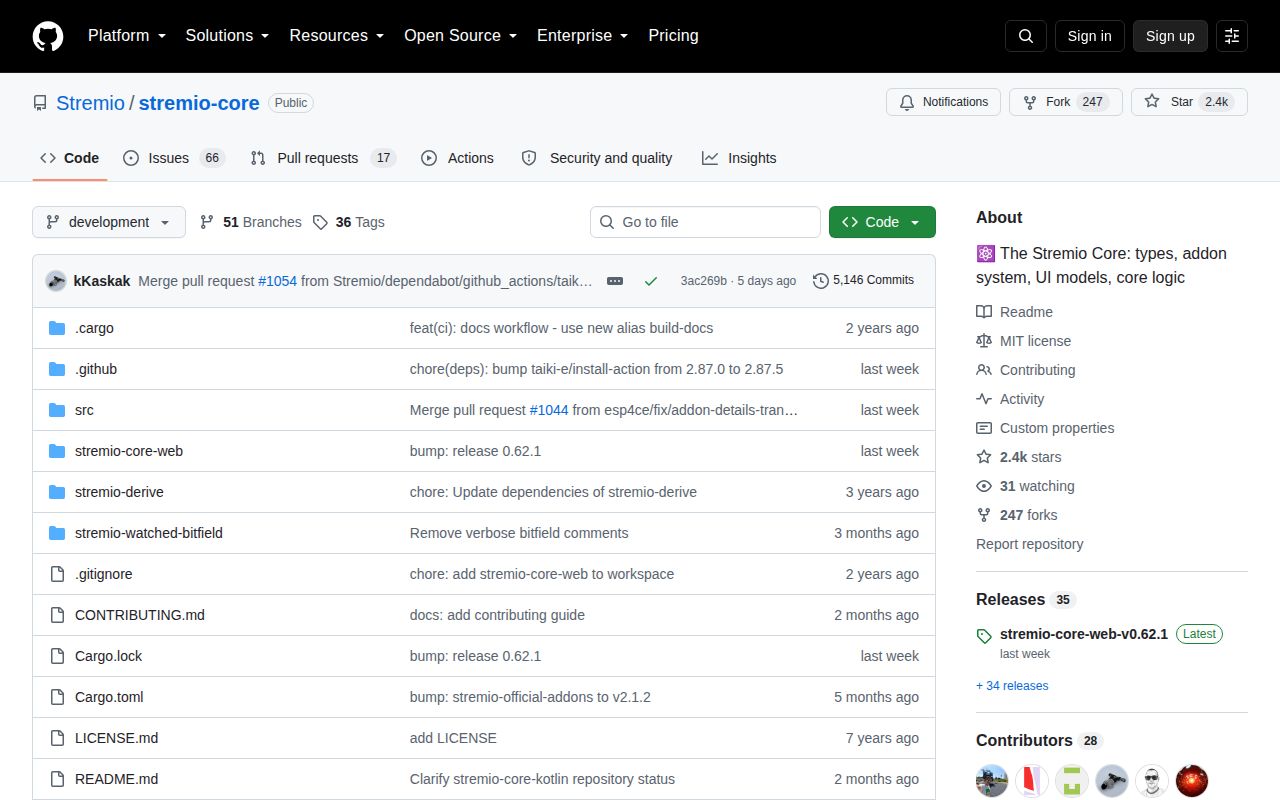
Our 81-second build confirms the measured Rust checkout compiled; it is not a browser integration test. Web maintainers still have a Rust-to-WASM boundary, JavaScript packaging, worker messaging, and release coordination across Cargo and npm versions. The latest GitHub release was stremio-core-web-v0.62.1, published on September 3, 2026. Its single listed change added a Windows link for VLC, a good example of how platform behavior reaches this shared engine.
Addons still lack client playback capability data
Open issue 1039, filed September 1, 2026, describes a concrete gap for a Jellyfin-to-Stremio addon. Stremio probes device capabilities internally, but the issue says the addon request does not receive video codecs, audio codecs, formats, channel limits, or platform data. The addon therefore cannot choose between direct playback and a device-matched transcode using the information the client already knows. The request was still open with no comments when we fetched it.
Passing 512 tests on a 3-CPU sandbox does not cover that device negotiation problem. If your product depends on addons selecting streams around client codec support, verify the interface before committing to this core. The limitation is narrower for clients using Stremio's usual stream flow, and irrelevant to addon types that only return catalogs or metadata. It is still a sound reason for one class of media app to wait, add its own contract, or choose a server-centered design.
September activity and 512 passing tests support a serious trial
The repository was pushed on September 10, 2026, one day after the measured commit landed, and the latest release arrived September 3. GitHub listed 2,375 stars and 83 open issues and pull requests when fetched. Recent open work covered live-channel identity, cast control, language preferences, redirected addon URLs, and subtitle properties. The dated push, release, and issue activity point to ongoing maintenance; the combined open count should not be read as 83 confirmed bugs.
Our 18-second install and 512 passing tests make Stremio Core easy to trial as source. Adoption is a narrower call. It is the sensible foundation when you are building a Stremio-compatible client and want the same models across native and web targets. If you need a finished player, a self-hosted library server, or one small addon, use the corresponding app, server, or addon SDK and avoid owning the platform adapter this crate expects.