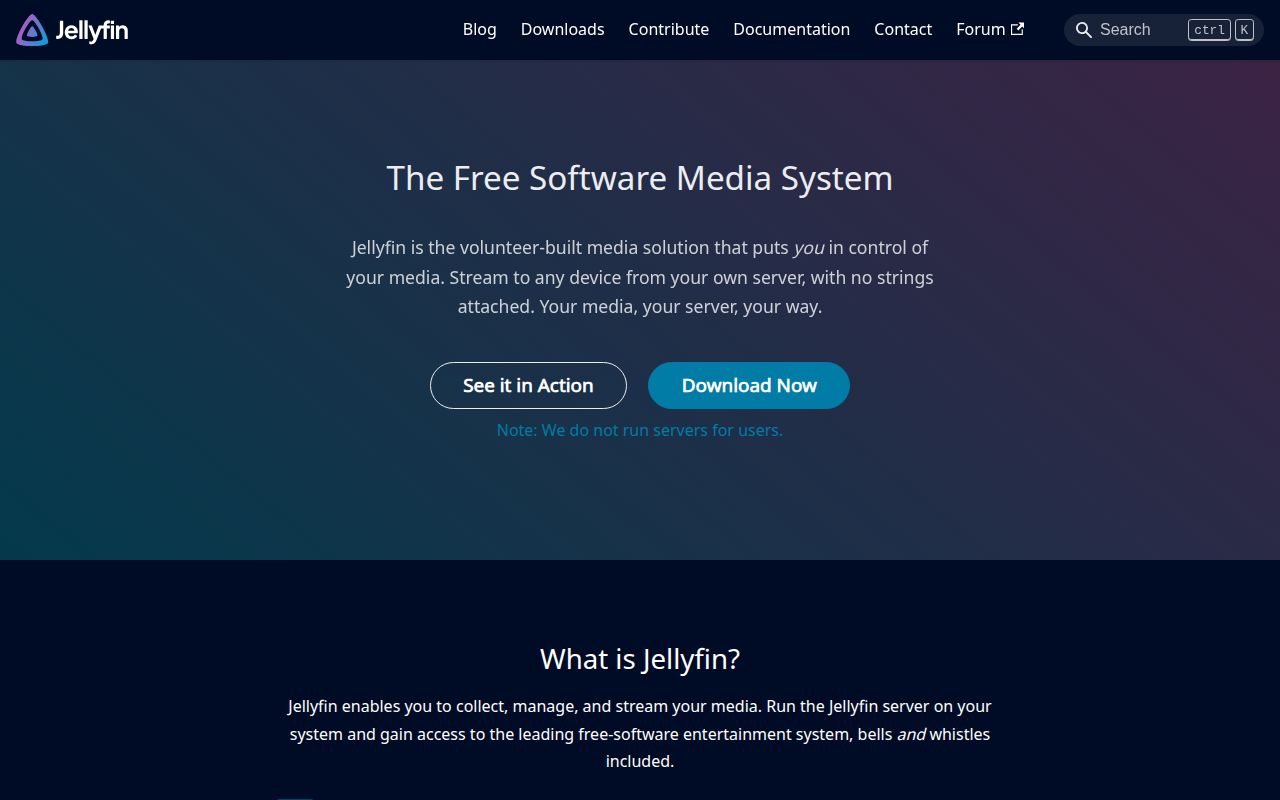
In the world of self-hosted media, you have three major choices: Plex, the polished market leader; Emby, its closest competitor; and Jellyfin. Jellyfin stands apart not just as an alternative, but as a statement. Born from a fork of Emby after it went closed-source, Jellyfin is a community-run project built on a simple, powerful promise: "The Free Software Media System." It’s a promise to give you total control over your movies, shows, and music, with no premium licenses, hidden agendas, or corporate oversight. For anyone invested in the open-source ethos, Jellyfin isn't just another option; it's the only option.
The FOSS Promise Kept
The project’s entire identity is rooted in its open-source, community-first philosophy. The README proudly declares, "There are no strings attached, no premium licenses or features, and no hidden agendas: just a team that wants to build something better and work together to achieve it." This isn't just marketing copy; it's the project's core directive. Unlike Plex and Emby, which lock certain desirable features like hardware transcoding or offline sync behind a paid subscription, Jellyfin makes every feature available to every user from the start. This commitment is legally enforced by its GPL-2.0 license, ensuring it will remain free software.
This philosophy has attracted a massive following. With over 55,000 stars on GitHub and a huge number of Docker pulls, Jellyfin has proven there's a significant demand for a media server that respects user freedom. The project is a testament to what a dedicated community can build when united by a common goal.
Core Functionality and Ecosystem
At its heart, Jellyfin is a backend server written in C# and ported to the .NET platform, which enables broad cross-platform support. The README notes it runs on all major operating systems, with the honest exception of FreeBSD. The server is the brain of the operation: it scans your media files, pulls down metadata like posters and cast information, and handles the on-the-fly transcoding needed to stream files to different devices.
This repository, jellyfin/jellyfin, contains only that server code. It’s part of a larger ecosystem of projects under the Jellyfin organization, including the official web client (jellyfin-web) and numerous other apps for mobile, desktop, and TV devices. This modular approach keeps development focused, though it does introduce some complexity for contributors. The server itself is robust, using the power of ffmpeg for its media processing needs, a standard and powerful choice for any media application.
Getting Started: A Tale of Two Setups
For a regular user looking to run their own media server, getting Jellyfin up and running is reasonably straightforward. The README directs you to a downloads page and detailed installation guides. The prominent mention of Docker Hub also points to the most popular and often easiest method: running Jellyfin in a container, which abstracts away most of the dependency management.
For a developer looking to contribute, the path is steeper. The prerequisites are clear: the .NET 10 SDK, an IDE like Visual Studio or VS Code, and a local ffmpeg installation. The real hurdle, however, is that the server repository doesn't include the web interface it serves. To get a fully functional development environment, you must either build the jellyfin-web project from its own separate repository or, as the documentation suggests, grab the pre-built files from an existing Jellyfin server installation. This two-part setup is a common source of friction for new contributors and adds a significant step compared to more monolithic projects. While it makes sense from an architectural standpoint, it's a practical barrier that lowers the score for setup ease.
Community Health and Project Vitality
Jellyfin's greatest strength is its vibrant community. The project is a masterclass in open-source engagement. The README doesn't just ask for help; it provides a "choose-your-own-adventure" guide for contributing, directing people to where they can be most effective. There are dedicated platforms for feature requests, a Weblate instance for collaborative translation, and clear guides for submitting code or reporting issues. Communication is open and accessible via a public Matrix channel.
The project's health is evident in its metrics. A latest release date (even if the year provided, 2026, is likely a typo for the current year) shows a forward-looking and active release schedule. A tally of 574 open issues against a project with over 55,000 stars is a remarkably healthy ratio, indicating that issues are being managed effectively and the software is stable for its vast user base.
Where It Fits
Jellyfin is not a Plex-killer for the average consumer who just wants to click 'install' and watch a movie. Its competitors have the advantage of venture capital, full-time staff, and marketing budgets that result in a more polished, consumer-friendly onboarding experience. Jellyfin's target audience is different. It's for the self-hoster, the privacy advocate, the tinkerer, and the open-source purist. It is the perfect media component in a personal homelab, sitting alongside other open-source tools. If you're the kind of person who wants to own their data and control their software stack from top to bottom, Jellyfin isn't just an alternative, it's the goal.