Encore puts infrastructure declarations in application code
Adding a database to an Encore application also gives its tooling a resource to run locally and provision in the cloud. The README's example declares a Postgres database, a message topic, and an object bucket through the SDK. These declarations form an application graph. That is the adoption decision: are you willing to put infrastructure intent into your backend code so the tooling can carry it between environments?
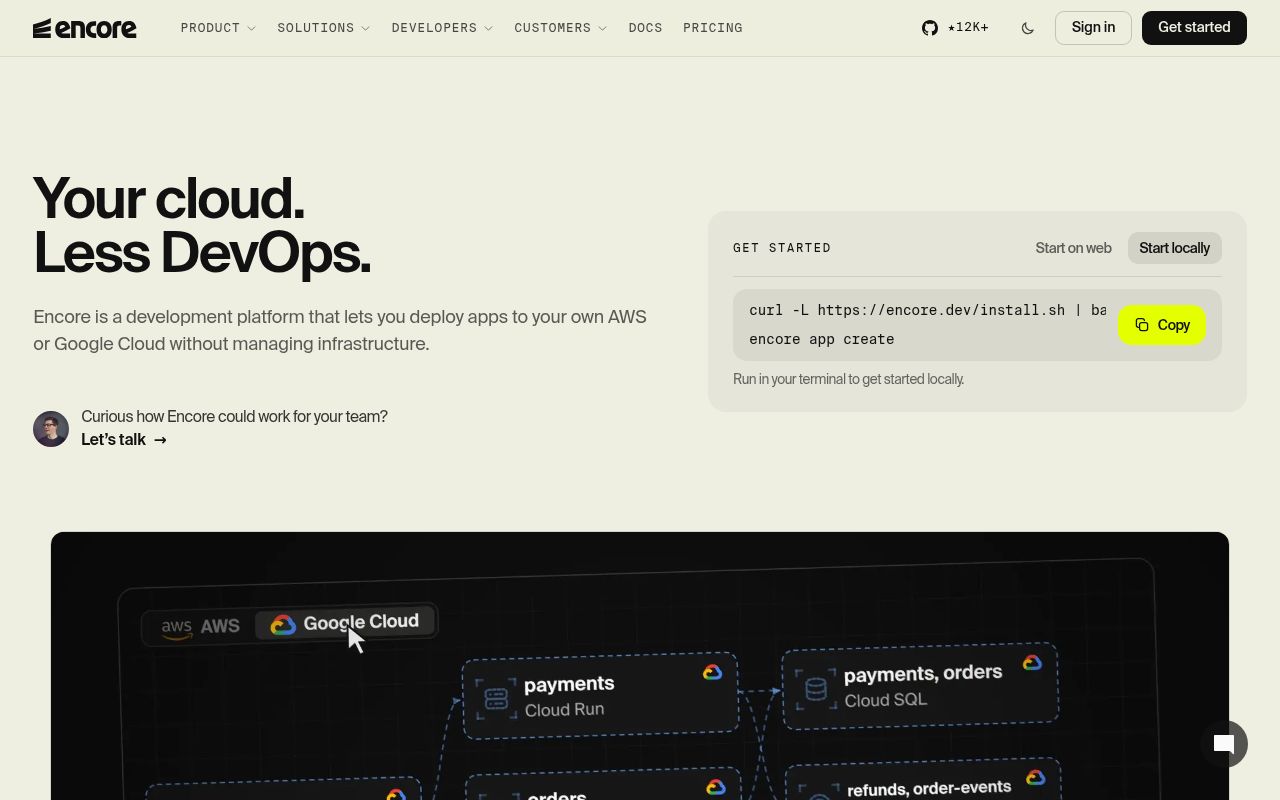
Encore combines an SDK and CLI with an optional deployment platform. Go and TypeScript are supported. The README says the local CLI starts the resources the application declares, while the platform provisions their cloud equivalents in your account. This can reduce repeated wiring for common services. It also makes the SDK part of how you describe the application, which deserves more thought than choosing a command-line convenience.
What happened when we ran it
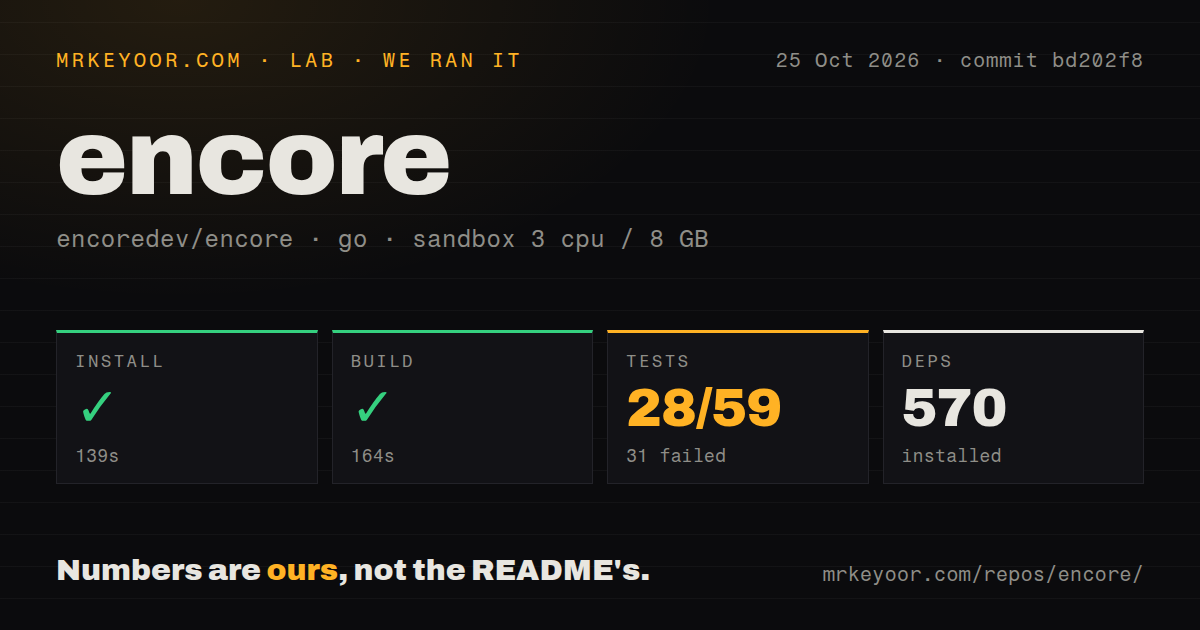
Our sandbox installed Encore commit bd202f8 in 139 seconds, recorded 570 dependencies, and completed the build in 164 seconds. The test command then failed with exit 1 after 66 seconds. Go reported 28 passed and 31 failed of 59. These are the supplied results from October 25, 2026, and the failed suite is the main qualification on our recommendation.
The tail names failing packages under v2/parser, including servicestruct, caches, crons, metrics, and sqldb, followed by v2/v2builder and a final FAIL. The locations package appears with an ok result between failures. There is no assertion message or underlying exception in this excerpt. We cannot tell whether the failures share a cause, require a missing prerequisite, or expose defects in the tested revision.
The checkout contained 1,910 files, roughly 328,600 source lines, and occupied 11.8 MB. Our scan recorded 2 CI workflow files, no Dockerfile, and no tests directory. The latter is a scan result, not proof of absent checks: the Go command plainly produced results. The recorded configuration had 3 CPUs and 8 GB of RAM with image golang:1.24-bookworm. Actual toolchain and operating-system versions require the raw logs.
Local equivalents do not establish cloud equivalence
Encore's resource table maps local Postgres to RDS or Cloud SQL, local object storage to S3 or GCS, and local messaging to cloud services. That makes the intended workflow concrete. It also shows why running an application locally cannot by itself prove its deployed behavior. Resource implementations and environment configuration differ even when application code declares the same intent.
For a trial, choose an existing service whose database and message behavior you understand. Check migrations, a failed message handler, and the way secrets reach the process. Then check those behaviors in the deployment route you intend to use. These are suggested acceptance tasks, not experiments from our lab. Our source build and failed Go suite don't establish any of them, and the log excerpt cannot explain away that gap.
Automated provisioning supports AWS and Google Cloud
The README limits fully automated provisioning to AWS and Google Cloud. Azure is described as a roadmap item. A team that needs Azure provisioning today should choose around that current boundary, rather than budget against an unshipped feature. Python and Rust are also listed as coming soon, so a language migration would be a separate cost for teams using them.
The managed platform is optional. Encore documents producing a standalone image with encore build docker and supplying infrastructure configuration yourself. That path lets you use other hosting arrangements, but it returns resource provisioning to your team. Decide which arrangement you want before evaluating the promise of less infrastructure work. Exporting an image and buying an automated deployment workflow solve different parts of the job.
Pulumi and Terraform keep resource definitions explicit
Pulumi provisions resources through programming languages and supports several cloud-provider targets. Prefer that approach when your team wants to write the infrastructure graph directly and keep the application framework independent. Encore is more attractive when the application declarations already describe the common resources you need. That is a workflow preference, not a performance comparison established by our sandbox.
Terraform describes infrastructure in configuration and generates an execution plan before applying changes. It is a reasonable alternative when infrastructure review needs its own artifact and approval sequence. Encore's README also allows independently managed resources alongside its SDK, so adoption need not require replacing every existing provisioner. Start with a service where the boundary between application-owned and separately managed resources is easy to explain.
October maintenance does not resolve the failed run
GitHub recorded the last push on October 22, 2026, and issue activity on October 26. Release v1.58.8 was published October 20. That shows ongoing maintenance. It doesn't establish whether the failures in our later sandbox are known, fixed, or specific to its configuration. The next evidence needed is the full failing output and a reproduction using the project's supported contributor setup.
The README also describes generated rules for tools such as Claude Code and an MCP server for inspecting application services, databases, and traces. Agent convenience makes a useful local model more valuable, but it doesn't strengthen a failed source check. Keep the first trial small enough to inspect every declared resource and every deployment permission. If a clean suite is your admission requirement, this measured revision has not met it.