Go integration is the reason to shortlist Compress
Klaus Post's Compress gives a Go service Zstandard compression without adopting a C library interface. It also contains gzip, ZIP and other compression packages, but the reason I'd shortlist it is specific: an application needs Zstandard while keeping the implementation in Go. Our repository run passed. We have no workload benchmark that says this implementation will make your service faster.
The main README lists Zstandard compression and decompression in pure Go, plus replacements for familiar standard-library packages. That gives an existing application a smaller integration decision than changing its storage format outright. A gzip replacement and a move to Zstandard are different changes: the latter also requires the reader at the other end to understand the format.
What happened when we ran it
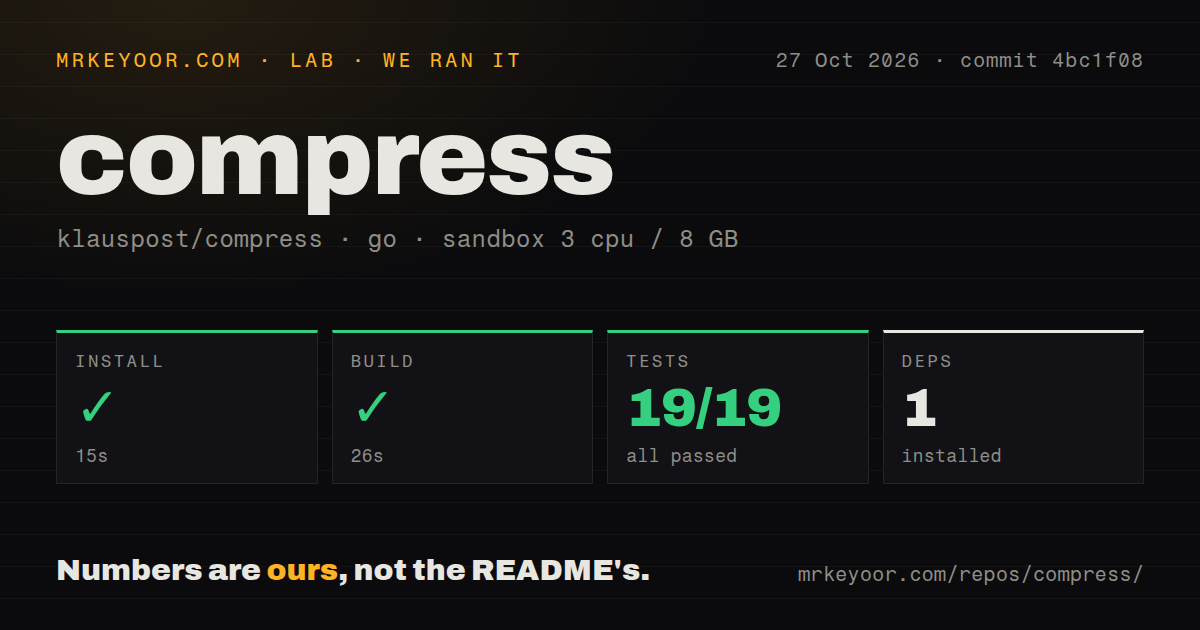
Our sandbox installed Compress commit 4bc1f08 in 15 seconds, built it in 26 seconds and completed the test step in 282 seconds on October 27, 2026. The supplied Go test summary recorded 19 passed, 0 failed of 19. That is the recorded result, without a claim that 19 describes every individual assertion or case in the repository.
The checkout contained 498 files and about 95,199 source lines, occupying 48.8 MB. Installation recorded 1 dependency. The scan found 4 CI workflow files, no Dockerfile and no dedicated tests directory. A missing directory named tests plainly doesn't mean an absence of checks: the recorded test command succeeded.
We used a sandbox configured with 3 CPUs and 8 GB of RAM, carrying the image label golang:1.24-bookworm. That label alone doesn't establish the actual Go or operating-system version. These results cover repository preparation and checks at one commit. They contain no compression throughput, compression ratio, peak-memory measurement or comparison against the standard library. The 282-second test duration is a contributor-workflow cost, not a request-latency result.
Zstandard streams need closing and deliberate reuse
The Zstandard guide documents both streaming and whole-buffer interfaces. A writer accepts a stream through Go's familiar io interfaces; EncodeAll handles independent buffers. The guide encourages smaller encodes to use the buffer route. Choose the interface around how your application receives data before experimenting with compression settings.
Closing a stream writer finishes its output, and the documentation says to close it even after an encoding failure to release resources. It also recommends reusing writers through Reset. Those details belong in the integration review: an application that repeatedly creates writers or forgets to finish output can defeat the reason it chose a tuned compression library.
Concurrency is another explicit choice. The guide documents encoder and decoder concurrency options, including synchronous operation. A web service handling many requests already has concurrency outside its compression calls. I would check the combined behavior under that service's own load before adopting a configuration intended for a large, isolated stream. Our sandbox did not measure that interaction.
Compressed bytes can change across versions
The Zstandard guide warns against using hashes of compressed output for similarity checks. It says encoding should never be assumed to remain the same, while the exact same code version can be assumed to produce the same output. This matters if a cache key, deduplication scheme or golden file depends on compressed bytes staying identical after upgrades.
Keep identity tied to the original content when that is what your application means to identify. If reproducible compressed artifacts are a requirement, pin the implementation and verify that requirement separately when changing it. A successful decode and an identical compressed byte sequence answer different questions.
The same guide says the package is heavily optimized for 64-bit processors and will be significantly slower on 32-bit processors. That's upstream's warning, without a speed ratio from us. A deployment dominated by 32-bit devices should evaluate its own hardware before choosing this package for performance reasons.
Current activity supports evaluation, with no support promise
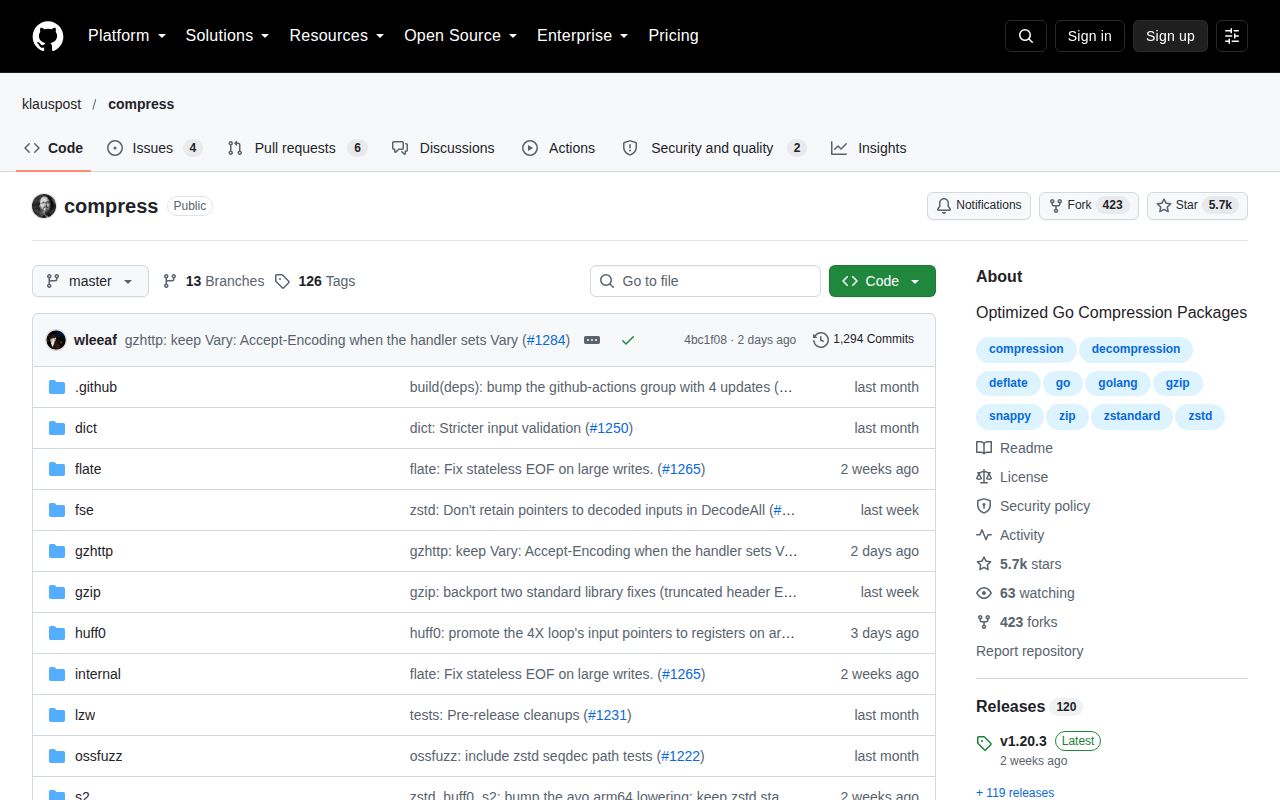
GitHub records the last push as October 26, 2026. Its recent issues and pull requests include an open October 27 S2 checksum proposal and an October 28 ZIP backport proposal. The October 25 HTTP Vary-header change is closed. This is ongoing work across several packages, rather than evidence of an abandoned release.
Those records don't establish response times or production reliability. Documentation earns 4/5 on this editorial scale: 1 means essential task instructions are missing, 2 means partial instructions, 3 means a usable main path, 4 adds concrete lifecycle and compatibility guidance, and 5 requires independently checked coverage across the documented paths. The writer-close, reuse and output-stability guidance supports 4. Setup ease, community support and operational maturity remain unassessed beyond the boundaries described here.
Choose an alternative around the required format
pierrec/lz4 provides LZ4 streams and low-level block functions in Go. Choose it when the reader or existing protocol already requires LZ4. It changes the format decision, so a claim that it is universally faster or smaller would be unhelpful even if we had run a benchmark. We haven't.
DataDog/zstd wraps the C Zstandard implementation and bundles its source by default. It also documents linking an external libzstd. Consider it when using that C implementation is a requirement and you're prepared to manage that integration. Our run supplies no comparative winner between the two Zstandard libraries.
Before replacing a production codec, keep a representative set of existing compressed records and new inputs. Verify decoding with the actual receiving application, including truncated input and empty content, then measure CPU and memory under your expected concurrency. Those results will settle the decision that our passing repository checks leave open.