Embedding Git means choosing which operations you need
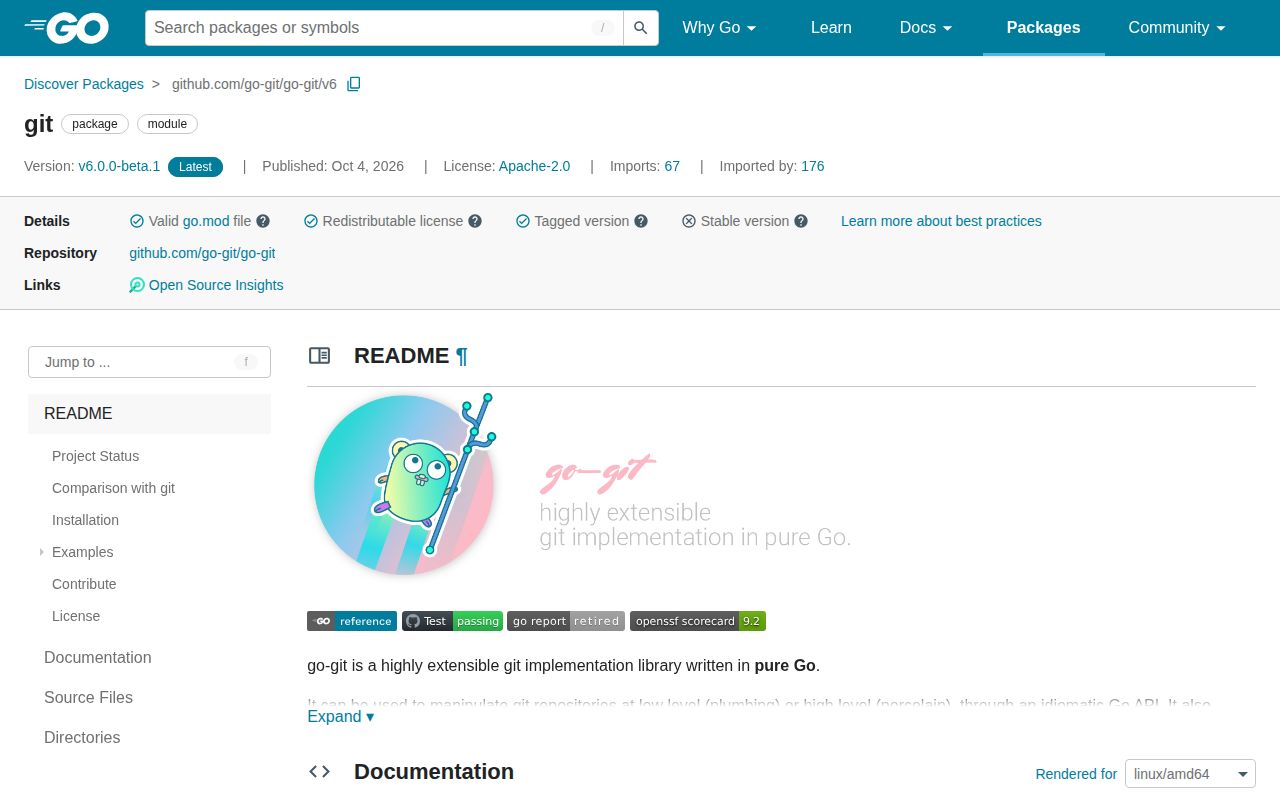
Go-git's README shows a repository cloned into memory and its commit history read through Go methods. For a service that inspects source without needing a working directory, that is a concrete reason to consider the library. Your program can work with repository objects directly and choose its storage implementation.
The harder decision arrives when that service starts accepting arbitrary Git workflows. Go-git aims for compatibility with Git, but its compatibility table documents gaps, including fast-forward-only pull and unsupported rebase. I would choose it for a bounded repository task whose operations I can name in advance. A general developer tool that promises to handle whatever a user does in Git needs a much closer compatibility review.
What happened when we ran it
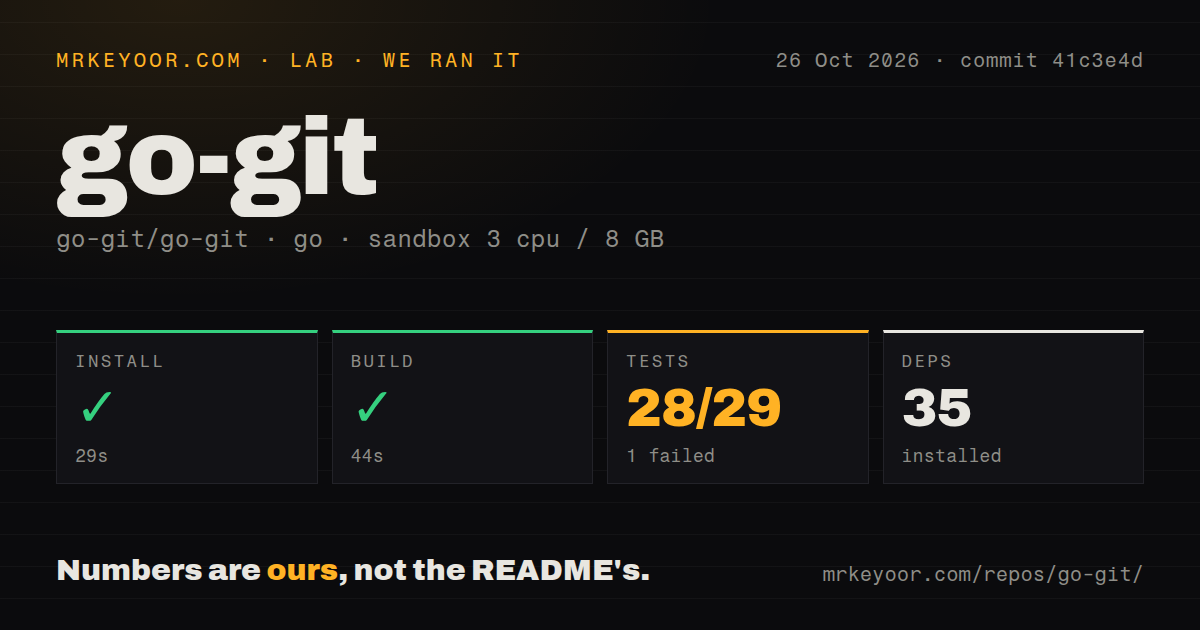
Our sandbox installed go-git commit 41c3e4d in 29 seconds with 35 dependencies recorded, then completed the build in 44 seconds. The test command exited 1 after 74 seconds: the supplied go test summary records 28 passed and 1 failed of 29. The run was on October 26, 2026. Installation and compilation succeeded, while the recorded suite did not pass.
The failing log tail contains successful package lines under merkletrie, sync and plugin, followed by an ok line for x/plumbing/worktree and a final FAIL. It does not name the failed case or show its underlying error. The worktree line reports success, so its position near the end is no reason to blame that package. We cannot attribute the failure to permissions, network access, a package or the environment from these lines.
The recorded configuration specified 3 CPUs, 8 GB RAM and image golang:1.24-bookworm. That image label does not establish the actual Go or operating-system version. The checkout contained 756 files, about 176,562 source lines and 5.2 MB. The scan found 7 CI workflow files and a tests directory, with no Dockerfile.
These results support a narrower conclusion than production readiness: the pinned checkout compiled, but its recorded test command failed for an unresolved reason. They provide no clone-throughput benchmark or memory profile. Before relying on it, obtain the complete failing output and reproduce the repository operations your application will actually perform.
In-memory storage is useful when a checkout is unnecessary
The README distinguishes low-level repository operations from higher-level actions such as cloning. Its Storer interface allows custom storage, and the in-memory example clones repository objects before walking the history of HEAD. That makes go-git worth evaluating for a Go service inspecting commits or building a repository analysis feature.
An in-memory clone still retrieves repository data. The example does not establish a small memory requirement or an advantage over a filesystem checkout. If your application processes repositories supplied by other people, measure the resources consumed by representative repositories before choosing where those objects should live. Our recorded source checks supply no workload result for that decision.
Authentication also belongs to the application. The compatibility table documents clone authentication through access tokens, username and password, and SSH, alongside unauthenticated access. Private repositories need the appropriate remote access method, plus storage and error handling chosen for your service.
Fast-forward-only pull rules out some synchronization jobs
The compatibility table says pull only supports merges that can resolve as a fast-forward. A service that merely follows an upstream branch may fit that boundary. Once local and remote histories diverge, a workflow that expects pull to reconcile them needs another approach.
The same table marks rebase and stash unsupported, while merge is partial and described as fast-forward only. Those are reasons to walk away if your product depends on those operations. They are documented boundaries, rather than explanations for our failed test command. Check the table against your intended version and operations instead of assuming the library name promises every Git command.
The current README uses the /v6 import path, which also appears in our supplied test tail. Keep module selection explicit when following examples. A snippet copied from another major version does not establish that the same API is available in the revision you adopt.
Git and git2go change what your application must ship
Git provides high-level operations and access to repository internals through its command set. Prefer invoking Git when the application's contract depends on familiar Git commands, including operations go-git's table excludes. That choice leaves your application responsible for the executable and for handling subprocess results. We did not compare its performance with go-git.
git2go wraps libgit2 and requires that native library. Consider it when you want libgit2 through a Go API and accept the native linking requirements. Its README explains both dynamic and static linking, including version matching. It is not evidence that every missing go-git operation is covered, so compare the required API before switching.
GitHub records go-git's last push as October 23, 2026. The recent issues-and-PR feed includes October 26 work on nested repository boundaries and an October 27 update to an exclude-pathspec request. That combination shows current development and reporting, without establishing maintainer response times. For your first trial, use a disposable repository that follows your intended history rules, then deliberately introduce divergence. The response to that second state will decide whether this library fits your synchronization job.