mrkeyoor.com_
Sat 12 Sept 15:51 UTC
LLM Toolsevaluationupdated 12 Sept 2026

reversa review

Reversa installs a collection of coding-agent skills into an existing project, then guides an agent through extracting business rules, architecture, data relationships, and gaps from the code. It is meant for teams that inherited a system without dependable specifications and want traceable working documents before they change or rebuild it.

Verdict

Our 80-second Reversa install added 61 packages and passed an audit with 0 known vulnerabilities, but the measured commit exposed no build or test target for us to run. Use it when a neglected codebase needs a structured first map and every generated claim will receive human review. Do not treat its write restrictions or confidence labels as proof that an autonomous agent understood the system correctly.

We ran it

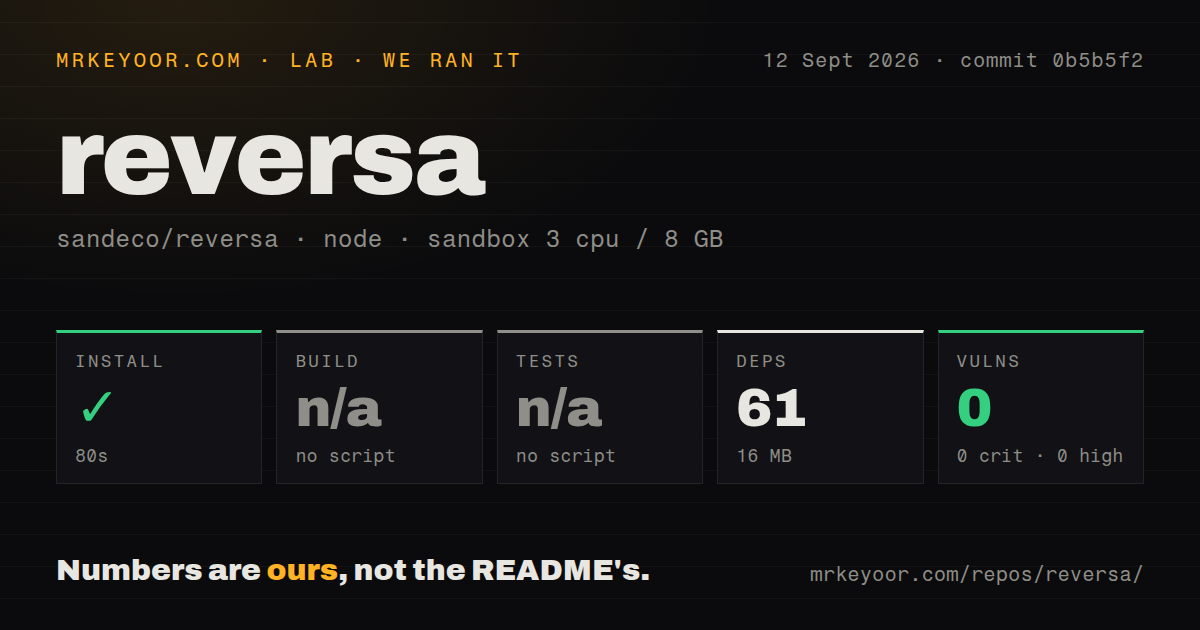
Lab card: what happened when we ran reversaScreenshot of reversa (github.com/sandeco/reversa)
Install✓ · 80s61 packages · 16 MB
Buildn/ano build script
Testsn/ano test script
Known vulns00 critical · 0 high · 0 moderate · 0 low (npm audit)
Repo479 files~4,855 lines of source · 2.8 MB · 2 CI workflows

Answers from our run

Does reversa build from source?

Dependencies installed in 80 seconds (61 packages), and the project has no separate build step. We cloned commit 0b5b5f2 into a clean Debian container with 3 CPUs and no project-specific setup.

Does reversa have tests you can run?

Not through a standard command: the project exposes no test script or target that our harness could run.

Does reversa have known vulnerabilities in its dependencies?

npm audit found none in the dependency tree at the time of our run.

Who should not use reversa?

Teams whose change-control rules cannot rely on agent instructions as a safety boundary: the README tells users to commit, keep a remote copy, and make a folder backup because AI agents can make mistakes.

What are the alternatives to reversa?

Spec Kit, Repomix, OpenRewrite. Our 80-second Reversa install added 61 packages and passed an audit with 0 known vulnerabilities, but the measured commit exposed no build or test target for us to run.

Setup4/580-second install; the coding agent and repo backup come first
Docs4/5Detailed workflows in 3 languages; one config gap is reported
Community3/51,593 stars and September activity, with 23 issues and PRs
Maturity3/5Version 1.3.3 is active; upgrade and review reports need care

Who it’s for

Maintainers who inherited a legacy codebase and need an evidence map before making changes.
Teams already paying for and operating Claude Code, Codex, Cursor, or another supported coding agent.
Consultants who need architecture, business-rule, data, and uncertainty artifacts from one repeatable workflow.
Developers willing to review every inferred claim and resolve gaps with people who know the system.

Who it’s NOT for

Teams whose change-control rules cannot rely on agent instructions as a safety boundary: the README tells users to commit, keep a remote copy, and make a folder backup because AI agents can make mistakes.
Anyone expecting proven runtime behavior from static inspection alone: open issue 30 says Discovery is predominantly static and reports inconsistent references, counts, severities, and required artifacts in one large run.
Maintainers who need unattended upgrades to be unquestionably complete: open issue 26 documents a version 1.2.56 update that reported success while leaving 16 of 64 skills absent.
Users who want a standalone analyzer without an existing coding agent: Reversa delegates the analysis to the agent already installed and authenticated in the environment.
Teams that cannot review Portuguese-facing details: English documentation exists, but the current CLI help and several issue discussions are in Portuguese.

Setup reality

Our sandbox installed Reversa in 80 seconds, adding 61 packages and using 16 MB. The checkout at commit 0b5b5f2 had no build target, so build was skipped, and no test target, so tests were skipped. Npm audit found 0 known vulnerabilities.

Node.js 18 or newer is required. Reversa itself asks for no model API key, but a supported coding agent must already be installed and authenticated. Running npx reversa install adds agent files, an engine entry file, state, configuration, and output directories to the target repository.

The README advises committing the project, keeping a remote copy, and making a separate folder backup before analysis. Agent writes are directed to .reversa/ and _reversa_sdd/, while longer runs save checkpoints and still depend on a human to verify inferred rules and unresolved gaps.

Five phases turn source code into reviewable specifications

Reversa's Discovery workflow sends a codebase through 5 phases: reconnaissance, excavation, interpretation, generation, and review. Specialist instructions map modules, trace business rules, describe data, and produce documents such as C4 diagrams, state machines, questions, gaps, and code-to-spec matrices. Another coding agent is the main consumer, although maintainers can read the Markdown. This fits a project where missing system knowledge is a bigger problem than missing source code.

The README groups agents into 10 teams covering existing systems, new projects, feature work, migrations, bugs, documentation, and code-quality tasks. That breadth becomes useful after an extraction because later work can read the same files. It also expands the review surface. A team adopting Discovery alone should install only what it intends to use and check each output against the repository and the running system.

Version 1.3.3 supports many agents but supplies no model

The package identifies itself as version 1.3.3 and requires Node.js 18.20.2 or newer. Its installer detects supported environments and writes the matching entry file, such as CLAUDE.md, AGENTS.md, or .cursorrules. The README lists 14 agent environments, including Claude Code, Codex, Cursor, Gemini CLI, Hermes, GitHub Copilot, and Aider. Reversa supplies instructions and state management. The selected coding agent supplies the model and execution environment.

Reversa says it neither requests nor stores model API keys. Analysis still runs inside an authenticated coding-agent session, so prompts and source follow that agent's provider and deployment policy. Teams with confidential code need to approve the agent first, then inspect Reversa's generated files and exclusions. The framework does not turn a hosted agent into a local service.

What happened when we ran it

Our sandbox installed commit 0b5b5f2 in 80 seconds. Npm added 61 packages, the installed tree occupied 16 MB, and npm audit reported 0 known vulnerabilities. The repository contained 479 files, about 4,855 lines of source, and used 2.8 MB after checkout. Those are modest figures for an installer carrying a large catalog of Markdown-based agent instructions.

There was no build script or target, so our build step was skipped. The measured checkout also exposed no test script or target, and the repository had no tests directory, so the test step was skipped rather than passed. Two CI workflow files were present, but no Dockerfile was included. We verified installation and dependency audit only. We did not prove that the 5-phase analysis produces correct specifications on a real legacy system.

Two output directories do not create a hard sandbox

Reversa directs analysis writes to 2 areas, .reversa/ for state and _reversa_sdd/ for output, with named exceptions for engine instruction files and installed skills. A SHA-256 manifest supports updates without overwriting files the user changed. Checkpoints in state.json let an interrupted analysis resume, and the guided workflow asks for CONTINUAR between agents. These controls make a long investigation easier to inspect and stop.

The README also says to commit the project, keep it on a remote host, and make a folder copy before starting. That warning matters more than the guarantee in its immutability section. AI agents receive the write boundary through instructions, and the project acknowledges that agents can make mistakes. Run Discovery in a disposable branch or worktree and inspect git status after each phase.

One open report found 11 integrity failures in review output

Open issue 30 describes a Reversa 1.2.58 run where the final reviewer marked work complete despite inconsistent artifacts. The reporter's checker found 11 problems, including orphaned question references, missing required files, conflicting severities, and mismatched counts. The issue says Discovery is predominantly static by design. Confidence marks help readers locate inferred claims and gaps, but they cannot replace deterministic cross-checks.

Issue 26 documents an installation updated from 1.2.43 to 1.2.56 that reported the new version while retaining 48 of 64 skills. An August 31 commit says the installer now always installs all agents, so the report does not prove version 1.3.3 still fails. It does justify comparing installed skill directories and manifests after an update instead of trusting the displayed version.

September activity offsets the absent GitHub release

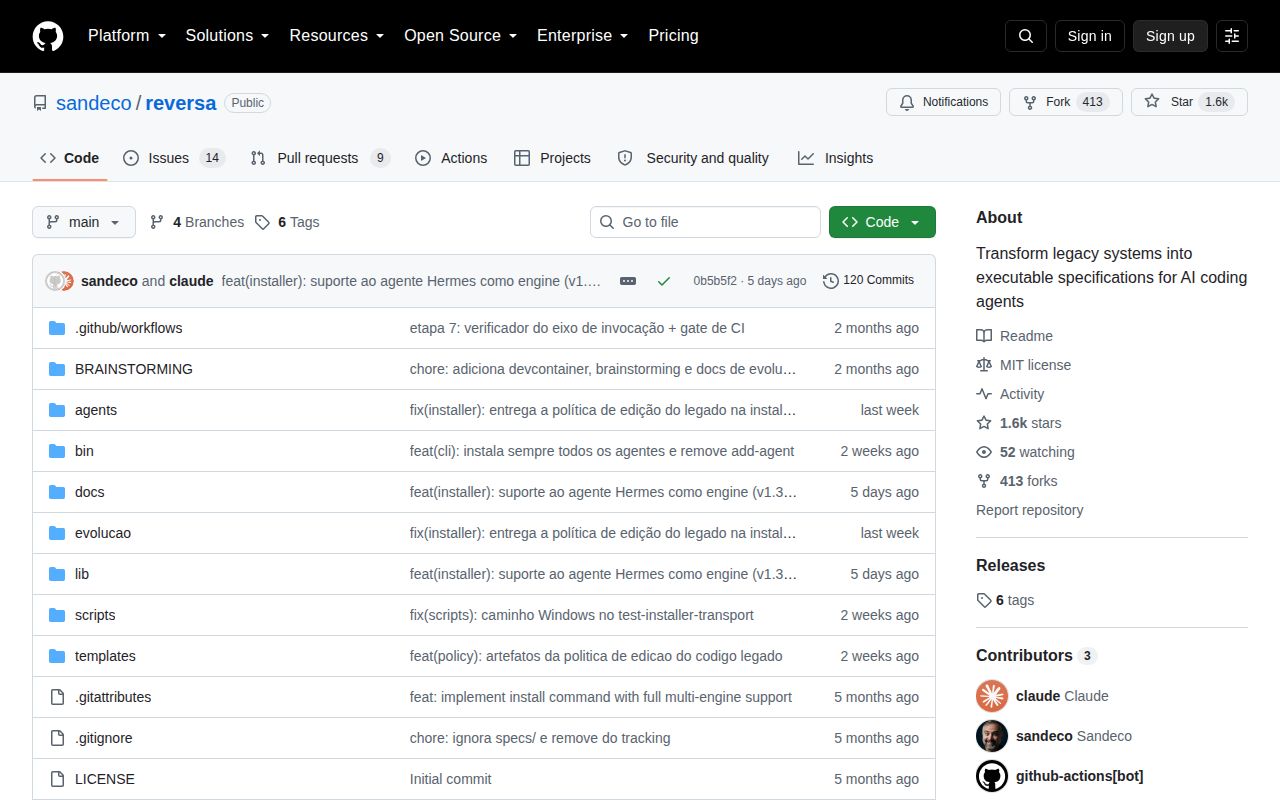
GitHub listed 1,593 stars and 23 combined issues and pull requests on September 12, 2026. The last push was September 8, only 4 days earlier, and recent commits added Hermes support plus installer policy work. The latest-release API returned no published GitHub release, while the package file says 1.3.3 and the visible tag list stops at 1.2.57. Pin the npm version instead of inferring it from the Releases page.

Documentation is available in English, Portuguese, and Spanish, yet some operational details trail the code. Issue 33, opened September 9, says the writer could not find documentation for reversa-config.json after an update made the project read-only. The CLI help we inspected is Portuguese. English-only teams should check policy files before an agent starts.

Reversa is a draft map, not proof of system behavior

Version 1.3.3 gives a team one vocabulary for extraction, uncertainty, planning, and later changes. Its best use is a structured first pass over a system whose original authors or documents are gone. The 5-phase flow can turn vague unease into a review queue. Our run had no test target, and issue 30 records inconsistent reviewer output, so every code reference, count, gap, and business rule still needs an owner before the draft guides production work.

Alternatives

ProjectWhat it isPick it when
Spec Kit gh↗A specification-driven workflow for turning feature intent into implementation plans and tasks.pick this instead when the main job is specifying new features rather than extracting undocumented legacy behavior.
Repomix gh↗A tool that packages repository contents into an AI-friendly file with filtering and token counts.pick this instead when an agent needs a compact snapshot of the code and a multi-phase specification process would be excessive.
OpenRewriteA recipe-based system for making repeatable source changes across large codebases.pick this instead when the target migration is already known and automated code transformation matters more than reconstructing business intent.

What people are saying

  1. [github-trending] sandeco/reversa

Sources

  1. Reversa repository and README
  2. Reversa documentation
  3. Issue 30: deterministic reviewer integrity checks
  4. Issue 26: updater omitted newer skills
  5. Issue 33: missing reversa-config documentation
  6. Reversa paper

More llm tools reviews

gemini-skills · Claude-Red · knowledge-work-plugins · llamafile · OpenContext · hyperresearch · the whole board →