Short answer: consider it for one RTX 5090 and one model
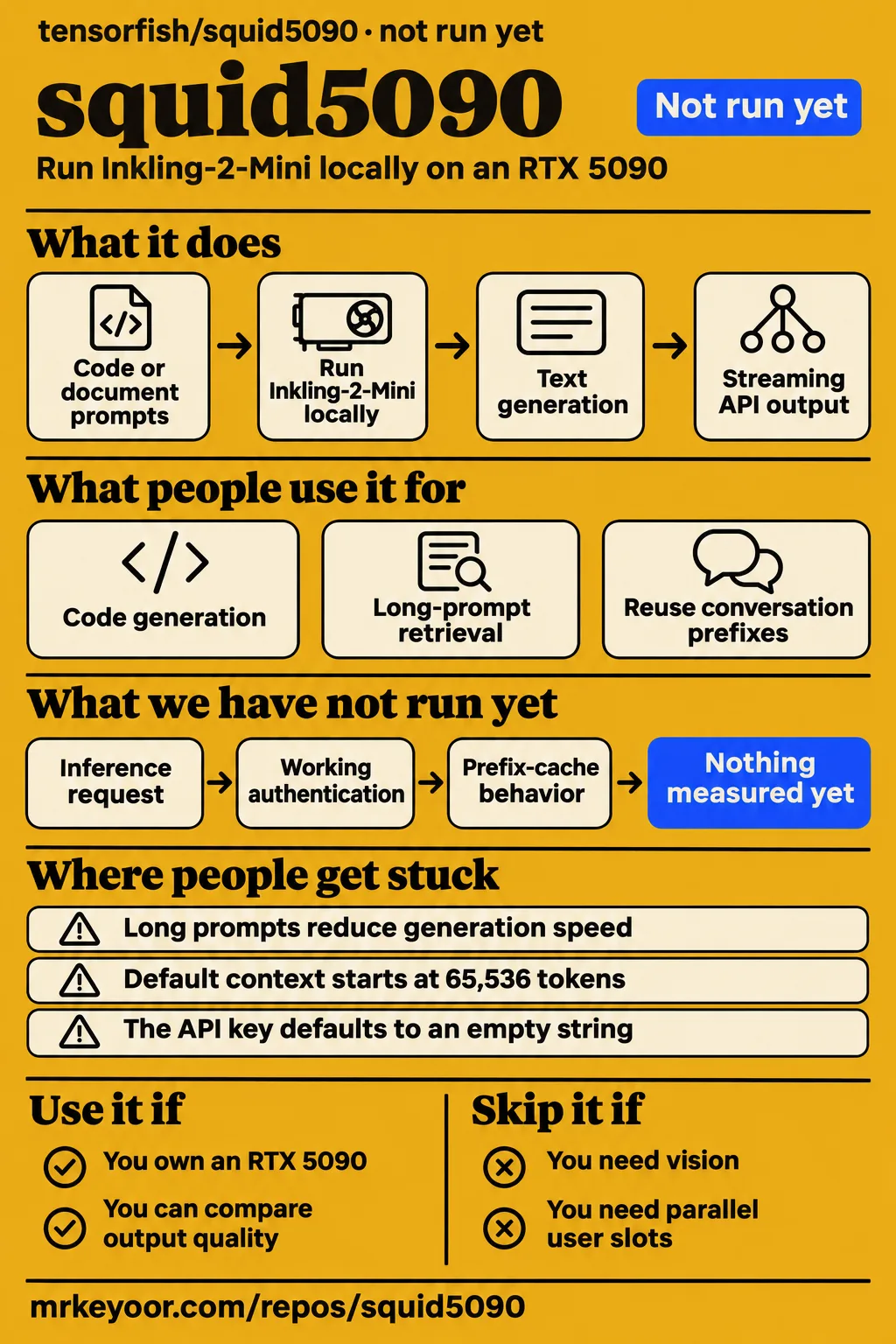
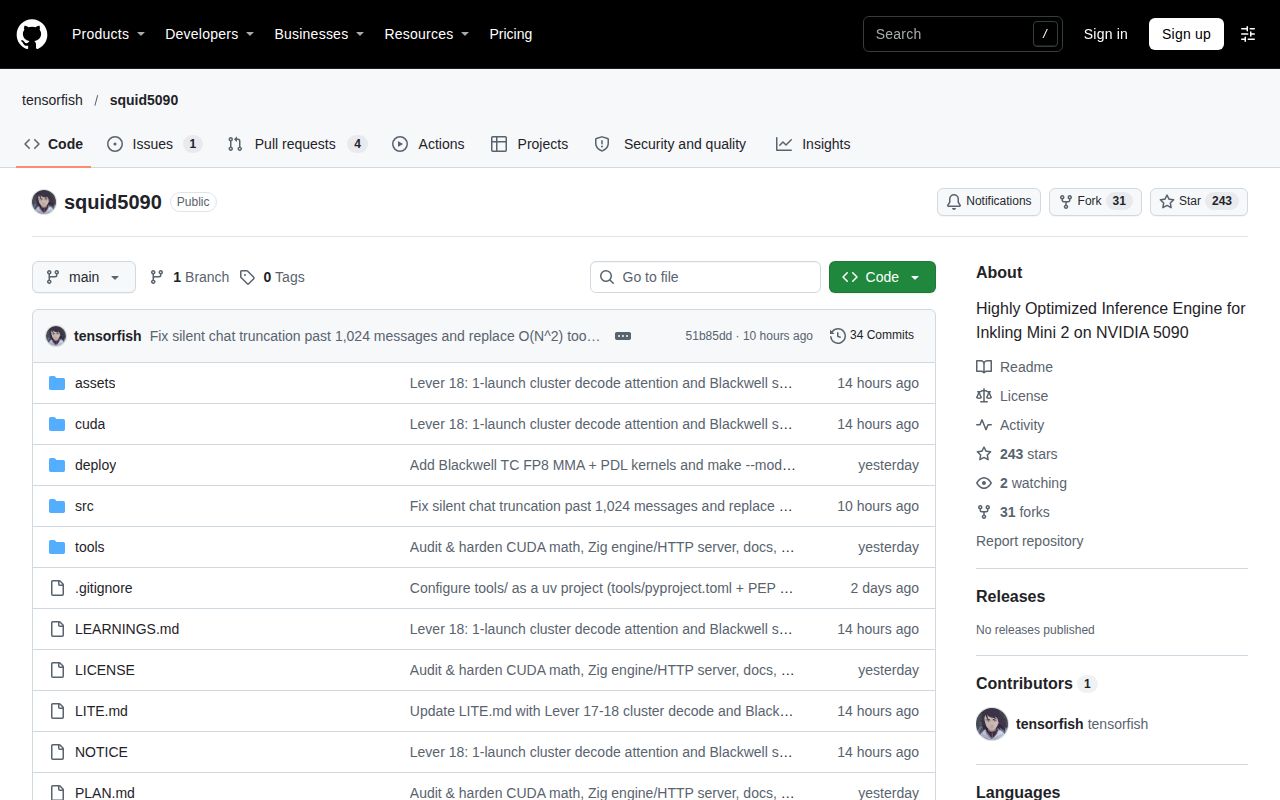
squid5090 is a Zig and CUDA text inference engine for Inkling-2-Mini on an RTX 5090, with an OpenAI-compatible streaming server, according to its README. Use it if you want to tune that specific workstation workload and can compare output quality alongside speed. Skip it if you need a shared vision service with constrained JSON output: the project's scope excludes those uses.
Our clone failed before installation. This is a research-led assessment of the engine's documented tradeoffs, with a failed lab attempt disclosed below, rather than an independent endorsement of its benchmark chart.
The most useful distinction is between a context window that fits in memory and a conversation the model has actually read. The author reports real single-passkey recall through 523,961 tokens, while the 1M row uses a synthetic zeroed cache. If you are choosing an engine for a large codebase, that difference belongs ahead of the fastest token rate.
What people use squid5090 for
The author has reported code generation, long-prompt retrieval and reused conversation prefixes; a separate contributor has reported running a smaller-GPU fork.
| Who used it | What they did | Reported outcome and why you would care |
|---|---|---|
| squid5090 author | Generated code and copied code over HTTP in FP8/FP8 mode | 356.8 tokens/s for code and 456.4 tokens/s for code-copy at temperature 1.0, so copying is a separate workload from writing new code. |
| squid5090 author | Planted a passkey halfway through a long prompt | Verbatim recall passed at 523,961 tokens, with 171.13 seconds of prefill and 74.4 tokens/s afterward. This measures one retrieval task at that depth. |
| squid5090 author | Reused prefixes across HTTP turns | Warm 16K and 82.5K turns had reported latencies of 71.9 ms and 62.4 ms, using checkpoints in host RAM. |
| squid5090 author | Evaluated optional LoopCD on math, code and logic | Selected thinking-mode settings raised the score from 25/30 to 27/30, while direct mode favored leaving the option off. |
| GitHub user dialectmaterial | Forked the engine as squid5060 for an 8 GB RTX 5060 Laptop GPU | 58.6 tokens/s median decode at temperature 0.6 and three successful 23.9K-token retrieval trials, reported for the fork. |
These examples suggest two different buyers. If you already own a 5090, the upstream engine gives you a focused way to investigate Inkling-2-Mini performance. If you own a smaller Blackwell card, dialectmaterial's fork is the relevant starting point. Its results belong to squid5060; changing the GPU name in an upstream launch command doesn't reproduce that work.
The prefix-cache example matters for chat over a stable document or code prefix. Prefill means processing the input before generation starts. Reusing that work can make a later turn feel very different from the first, cold request. The author's warm results use host-RAM local checkpoints, so include system memory in your deployment thinking even when the attention cache stays on the GPU.
What happened when we ran it
Our November 25, 2026 attempt stopped at git clone with a write error: we could not clone squid5090.
| Stage | Recorded result | What it tells you |
|---|---|---|
| Clone | FAILED: fatal: write error: No space left on device | The checkout did not complete. |
| Fetch processing | fatal: fetch-pack: invalid index-pack output | The clone log ends with a second fatal error. |
| Installation, build and tests | Not run | There is no result to score or compare. |
| Cleanup | teardown: ok | Cleanup was recorded as successful. |
We started with a configured sandbox of 3 CPUs and 8 GB RAM. Git returned the disk-space write error, followed by the invalid index-pack message. Nothing in that sequence demonstrates a CUDA, Zig or model-loading failure. The log does identify a storage error during cloning; it doesn't identify what consumed the space.
The configured image was listed as n/a, the commit was unknown, and actual runtime versions require raw toolchain logs. Those configuration details aren't a successful execution environment for the engine.
The run summary describes a Compose deployment with localhost-bound ports, but the concrete step log stops at cloning. We therefore count this as a failed clone attempt, not a working deployment. The next useful lab result would start with a complete checkout on supported GPU hardware and record a real request, its output and its configuration.
Where people get stuck: the defaults and the headline describe different runs
The serving code defaults to 65,536 context tokens, rather than automatically allocating the advertised maximum, and switches on host embeddings above 524,288 tokens in non-exact modes.
An attention key-value cache stores the model's working state for previous tokens. It competes with weights and other runtime allocations for GPU memory. You choose both its capacity and its number format, so a headline about maximum capacity doesn't describe every ordinary server launch.
| Decision or problem | What the project documents | Practical response |
|---|---|---|
| You expect the maximum window from a default launch | The serving context starts at 65,536 tokens. | Set the context deliberately and budget memory for that configuration. |
| You read “zero spill” as “no system RAM” | Non-exact modes enable host embeddings above 524,288 tokens. | Distinguish GPU cache residency from the location of embeddings and prefix checkpoints. |
| Prompt lookup meets nonzero-temperature sampling | The README says lookup defers to DSpark above temperature zero. | Compare the same sampling settings, rather than extrapolating greedy copy speed. |
| You want upstream support below 15 GiB | dialectmaterial's issue #4 asks whether to upstream its host-backed expert cache. | Treat the fork as a separate route until a maintainer decision or merged implementation says otherwise. |
DSpark is the project's token drafter: it proposes continuations for the main model to check. Prompt lookup instead finds likely continuations already present in the input. These paths help explain why a code-copy result can outrun conversational generation. The README describes adaptive verification widths of two, four or eight tokens, choosing how much draft text to check together.
For the smaller-GPU route, dialectmaterial reports a cache that keeps some experts, the model's selectable computation blocks, on the GPU and backs the rest with host memory. That is an architectural change involving PCIe transfers, not proof that upstream has the same behavior. The issue was open with no comments in the captured thread.
FP8 is the sensible starting point for fidelity
The author's 7,784-token evaluation reports mean KL divergence of 0.0094 for FP8/Q4 and 0.0268 for NVFP4/Q4 against the exact checkpoint, as shown in the precision table.
KL divergence measures how much the next-token probability distribution changes from a reference; lower is closer on the evaluated text. It doesn't tell you that every answer is correct. FP8 and NVFP4 are compact numerical formats, while Q4 refers here to the compressed attention cache. A mode name therefore describes more than one choice about which numbers to shrink.
For your first comparison, keep the default FP8 weight mode and use representative prompts. Then ask whether NVFP4's memory headroom or throughput is worth its larger measured distribution change. A code assistant that repeats source material and one that reasons through a new bug should each be judged on their own output.
LoopCD is another independent choice. It adjusts the model's internal representation using differences between recurrent passes. The author's thinking-mode sweep improved from 25/30 to 27/30 at selected settings, while direct mode scored 29/30 with it disabled versus 27–28/30 with tested enabled settings. Leave omega, its strength parameter, at zero unless your own task evaluation earns a change. The README's results argue against treating an optional technique as an automatic improvement.
Long context trades first-answer delay for capacity
The author reports 171.13 seconds of cold prefill at 523,961 tokens, followed by 74.4 tokens/s of generation and 20.3 GiB GPU memory use in the real retrieval trial.
That result is more useful for a large repository question than a short-prompt headline. It tells you the engine read a long prompt and recovered the planted passkey, while also showing the wait before generation. Earlier reported real trials at smaller depths took less time to process and generated faster. Keep context depth attached to any speed comparison.
Prefix caching addresses repeated input. It does not make the first cold prefill disappear. If your application resends a stable code prefix, cache reuse is worth investigating. If every request brings a different large document, use cold-prefill performance to decide which engine deserves your attention.
The synthetic million-token result answers a narrower engineering question: how much cache can be allocated and how fast a decode step runs against that allocation. The author labels its 45.7 tokens/s B=1 result as zeroed-KV testing. It should not become a claim about answering questions after reading a million tokens of real code.
Network access needs an explicit choice
The command-line source defaults the host to 0.0.0.0 and the API key to an empty string, with a key optionally read from SQUID_API_KEY, as shown in main.zig.
Binding to 0.0.0.0 means listening on the machine's network interfaces. For a local evaluation, choose a loopback binding explicitly. If you intend remote access, configure authentication and the network boundary before treating this like a private workstation endpoint. An OpenAI-compatible API tells you how a client speaks to the server; it doesn't choose who should reach it.
The README documents optional bearer-key authentication. That is a configuration feature, not a security audit. The failed clone in our lab offers no security assurance about the running server.
squid5090 vs ingine, basalt, llama.cpp and squid5060
The author's comparison favors different engines for single-stream decode, cold prefill and serving features; it doesn't support one universal speed winner.
| Alternative | What the comparison or contributor reports | Pick it when |
|---|---|---|
| ingine | The squid5090 author reports faster FP8 single-stream decode and vision support, with CUDA 13.4 and a 262K context ceiling. | Your priority is the compared decode workload or vision, and its platform requirements fit. |
| basalt v0.5.7 | The author's comparison credits it with the highest HTTP cold-prefill rate and features including constrained JSON grammar, parallel slots and multi-GPU operation. | Serving features or processing fresh long prompts matter more than the fastest copy row. |
| llama.cpp | The README quotes an external IQ4_NL result without DSpark, rather than including it in the live comparison. | You already use it and want a baseline for a controlled comparison on your workload. |
| dialectmaterial/squid5060 | Its author reports an 8 GB laptop-GPU run using host-backed expert caching. | Your Blackwell GPU is smaller than the upstream target and you accept the fork's different memory path. |
The README describes ingine, basalt and squid5090 runs made back-to-back on the same RTX 5090, with matched prompts and sampling conditions. That is a better starting comparison than a viral multiplier, although it is still the squid5090 author's work. In that comparison, NVFP4/Q4 squid5090 beats basalt on all eight reported decode cases. That result carries a precision choice; it is not interchangeable with an FP8 quality claim.
For a useful decision, copy your actual prompt into each candidate, keep sampling settings aligned, and judge the generated answer as well as its arrival time. Do not combine one mode's fidelity score with another mode's fastest throughput and call the combination a product result.
What the other reviews get wrong
Wassim younes AI's Facebook explainer turns a synthetic million-token result into a filled-conversation claim, while MyArgoQuest's article uses older comparison and fidelity information.
The Facebook post says a “full million tokens” ran at about 101 tokens/s in 22.7 GiB. The README instead labels the million-token row synthetic zeroed-KV testing, with 23.23 GiB allocated and 45.7 tokens/s at B=1. Its faster B=4 numbers include a synthetic multiplier. Those are different conditions from reading an active conversation.
MyArgoQuest's “How Squid5090 runs Inkling 2 Mini” says the repository lacks a reproducible same-configuration baseline for the viral llama.cpp comparison. The llama.cpp qualification still matters. The newer README also contains a documented live comparison against ingine and basalt, so readers should not infer that all same-hardware comparison work is absent.
The same article uses 0.0050 FP8/Q4 and 0.0184 NVFP4/Q4 divergence figures from short prompts. The README's longer 7,784-token evaluation reports 0.0094 and 0.0268. Keep the evaluation length attached to the quality claim, especially when your reason for considering the engine is long context.
Gabe's X explanation also circulates the single-GPU, million-context headline. It is commentary about the project, not another independent runtime measurement.
Questions people ask
To set up the engine shown in the post, follow the repository's Linux build-and-weights workflow for Inkling-2-Mini; you don't need to recreate the reported Gemini-assisted development process.
How do I set up the local inference optimization shown in the post?
The README quickstart specifies Linux x86_64, a Blackwell GPU, an NVIDIA driver, CUDA and Zig. Its documented workflow is to clone the project, build with Zig, download thinkingmachines/Inkling-2-Mini weights and launch the server with a model directory. These are instructions, not successful steps from our lab. Choose the context and precision flags for the workload you intend to run, rather than copying the maximum-context command for every request.
How much does using Gemini for this optimization cost?
A Gemini development bill is unknown: the Facebook account of the project names Gemini as a development aid but gives no spend. The local engine quickstart runs Inkling-2-Mini and does not list Gemini as a serving dependency. Instagram commenter vinjakgaming asks about Gemini's cost; that question doesn't supply a price. Separate buying AI development assistance from operating the resulting local engine.
Would squid5090 accept upstream support for GPUs with less than 15 GiB VRAM?
There is no acceptance decision in issue #4: dialectmaterial asks that exact upstreaming question, and the captured thread has no comments. The contributor describes working fork results and proposed shared improvements, not maintainer approval for the larger memory architecture.
Should support for smaller GPUs stay in squid5060 while squid5090 focuses on full-VRAM cards?
That split is an option the fork author explicitly offers in issue #4, rather than an agreed policy. If you need the smaller-GPU implementation today, evaluate squid5060 on its own terms. Do not schedule an upstream migration around an unanswered request.
What we have not tested yet
We have not completed a checkout, installation, build, test suite or inference request, so every runtime performance and quality result discussed above belongs to its named author.
Our lab attempt supplies no GPU speed, model accuracy, working authentication or sustained-service result. It has no known commit or confirmed runtime versions. The generic Compose summary cannot fill those gaps after a failed clone.
The author's real retrieval result is a single planted passkey at the stated prompt position. It does not establish broad document reasoning, retrieval across many positions or successful recall from a real million-token prompt. The synthetic cache result answers none of those questions. We have not independently reproduced the cross-engine comparison, the LoopCD sweep, prefix-cache behavior or the small-GPU fork's results.
For application selection, collect the boundaries in one place: upstream documents text-only operation, one active user slot and no constrained JSON-schema decoding. System RAM can still hold prefix checkpoints and, above the source-code threshold, embeddings. Fork support below 15 GiB is an unresolved upstream question. None of those facts proves poor performance for the single-user text workload the project targets.
The YouTube entries available to this review contain no transcript, so they support no claim about a creator's setup or results. Adoption, support response times and production reliability also lack enough evidence for a rating. The next lab assessment needs a completed checkout and a real cold prompt on supported hardware, followed by a repeated-prefix request and output checks on the same configuration.