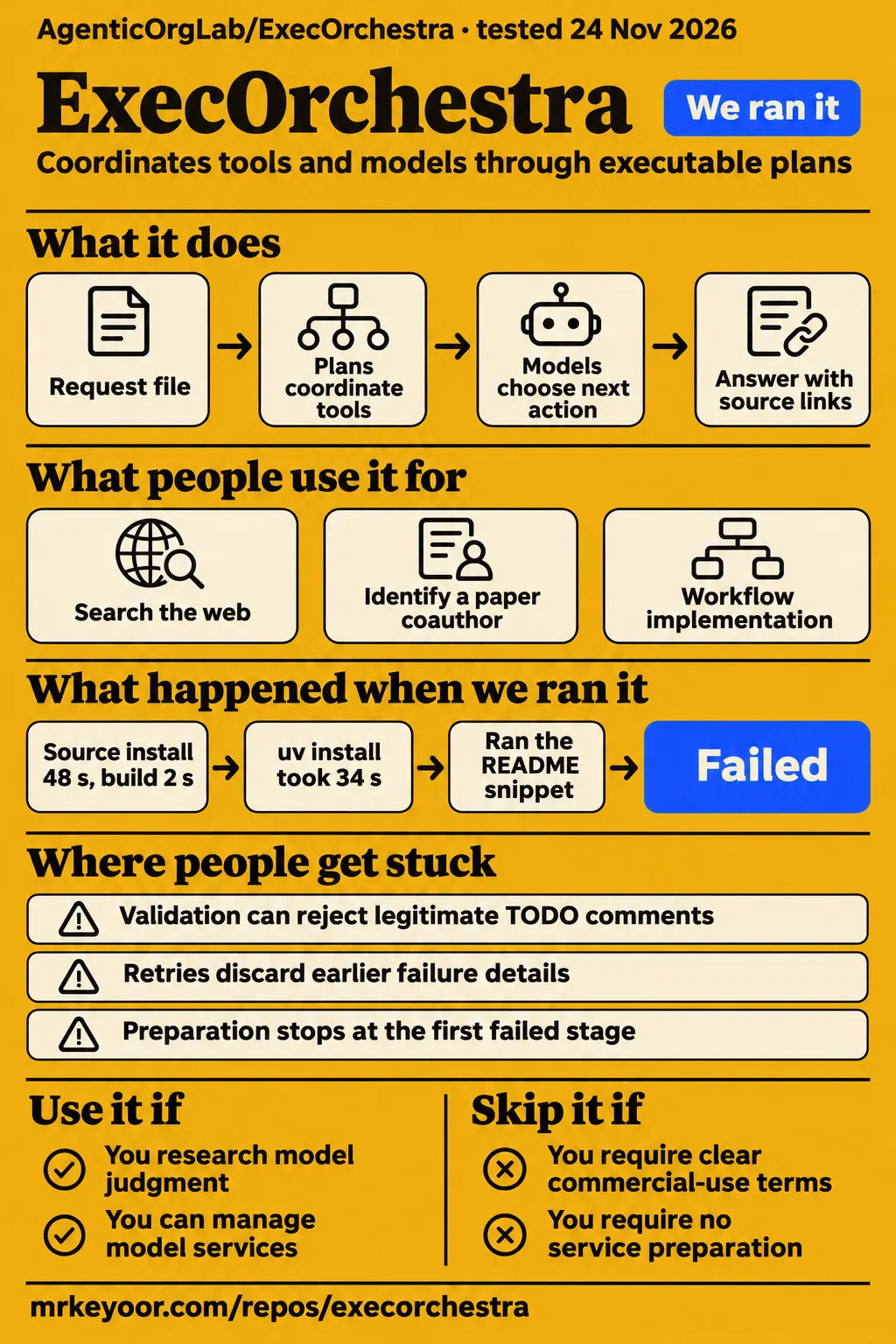
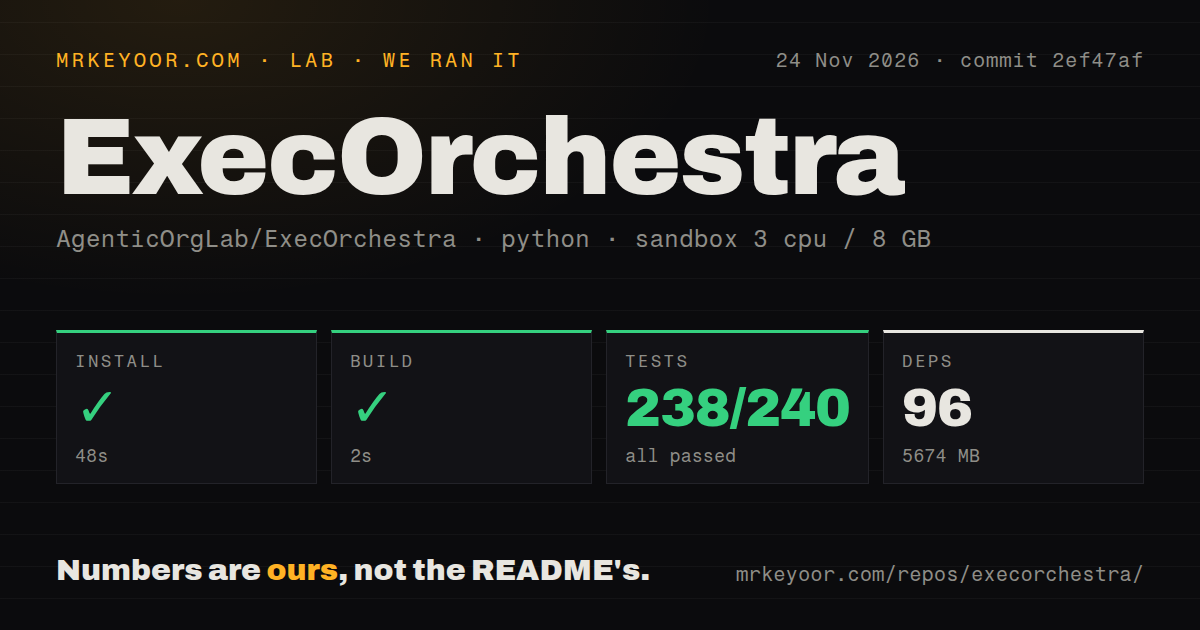
Our run installed ExecOrchestra in 48 seconds and built it in 2 seconds, then testing exited 1 with two missing-file errors. ExecOrchestra suits Python developers investigating how much model control each workflow step needs and prepared to operate its model and embedding services. Teams requiring clear redistribution or commercial-use terms should hold off: the November 24, 2026 GitHub metadata records no detected repository license. The measured checkout was commit 2ef47af, and the test errors both name a missing retrieval-policy file.
What you can do with ExecOrchestra
ExecOrchestra assigns Direct, Localized, or Extended execution to subtasks in plans that coordinate tools, models, skills, and agents. The ExecOrchestra README describes Direct as fixed operations and inputs executed by tools without an intermediate model call. Localized gives a model a specific job, such as writing a short processing script. Extended allows a model or agent to inspect tool responses and choose its next action within permitted tools and session limits.
The useful distinction is where a plan gives a model discretion. A specified computation can use fixed execution, while a subtask requiring generation or interaction can receive a different execution mode. That gives developers an explicit vocabulary for designing a mixed workflow. The README presents these modes as architectural choices; our installation and test results below describe what happened when the checkout entered a sandbox. Both belong in an adoption decision, but they answer different questions.
What people use ExecOrchestra for
The project authors describe XBench DeepSearch-2510 case 157 as a paper-coauthor research task. The research synthesis's README quotation describes searching the web, checking the paper's author list, and delivering an answer with source links. That makes the intended deliverable concrete: a name accompanied by evidence a reader can inspect. It is the documented use case available here, with no need to expand it into a claim about customer deployments.
| Who | Task | Reported outcome |
|---|---|---|
| Project authors | Identify a paper coauthor using XBench DeepSearch-2510 case 157 | The README describes web search, author-list checking, and an answer with source links. |
A Chinese-language X post by aiyuange proposes workflow implementation and evaluation services. The post describes a service business built around ExecOrchestra and suggests project pricing. It names no completed customer deployment. Its role in this review is therefore limited to showing one author's proposed application of the framework. The coauthor example is a project-documented research task; the X post is a commercial proposal, and its prices are not operating-cost measurements.
What happened when we ran it
Our sandbox install succeeded in 48 seconds, the build succeeded in 2 seconds, and testing exited 1 after 13 seconds. These are our November 24 measurements at commit 2ef47af, recorded with 3 CPUs and 8 GB RAM. Installation recorded 96 dependencies and 5674 MB on disk. The sandbox image label was ghcr.io/astral-sh/uv:python3.12-bookworm. The checkout contained 675 files, approximately 144238 lines of source, and 13.7 MB of files.
| Step | Our recorded result | What it means for you |
|---|---|---|
| Install | Succeeded in 48 seconds; 96 dependencies; 5674 MB on disk | The installed footprint exceeded the 13.7 MB checkout. |
| Build | Succeeded in 2 seconds | The harness build stage completed. |
| Tests | Exit 1 after 13 seconds; 238 passed, 0 failed, 14 skipped, 2 collection/setup errors | Passing cases did not make the overall command successful. |
The test log names tests/test_cli_research_limits.py and tests/test_terminal_audit_outcome.py, both reporting FileNotFoundError for /work/repo/execorchestra/sgar_mvp/config/retrieval_policy.json. Its summary reads 238 passed, 14 skipped, 3 warnings, 2 errors in 9.89s. The 9.89 seconds is pytest's internal duration; the harness recorded 13 seconds for the test step. The warnings concern Swig types without a __module__ attribute. The recorded failure is the absence of the policy file.
The source lives under execorchestra/, one directory below the checkout root. The harness detected a tests directory and 1 CI workflow, and reported no Dockerfile. The README installation instructions name the nested runtime path sgar_mvp/docker/Dockerfile.runtime. The scanner's general detection signal and the README's explicit build path are separate facts. The documented command selects that nested file directly when building the tool runtime.
A separate quickstart-lib attempt used commit 2ef47af121c6 in a fresh unprivileged container, with 2 CPUs, 4 GB RAM, no published ports, and no secrets. Its clone step took 3 seconds. The recipe then installed PyPI torch 2.15.0 in 34 seconds instead of the README's pinned CPU torch 2.11.0. This was a different dependency installation from the documented command.
That recipe recorded 5255.3 MB in the virtual environment's site-packages and 28 packages besides torch. It then failed at the snippet step because the README had no Python code block to run. The no-snippet finding records the same stopping point, and teardown completed successfully. These observations belong to quickstart-lib, separate from the harness installation, build, and pytest results.
Linux setup includes model services and resource preparation
The README requires Linux x86-64, Python 3.11 or higher, Git, Conda, Docker, a compatible LLM API, and embedding services. Its installation sequence creates an environment, installs pinned dependencies, initializes configuration, and builds the Docker tool runtime. Model access and retrieval resources add further preparation. The framework terminal loads credentials from .env; a locally hosted embedding service uses a separate environment and terminal, with matching configuration shared between service and client.
The default embedding model is Qwen3-Embedding-4B. An existing endpoint must use the configured revision and return normalized 2,560-dimensional vectors, while the client needs the matching tokenizer. The preparation command is python -m scripts.prepare_release all --allow-unavailable. The README says preparation checks resources, builds their index, makes live requests, may incur charges, and stops at the first failed stage. Unavailable candidates are recorded in sgar_mvp/runtime_state/preparation_report.json; omitting the option requires every configured candidate to be available.
For task execution, the query file belongs inside a declared input directory, and the run directory must be new or empty. The README's task parameters define --query-file as the request file, --public-input-root as a directory the task may read, and --run-dir as the location for that attempt's logs and results. Multiple input roots and named attachments are supported through repeated options. These paths form part of the task interface.
Where people get stuck: output validation and retry history
Issue #6 reports legitimate TODO comments being treated as placeholders, while issue #10 reports lost diagnostic detail across SmartExecutor retries. The TODO-validation report distinguishes intentional future-work comments from unfinished implementation stubs. The retry-history report says earlier partial responses and structured provider errors are discarded, leaving a generic RuntimeError after the final attempt. These are contributor reports about artifact acceptance and failure diagnosis after execution has started.
| Report | What the author says | Recorded response |
|---|---|---|
| Issue #1 | Substring matching could mistake decode or encode for a code deliverable | TL-Z reports a fix on main in commit 72bab7a. |
| Issue #6 | Legitimate TODO comments can be treated as unfinished placeholders | Open proposal for a whitelist or artifact-level opt-out. |
| Issue #10 | Earlier retry diagnostics are discarded | Open proposal for per-attempt diagnostic records. |
The proposed retry record includes attempt number, latency, finish reason, partial response, and error type. Those fields describe the diagnostic history requested in issue #10. Separately, issue #8 requests connection reuse in REST API tool scripts, and issue #9 proposes a mapping table for media-type fallback checks. Issue #9 already shows an extension dictionary; its proposed change concerns the subsequent media-type fallback logic.
Batch processing gives callers control over partial progress
TL-Z says iter_query_profile_batches processes configurable chunks and yields each batch in input order. The response to issue #2 explains that callers can save or release results as they arrive, while failures report the affected batch and stage. The response to issue #3 describes counting completed results batch by batch. The interface addresses partial progress by giving callers a batch boundary at which to handle results.
With retry_embedding=True, TL-Z says an embedding connection failure can be retried once using profiles already generated. This separates the repeated embedding request from another profile-generation attempt. The caller chooses chunk size and handles completed results. For a developer designing bulk evaluation, the useful detail is which work the reported retry preserves: profiles generated for the affected batch. The discussion supplies behavior and API names, rather than a benchmark of memory use or throughput.
Network policy and the smoke task have explicit requirements
Tool network access is disabled by default, and web tasks use --network-policy declared after search and browser services are configured. The README's run parameters also declare readable input roots. Preparation makes its own live-service requests, so service preparation and task network policy describe different workflow stages. A web-research task therefore requires both prepared resources and the task's declared network access, alongside the configured search and browser services.
The migration guide's smoke task requires a committed answer.json containing {"sum":42} after preparation. It instructs operators to inspect the terminal outcome, run_manifest.json, delivery_manifest.json, and the committed answer. An API probe, generated plan, or uncommitted file does not satisfy that documented end-to-end criterion. The guide also calls for a new run directory for each attempt and retention of the failed attempt before retrying.
Index rollback requires keeping a generation together
The migration guide says to keep Pool/index_meta/ and the active retrieval policy together when backing up a standard checkout. Its index lifecycle procedure explains that the generation manifest records embedding identity, resource order, and index hashes. If a refresh changes retrieval inputs, the backup includes matching configuration, readiness records, effective catalogs, and associated evidence. Recovery concerns a matching generation of files, including the active policy at sgar_mvp/config/retrieval_policy.json.
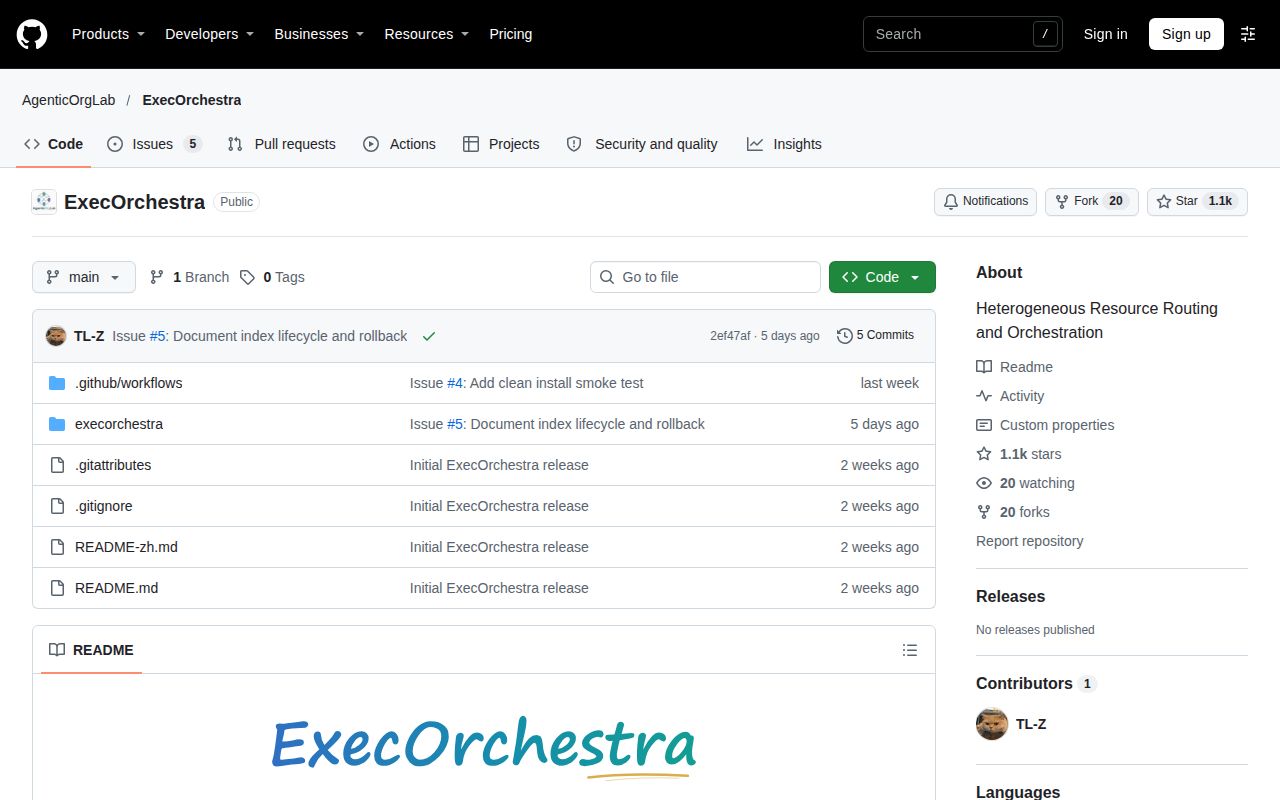
For sealed releases, the guide describes promoting the complete staged directory after its profile audit has no errors, then retaining the promotion receipt and backup directory together. Issue #5 records TL-Z's documentation update in commit 2ef47af, matching our harness's short checkout identifier. The standard path describes a 4B embedding profile with 2,560 dimensions; the sealed promoter expects a 0.6B BF16 profile with 1,024 dimensions. Operators following these procedures need the configuration belonging to the selected path.
ExecOrchestra vs LangGraph and Kestra
Choose ExecOrchestra for explicit model-control boundaries, LangGraph for stateful agents, or Kestra for scheduled and event-driven workflows. These selection criteria follow the projects' documented purposes: the ExecOrchestra README describes three execution modes, the LangGraph README emphasizes stateful agents, and the Kestra README describes scheduled and event-driven automation. Start with the requirement your application needs to control, then examine the corresponding project's operating model.
| Project | Documented focus | Choose it when |
|---|---|---|
| ExecOrchestra | Executable plans with three levels of model control | You are researching which subtasks need model judgment. |
| LangGraph | Low-level orchestration for building stateful agents | Agent state across execution is the central requirement. |
| Kestra | Scheduled and event-driven automation with a declarative YAML interface | Workflow triggers and explicit definitions are the starting point. |
LangGraph describes durable execution, human oversight through agent-state inspection, and memory among its supporting capabilities. Kestra describes schedules, event triggers, and YAML workflow definitions. ExecOrchestra makes the allocation of fixed execution and model judgment explicit through Direct, Localized, and Extended modes. This comparison gives a documented starting point for selection. A developer choosing among them should identify whether the governing requirement is agent state, workflow triggers, or control over individual subtasks' generative scope.
FAQ
TL-Z reports configurable query batches and embedding-profile reuse; TODO opt-outs and complete retry histories are contributor proposals. The batching response, TODO report, and retry-history report establish that distinction. The questions below come from contributor discussions about processing large collections, handling retries, dependency compatibility, index recovery, and artifact validation. Each answer identifies whether it describes a maintainer response, documented procedure, or requested change.
Can large query batches be processed incrementally with configurable chunk sizes and progress reporting?
TL-Z says the opt-in batch API supports configurable chunks returned in input order. The responses to issues #2 and #3 put progress accounting in the caller's hands: callers count completed items per batch and inspect the batch range and stage after a failure. An application can use those batch boundaries to persist partial results as they arrive or release results it has already processed.
Can embedding retries reuse successful HyDE profiles instead of generating them again?
TL-Z says retry_embedding=True permits one embedding connection retry using already generated profiles. The issue #2 response identifies the retry condition and reused work. The answer concerns a connection failure in the embedding stage after profile generation. It gives callers a specific recovery behavior to account for when using the batch API: the connection retry reuses profiles from that batch.
Are pinned dependencies tested together in a clean environment, and when are the pins refreshed?
TL-Z reports that the first main-branch clean-install smoke check passed. The issue #4 reply describes unpacking the source archive, installing the documented CPU PyTorch build and pinned dependencies, running pip check, initializing configuration, importing core modules, and starting the CLI. The response identifies Linux x86-64 and Python 3.11 as the environment for that check. Its listed checks concern installation, configuration, imports, and CLI startup.
Which index output is safe to promote, and how can a previous generation be retained for rollback?
The migration guide says to promote the complete staged directory after its profile audit has no errors and keep the promotion receipt with its backup directory. Its sealed-release procedure describes manifest and artifact checks before activation and receipt-based restoration afterward. Standard checkouts back up the index, active policy, and changed matching inputs, then run the preparation check on the restored generation before resuming.
Can artifact validation allow legitimate TODO comments through a whitelist or opt-out?
A whitelist or artifact-level opt-out is the reporter's proposal in open issue #6. The TODO-validation report says the current check treats developer-authored TODO markers like framework placeholders. The requested control would distinguish intentional future-work comments from unfinished implementation stubs. That request explains the desired behavior without presenting a configuration switch or code workaround as an existing feature.
Can SmartExecutor preserve diagnostic details from every failed retry attempt?
Issue #10 proposes collecting a record for each failed attempt or writing diagnostics into the run manifest. The reporter's suggested fields include attempt number, latency, finish reason, partial response, and error type. The motivating example is a final generic exception that loses earlier detail needed to distinguish network problems, token limits, and provider refusals. The attempts list is the contributor's proposed remedy.
Can REST API tools reuse HTTP connections across repeated calls?
Issue #8 requests a shared HTTP client for REST API tool scripts that use standalone calls. The report describes repeated requests to the same endpoint, including pagination, as the use case for connection reuse. Its suggestions concern client lifetime, sharing, and caching. The review retains that architectural request without turning the reporter's asserted latency figures into measurements from our sandbox.
Could artifact media-type classification use a mapping table instead of a long fallback chain?
Issue #9 proposes a priority lookup or small MIME-type mapping table after the existing extension dictionary. The report identifies string-containment checks in the fallback logic. The request concerns maintainability in _portable_artifact_type. Its example already uses a dictionary for extensions such as .csv, .json, and .py; the proposed refactor applies to the subsequent media-type classification path.
How do the source seal, readiness report, embedding configuration, and index generation manifest fit together?
TL-Z says the migration guide's lifecycle diagram connects those inputs to the staged index and its generation manifest. The issue #5 response points to promotion and rollback guidance. The guide describes readiness and configuration as index-building inputs, while the manifest records the generation's identity and output hashes. Its backup procedure preserves those relationships so restoration can return to a matching generation.
What we have not tested yet
Our harness completed installation and build, but testing ended with two missing-file errors; the log gives no cause for the absent policy. We have not completed a prepared, credentialed research task, reproduced the XBench coauthor answer or migration smoke task, or measured task cost, accuracy, throughput, production reliability, or savings from fewer model calls. The separate quickstart-lib recipe stopped before task execution and substituted PyPI torch 2.15.0 for pinned CPU torch 2.11.0.
The image label does not establish actual Python or operating-system versions. We have not reproduced the maintainer's clean-install result, issue fixes, batch behavior, rollback, or security isolation. The standard and sealed embedding procedures specify different profiles. The issue #4 discussion gives no pin-refresh schedule, and the recorded discussions contain no implemented resolution for the TODO opt-out, retry-history, shared-client, or media-type proposals. Maintainer responses and contributor reports are attributed accounts of those discussions.
The release lookup contains a null value, which does not establish whether a release exists. Repository metadata records a November 19, 2026 push, but the discussions do not measure support capacity or production adoption. No declared license was detected; that is not legal clearance. LangGraph and Kestra were compared through documentation, without a shared workload test. Rendered layout, automatic related links, recommendation modules, and template content were outside this text review. Adoption still requires resolved licensing and a recorded representative task outcome.