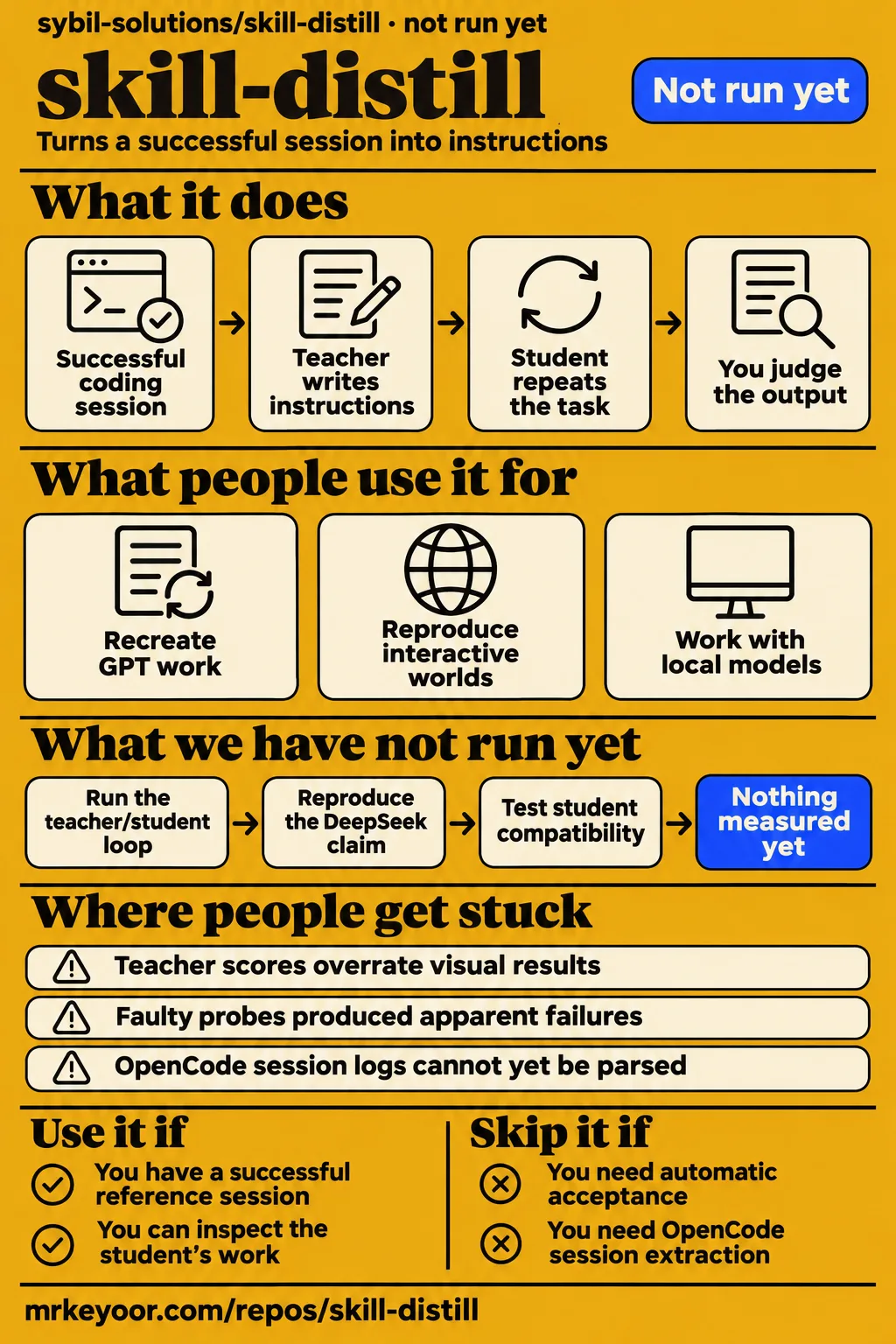
skill-distill's author reports that every feature survived the student runs, yet the user rejected the visual results. Use it if you want to investigate whether a particular open-weight model can repeat a successful coding task and you can judge the output yourself. Skip it if you need automatic acceptance from a model's score. Our lab attempt stopped before execution, so this review assesses the documented workflow and creator reports, rather than claiming a reproduced installation.
What people use skill-distill for
Creator 0xSero reports recreating GPT work with DeepSeek; the project's own instructions describe a more difficult outcome for interactive worlds. These are accounts from the creator, and they answer different questions about usefulness.
| Who used it | What they attempted | Reported outcome |
|---|---|---|
| Creator 0xSero | Recreate work originally completed with GPT | 0xSero says the work was recreated with a skill and DeepSeek. |
| Project author, in the documented visual experiment | Reproduce interactive worlds from a successful reference | Every trial had the features, but the user rejected the visual quality. |
| Creator 0xSero | Use local models alongside frontier models | 0xSero attributes 50% local AI usage to Skill Distill. This is a usage-share claim, not an accounting of money saved. |
The useful distinction is between repeating a result and deciding that the result is worth keeping. A developer with a successful agent session gets a concrete reference to compare against. That is a better starting point than asking a model to write reusable instructions from memory. But you still need to know what made the reference good, especially when a working button and a convincing interface are separate requirements.
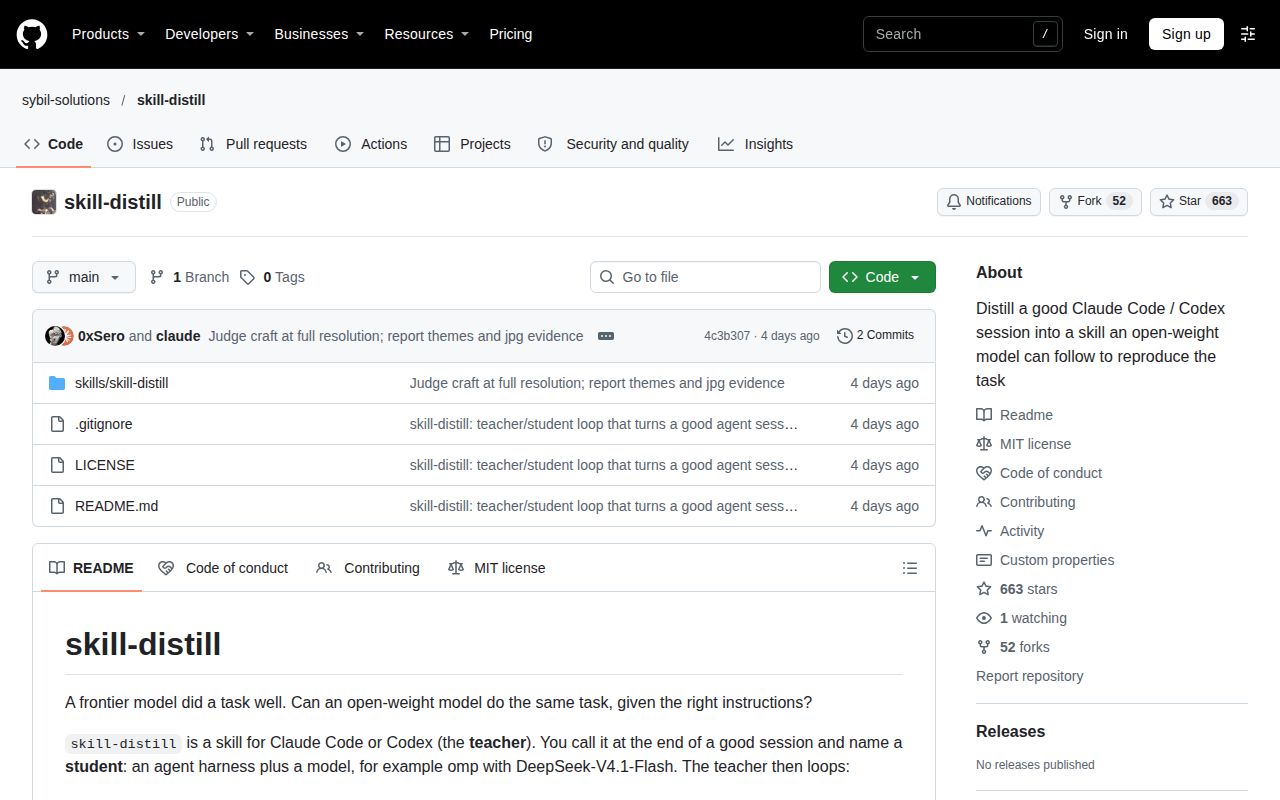
The name here means sybil-solutions/skill-distill. Several other projects use nearly the same words for extracting documents, building skills from articles or preserving session knowledge. This project's README defines its output as a skill for one task, one model and one harness, the software that gives the model its tools and runs its commands.
What happened when we ran it
The recorded sandbox configuration was 3 CPUs and 8 GB RAM, with no image specified. Those are configuration facts, not measured resource needs for the project.
| Recorded check | What happened | What you can conclude |
|---|---|---|
| Build/test runner | Not run: unsupported Python ecosystem in our runner; no Dockerfile | No installation, build or test result was produced. |
| Separate hands-on safety step | The safety check failed because no Compose file existed | The lab's Compose requirement blocked this attempt before application execution. |
| Hands-on run label | The label says it was deployed with its own Docker Compose | That description conflicts with the failed safety check; it is not proof of a running application. |
| Cleanup | Teardown reported success | Cleanup succeeded, without establishing that a student task ran. |
The safety log says unsafe repo: none of compose.yaml, compose.yml, docker-compose.yaml, docker-compose.yml exists (rule: a compose file is required). Here, “unsafe repo” is the runner's rejection label for a missing required file. It is not a security assessment of the project's code. The failure belongs to this lab route: the documented product is an agent skill with Python helpers, and its README describes cloning it and linking it into an agent's skills folder.
There is no honest install timing or passing-test total to put beside this attempt. The runtime and operating-system versions also require raw toolchain logs; the sandbox configuration alone cannot identify them.
Where people get stuck: a passing feature list can hide poor work
The author's teacher scored the visual trials 8.5–9, then the user rejected them immediately. In the author's account, the worlds looked similar at thumbnail size but were sparse and plain up close. That is the most useful finding in the project: its own judge could mistake feature coverage for equivalent quality.
For visual work, the instructions now call for matching regions captured at full resolution and 2× scale. The teacher must identify specific differences in object detail, density, typography and motion before assigning a score. You can use that procedure without accepting the teacher's taste as your own. A screenshot containing a tent does not answer whether that tent has the reference's shape, texture or surrounding detail.
| Problem the author documents | Response in the instructions | How to use that advice |
|---|---|---|
| Similar thumbnails concealed sparse worlds | Compare the same regions at full resolution and 2× scale | Review the craft before accepting a score. |
| Subjective requests for more detail gave the student too little guidance | Add a script measuring visible detail and mapping empty regions | Give the student a checkable target for the property you care about. |
| Apparent failures came from faulty probes | Rerun failing checks against the reference | Repair a broken check before changing the student skill. |
| Saved state disappeared on reload | Use Playwright add_init_script before application scripts run |
Inspect intermediate and completed states using the same procedure on both results. |
| The student reported success without trustworthy proof | Run checks independently and drive the application manually | Treat its final message as a report to investigate. |
All of those responses come from the project's judging instructions. They are process advice, rather than an accepted rerun of the rejected worlds.
The probe failures deserve particular attention. The author says a guessed storage key, Escape opening a pause menu and a missed dismiss click caused apparent application failures. If your check cannot operate the successful reference correctly, it cannot fairly reject the student. The instructions require identical interactions and state injections on both sides, including the middle and end of an application's core loop.
The teacher rewrites instructions, not model weights
skill-distill produces a task-specific instruction skill rather than fine-tuning a model. You start with a successful session, keep the original prompt unchanged and name a student model plus harness. The teacher then launches fresh copies of the starting state, compares results and repairs the skill at the first consequential divergence.
The division of work is practical. distill.py handles run bookkeeping, while the teacher decides what belongs in the instructions and whether the result matches. The author asks the teacher to write observable acceptance criteria and run scripted checks on the reference first. A reproducible starting state matters here: otherwise the student could inherit work from the successful session and appear more capable than it is.
The README requires three trials per skill version. It also prohibits putting the finished reference output, or a script that writes it, into the skill. That constraint is worth keeping if your purpose is to learn whether instructions help the student complete the task. Copying the answer would defeat that question, even if it produced an attractive comparison screenshot.
For your first evaluation, choose a task whose result you can inspect directly. Write down the outputs you require before starting the loop. If visual quality matters, include the details that made the original worth preserving; otherwise the teacher can optimise toward the easier feature checklist that failed the author.
omp has the documented student path
The README marks omp, also called oh-my-pi, as tested as a student harness. Codex is marked tested as the teacher, which is a different role. The adapter table distinguishes these paths explicitly.
| Harness | README status | Configuration or boundary |
|---|---|---|
| omp | Tested as student | Install the harness and point it at the chosen model. |
| Codex CLI | Tested as teacher | Student use needs a provider in STUDENT_ARGS. |
| Claude Code | Adapter written | Open models need ANTHROPIC_BASE_URL pointing at an Anthropic-compatible server. |
| pi | Written, untested | An adapter file is available, without the README marking student trials successful. |
| OpenCode | Written, untested | Its JSON session log has no parser in extract_session.py. |
The documented prerequisites are tmux, git, Python 3.10+ and a configured student harness. Web comparisons add Playwright, Pillow and Chromium. This is more preparation than installing a Markdown file: the teacher needs a student it can actually call, a recoverable starting state and a way to collect evidence from the result.
Credentials depend on the model service you select. The instructions begin by checking that the student answers at all, because a missing key, incorrect model identifier or unavailable server can otherwise look like a failed skill. Start with the named model endpoint working before interpreting a bad result as evidence about distillation.
Private traces and shareable skills need separate checks
Raw session logs stay in the Git-ignored runs/ directory, while the final skill needs its own inspection for secrets, private hostnames and personal data. The delivery instructions require that final inspection, even after the user accepts the result.
That separation makes sense: excluding a directory from Git keeps its files out of an ordinary commit, but says nothing about private details copied into a generated instruction. A local path can be useful during the experiment and inappropriate in a shared skill. Check both what you retain privately and what you distribute to another model or colleague.
The README says the session extractor drops system and AGENTS.md text. Treat that as a documented filtering behaviour, rather than a guarantee that a conversation contains nothing sensitive. The final inspection is still part of the project's own delivery procedure. For work involving private services or data, the instructions also ask you to record how each trial receives a clean copy of those outside resources.
skill-distill vs skill-distillery, Skill-Distiller and skills-evolve
Choose Sybil's skill-distill when the question is whether one named student can repeat a known successful session. The alternatives below start with different material or demand different proof. These are comparisons of their documented workflows, without a side-by-side performance ranking.
| Project | What its documentation starts from | Choose it when |
|---|---|---|
| sybil-solutions/skill-distill | A successful session, its original prompt and starting state | You want repeated student executions judged against that reference, with human acceptance. |
| kylezantos/skill-distillery | Articles, talks, ideas, recent work or an existing skill to audit | You need to design a skill from raw material. |
| xue160709/Skill-Distiller | An existing skill and multiple input cases | You want assertion-based optimisation with blind evaluation and keep/discard/rollback decisions. |
| agulli/skills-evolve | Recurring successful task trajectories | You need a procedure generalised from repeated work and checked on unseen instances. |
Skill Distillery's broader starting points suit a reader who has an article or an idea rather than a reference execution. Skill-Distiller's input-case directory suits someone who already has a skill and wants to improve it across examples. Neither distinction establishes that either project produces better results; it tells you which evaluation problem each workflow addresses.
The skills-evolve comparison exposes the boundary that matters most here. Its instructions require trying new instances of the task class. Sybil's central loop returns the student to the original prompt and starting state. Successful repetition gives you a reason to try a new task, but the new task needs its own evaluation.
What the other reviews get wrong
Talira's directory description says the loop runs until the student matches, while michabbb's X summary says later runs stay fully local. Both descriptions need the stopping and teacher rules from the project itself.
Talira describes repeated repair and trials until the student matches. The operator instructions also define unsuccessful stopping conditions: an iteration limit and a limit for repeated lack of improvement. The teacher must report what the student still cannot do. Matching is the objective, and human acceptance remains a separate decision.
michabbb's X summary claims the paid frontier run happens once and every later run stays fully local. The documented teacher continues to judge outputs, find divergences and rewrite the skill through the loop. You should budget for that teacher work whenever your teacher uses a paid service. The instructions do not promise that producing an acceptable skill takes only the original frontier session.
Talira also acknowledges the limited adapter status, so it would be unfair to describe its entire listing as a universal compatibility promise. The correction concerns completion: a loop with stopping rules can end with a useful failure report instead of a matching student.
Questions people ask
An open-weight model can attempt the same task using distilled instructions; 0xSero reports a DeepSeek recreation, while the author's visual experiment ended in rejection. Those creator accounts and judging notes support different outcomes, not a universal yes.
Can an open-weight model reproduce a frontier model's successful task given the right instructions?
0xSero says work completed with GPT was recreated using a skill and DeepSeek. The README's procedure repeats the original prompt from the original starting state; that is the specific reproduction question this tool addresses. It produces instructions for the selected task, model and harness, rather than generally improving the student's weights.
Is the student's result actually as good as the reference?
The student's result was not as good as the reference in the author's documented visual experiment: the user rejected worlds that the teacher rated highly. The instructions now require close visual comparison and the user's final acceptance. Feature completion and an automated score cannot answer that question for you.
What does skill-distill require?
The README lists tmux, git, Python 3.10+ and a student harness configured for its model. For web results it adds Playwright, Pillow and Chromium. It documents linking the skill into Claude Code or Codex and watching student sessions in tmux. These are upstream requirements, not an installation reproduced by our lab.
What we have not tested yet
We have not run the teacher/student loop, reproduced the DeepSeek claim, measured installation or evaluated student compatibility ourselves. Our sandbox stopped before execution. The author's rejected visual pilot is evidence about its own task, not our independent success-rate measurement. No accepted rerun appears in the judging account we read.
Independent success rates, transfer to unseen tasks and net cost savings are not established by the creator posts and project instructions. The 50% local-usage claim has no accompanying usage logs or cost ledger. A useful cost comparison would include teacher reviews and repairs, student trials, setup effort and human inspection, alongside the cost of completing the repeated task directly with the frontier model.
The research available for this review includes no independent Reddit or GitHub issue account demonstrating the workflow. The YouTube extracts contain no transcript, so they cannot support claims about what a video demonstrated. The similarly named bootcamp and document-extraction projects are separate entities. We also have no security audit, tested privacy guarantee, production reliability result or independent comparison against the alternatives.
Before moving a recurring job to your student model, retain the reference, save the produced skill and ledger, then judge a new instance against your actual acceptance criteria. That new instance is the missing result between repeating yesterday's success and depending on the workflow tomorrow.