mrkeyoor.com_
Tue 01 Sept 17:41 UTC
Self-Hostedevaluationupdated 26 Aug 2026

spacedrive review

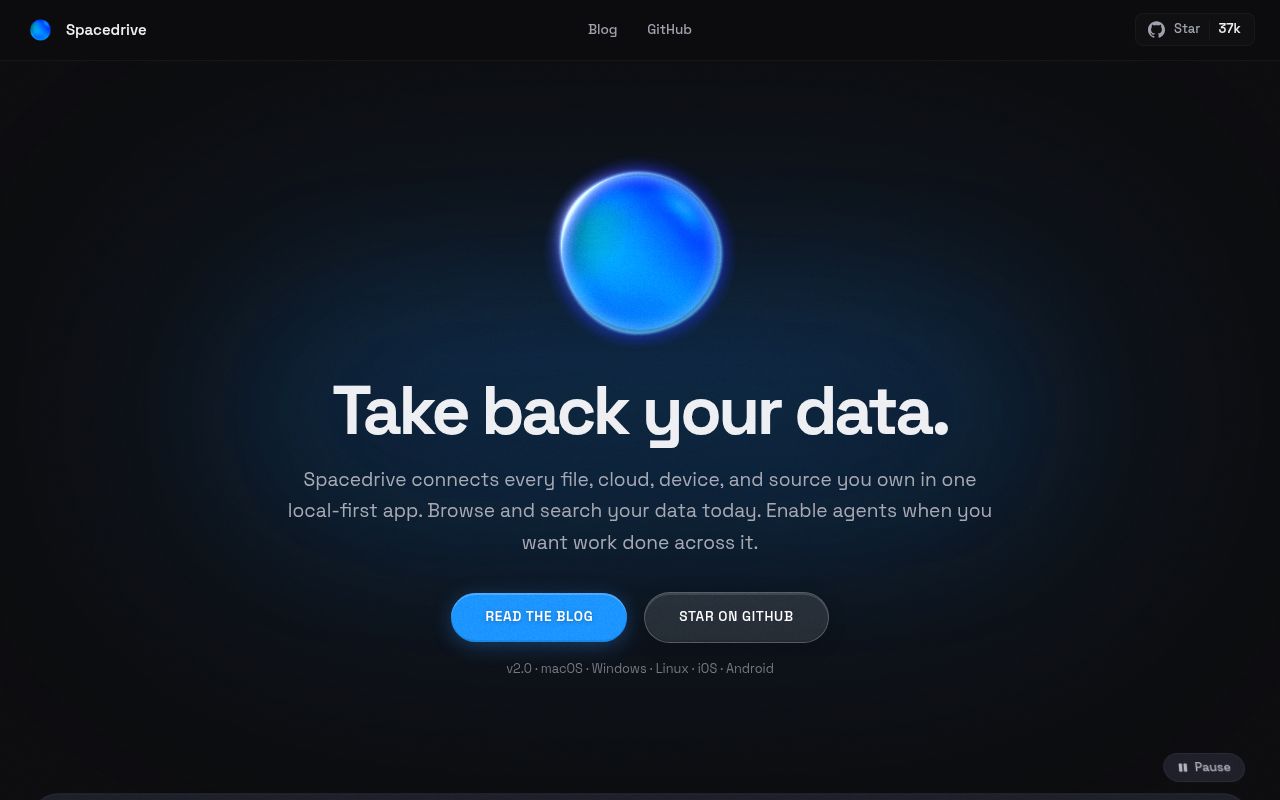
Spacedrive is a file catalog that puts local disks, other computers, cloud storage, and imported sources into one searchable view. It leaves files where they live, then adds shared metadata, peer-to-peer sync, previews, deduplication, and controlled access for automation.

+25stars / 7d
Verdict

Our Spacedrive install failed after 76 seconds at its Bun-only preinstall guard, which makes the current v2 alpha suitable only for developers testing with disposable data. Its content identity and offline catalog solve a harder problem than an ordinary file manager, but the reported deletion bug raises the cost of being an early user. Try it beside independent backups if cross-device indexing is the point; choose a narrower tool for daily file handling or folder sync.

We ran it

Lab card: what happened when we ran spacedriveScreenshot of spacedrive (spacedrive.com)
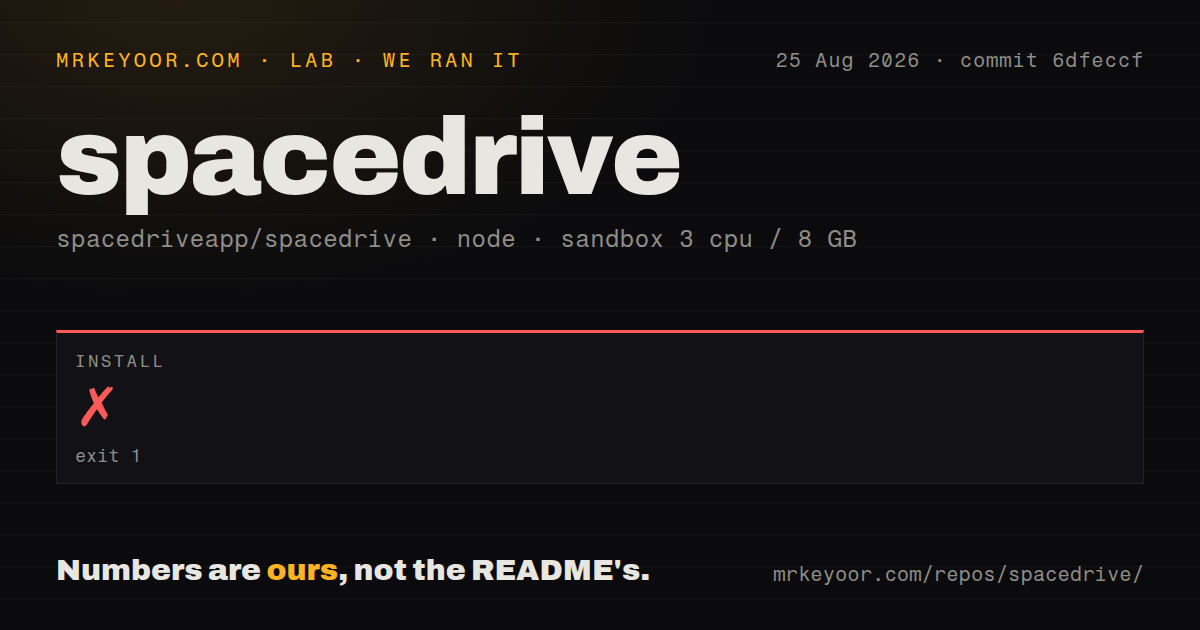
Install✗ · 76s
Build
Repo2917 files~323,090 lines of source · 45.4 MB · 6 CI workflows

Answers from our run

Does spacedrive build from source?

The dependency install failed, and the project has no separate build step. We cloned commit 6dfeccf into a clean Debian container with 3 CPUs and no project-specific setup.

Who should not use spacedrive?

Anyone unwilling to test with disposable data first: open issue 3056 reports that v2.0.0-alpha.2 deleted a nonempty root-level tmp folder on tracked Windows volumes.

What are the alternatives to spacedrive?

TagSpaces, Nextcloud, Syncthing. Our Spacedrive install failed after 76 seconds at its Bun-only preinstall guard, which makes the current v2 alpha suitable only for developers testing with disposable data.

Setup1/5Install stopped at the Bun package-manager guard after 76 seconds
Docs3/5Clear architecture, but the Linux quick start omits native packages
Community4/538,857 stars with code and issue activity in July and August 2026
Maturity2/5The v2 line is alpha with serious open file-safety reports

Discussed on

  1. hnSpacedrive – an open source cross-platform file explorer348 points
  2. hnSpacedrive – a cross-platform file explorer, powered by a distributed filesystem310 points
  3. hnSpacedrive is an open source cross-platform file explorer written in Rust14 points
  4. hnSpacedrive Alpha 0.1.09 points

Who it’s for

People whose files are split across computers, external drives, NAS boxes, and cloud accounts.
Developers who want a Rust file index with a headless server, typed APIs, and an embeddable web interface.
Self-hosters willing to test alpha software against copied data before trusting its file operations.
Teams designing agent access to files through permissions and structured actions instead of unrestricted shell access.

Who it’s NOT for

Anyone unwilling to test with disposable data first: open issue 3056 reports that v2.0.0-alpha.2 deleted a nonempty root-level tmp folder on tracked Windows volumes.
Linux contributors expecting the README quick start to cover a clean machine: open issue 3087 documents omitted native packages and a bootstrap failure in just setup.
Organizations that need an OSI-approved license or permission to sell a hosted file service today: FSL-1.1-ALv2 restricts competing and managed services before each version converts to Apache 2.0 after two years.
People seeking a finished cross-platform daily driver: the v2.0.0-alpha.2 release says many features do not work and that macOS is the most stable target.

Setup reality

Our commit 6dfeccf checkout contained 2,917 files, about 323,090 source lines, and 45.4 MB. In a fresh Debian container with 3 CPUs and 8 GB of RAM, installation failed with exit 1 after 76 seconds. The log shows bun x only-allow bun, six dependencies resolved, a saved lockfile, and an instruction to use bun install. No build or test result was recorded.

The README requires Rust 1.81 or newer, Bun 1.3 or newer, just, and Python 3.9 or newer. Local-first use does not advertise a hosted account requirement. Cloud volumes need their respective services, while Spacebot is a separate optional process with its own pairing and permission setup.

Desktop, mobile, server, web, native media, and OS integration live in one monorepo. The v2.0.0-alpha.2 notes say FFmpeg is not bundled on Windows, Linux, or server builds, so thumbnails do not work there in that release. An open Linux issue also says the quick start omits required system packages.

Spacedrive catalogs files without moving them

Spacedrive sits above Finder, Explorer, and ordinary Linux file managers. A file can remain on a laptop, NAS, external disk, or cloud volume while its metadata appears in one library. Offline devices stay in the catalog with their contents marked unavailable. Script adapters can also bring Gmail, Apple Notes, browser history, Obsidian, Slack, calendars, contacts, and GitHub into the same search surface. This is useful when the problem is remembering where data lives, rather than copying all of it into one new folder tree.

The scope is much larger than a desktop shell. Our 45.4 MB checkout contained 2,917 files and about 323,090 source lines. A Rust core handles SQLite data, BLAKE3 identities, jobs, search, encryption, and peer communication over Iroh and QUIC. Tauri supplies the desktop app, React Native covers mobile, and the monorepo also contains a web client, CLI, and headless server. Six CI workflow files were present, while our scan found no Dockerfile and no directory named tests.

What happened when we ran it

Our run at commit 6dfeccf used an unprivileged Debian container with 3 CPUs, 8 GB of RAM, Node 22, and no secrets. Installation failed with exit 1 after 76 seconds. The final log shows bun x only-allow bun, six dependencies being resolved, and a lockfile being saved. The preinstall script then printed a direct instruction to use bun install for this project. That is the measured outcome; the log does not show a Rust compiler error or a missing native library.

The failed install prevented any recorded build or test result. Spacedrive's README points contributors to just setup, which requires Rust 1.81 or newer, Bun 1.3 or newer, just, and Python 3.9 or newer. A separate open issue reports that this route still fails on a fresh Ubuntu machine because native packages are omitted and the first cargo xtask setup call cannot see an alias that the setup process creates. That issue is separate from our 76-second package-manager failure.

Content identity is the reason to accept the complexity

Paths are poor identities for files spread across several machines. Drive letters change, folders move, and identical bytes can sit under unrelated names. Spacedrive assigns BLAKE3 content identities and uses a universal SdPath across devices. That model supports redundancy checks and deduplication without assuming that every file is mounted or online. Cloud volumes for S3, Google Drive, Dropbox, OneDrive, Azure, and Google Cloud Storage appear beside local locations instead of becoming a separate browsing mode.

File operations are represented as actions that can be previewed and approved, then continued as durable jobs after an interruption. Metadata uses leaderless synchronization, while file bytes remain on their source devices until requested. The same 323,090-line codebase can pair with the separate Spacebot runtime and apply permissions by device, path, and operation. Optional screening can quarantine imported records before an agent searches them. The design is thoughtful, though each added surface creates another place where an alpha defect can affect real data.

The v2 alpha requires copied data and independent backups

Open issue 3056 reports that v2.0.0-alpha.2 deleted a nonempty folder named tmp at the root of a tracked Windows volume when Spacedrive started. The reporter says the behavior reproduced on multiple volumes and did not appear in daemon logs. We did not reproduce or test that claim in our sandbox. A file manager has a low tolerance for this class of report, so the sensible trial uses copied files on a disposable volume while the original remains outside Spacedrive's reach.

The alpha.2 release published on February 7, 2026 says many features do not work, calls macOS the most stable platform, and says FFmpeg is not bundled with Windows, Linux, or server builds. Its notes warn that thumbnails will not work on those targets. Another open report describes both macOS instances crashing during pairing and then appearing offline. GitHub listed 54 open issues and pull requests when fetched, so the queue is modest for a project this broad, but the unresolved items touch core daily behavior.

The current license restricts hosted competition for two years

Spacedrive uses FSL-1.1-ALv2 rather than an OSI-approved open-source license. It permits internal use, modification, redistribution, education, and research, while barring competing products and several managed service categories. Each released version converts to Apache 2.0 on its second anniversary. An August 2026 maintainer issue documents consent for surviving contributions made before the change from AGPL; seven of nine named contributors were checked off when we read it. A company planning redistribution or a hosted product should review the exact version and provenance record.

Development has resumed since the funding pause announced with stable release 0.4.3 in March 2025. The v2.0.0-alpha.2 prerelease arrived in February 2026, the measured commit was pushed on July 29, and issue discussion continued in August. The repository had 38,857 stars when fetched. Those are signs of attention, not proof that the alpha is safe for irreplaceable files. Spacedrive earns a trial when one searchable layer across devices and clouds is the requirement; TagSpaces, Nextcloud, or Syncthing is easier to justify for a narrower job.

Alternatives

ProjectWhat it isPick it when
TagSpacesA local file organizer built around tags, sidecar metadata, and ordinary folders.pick this instead when local organization matters more than a distributed device and agent layer.
Nextcloud gh↗A centrally hosted file sync and collaboration server with a mature app ecosystem.pick this instead when shared server storage and established collaboration features matter more than peer-to-peer indexing.
Syncthing gh↗A focused peer-to-peer folder synchronization tool without a universal file catalog.pick this instead when reliable folder replication is the job and you do not need Spacedrive's metadata or agent model.

What people are saying

  1. [github-trending] spacedriveapp/spacedrive

Sources

  1. Spacedrive README
  2. Spacedrive repository facts
  3. Spacedrive 0.4.3 release
  4. Spacedrive v2.0.0-alpha.2 release
  5. Open root-level tmp deletion report
  6. Open Linux quick-start dependency report
  7. FSL relicensing consent record

More self-hosted reviews

v2 · OpenShell · wigolo · Mindwtr · club-3090 · reclip · the whole board →