mrkeyoor.com_
Tue 20 Oct 07:39 UTC
LLM Toolsevaluationupdated 20 Oct 2026

smg review

Shepherd Model Gateway, or SMG, routes requests across existing language-model servers and cloud providers. It manages workers and routing policies, including a documented cache-aware policy that considers workers' cached prompt content.

Verdict

SMG's documented cache-aware routing makes it a candidate for teams with an existing inference fleet. The supplied build and test steps at commit bc9ea78 each timed out at 900 seconds, leaving correctness and serving behavior unverified. Evaluate the exact gateway artifact and worker-registration path before replacing an existing routing layer.

We ran it

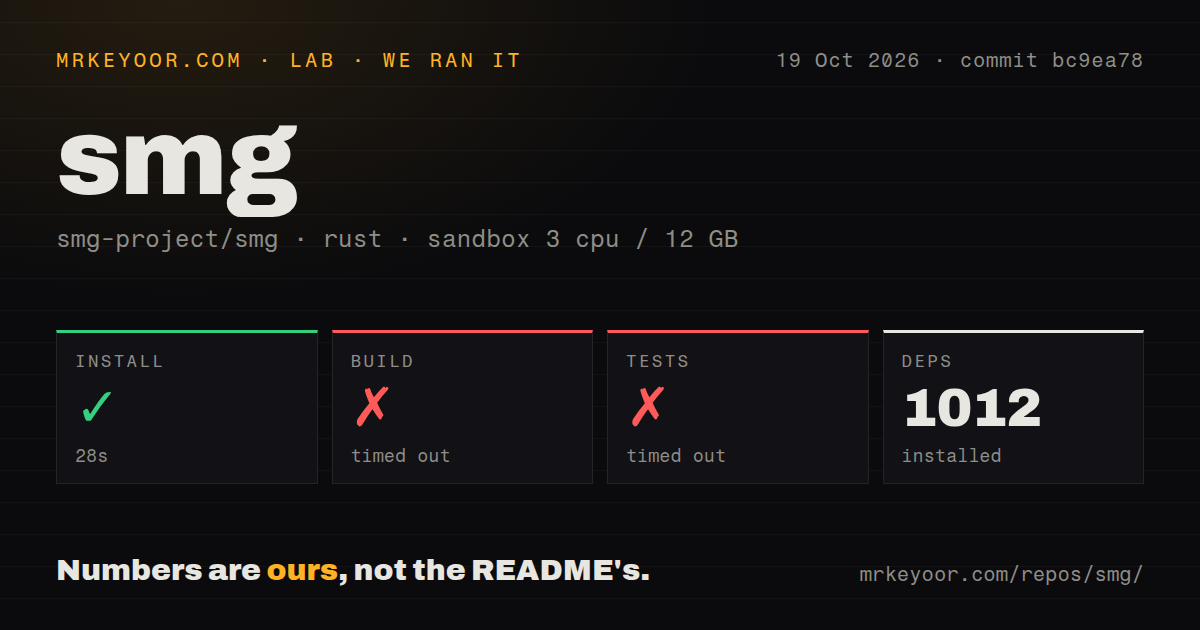
Lab card: what happened when we ran smgScreenshot of smg (lightseek.org/smg)
Install✓ · 28s1012 packages
Build✗ timed out · 900s
Tests✗ timed out · 900sran, no count parsed
Repo2293 files~927,503 lines of source · 44.8 MB · 42 CI workflows

Answers from our run

Does smg build from source?

Dependencies installed in 28 seconds (1012 packages), and the build failed. We cloned commit bc9ea78 into a clean Debian container with 3 CPUs and no project-specific setup.

Do smg's tests pass?

We could not finish them: the suite was still running after 15 minutes in our container.

Who should not use smg?

Developers seeking a standalone local model runner: the gateway quick start expects inference-worker URLs.

What are the alternatives to smg?

LiteLLM, Envoy. SMG's documented cache-aware routing makes it a candidate for teams with an existing inference fleet.

SetupN/AInstallation completed, but build and test timeouts left setup through a working gateway deployment unassessed. The short README launch command is not evidence that integration with an intended worker succeeds.
DocsN/AThe supplied README and release notes explain installation choices, worker URLs and deployment changes. They support describing those requirements, but do not establish documentation completeness or successful task completion, so no numerical rating is assigned.
CommunityN/AThe supplied release notes and worker-registration report show public project activity. Support responsiveness was not assessed. Repository API metadata could not be independently inspected, so this review makes no last-push claim.
MaturityN/AThe source build and test steps did not complete within the cap. Serving behavior, release-artifact correctness and operational reliability remain unassessed; a timeout does not establish that the gateway is broken.

Who it’s for

Platform teams already operating inference workers and evaluating cache-aware routing.
Operators who can validate HTTP or gRPC integration against their exact worker versions.
Teams prepared to complete deployment and correctness checks before changing a serving fleet.

Who it’s NOT for

Developers seeking a standalone local model runner: the gateway quick start expects inference-worker URLs.
Operators requiring a completed source build and test result within the supplied sandbox cap: both steps timed out at 900 seconds.
Teams treating a documented backend listing as proof that their exact transport, registration and request configuration works.

Setup reality

The supplied SMG run at commit bc9ea78 completed installation in 28 seconds and recorded 1,012 dependencies. The build and test steps each timed out at 900 seconds. The test-log tail still showed compilation, including pyo3, smg-client and openapi-gen. No completed suite summary or dependency-audit result was supplied.

The README lists Docker, Helm, Python and Rust installation paths; its Cargo route requires protoc. Its gateway quick start points SMG at existing inference workers. These are documented setup paths, not successful deployments established by this run. Chat-history storage is separately configurable.

The recorded sandbox had 3 CPUs, 12 GB RAM and image lab-rust:1. Actual runtime versions remain unverified. The log tail contains no compiler error or confirmed timeout cause. Installation completion therefore does not establish a working gateway. Validate the intended gateway artifact with your own worker, including registration and a request through the gateway, before replacing an existing routing layer.

SMG needs inference workers before its routing can help

Shepherd Model Gateway is a candidate for teams evaluating cache-aware routing across an existing inference fleet. Its gateway quick start launches SMG with worker URLs, then sends a chat request through the gateway. The workers serve the model. A reader seeking a standalone model runner should account for that separate serving requirement.

The README describes cache-aware routing that tracks each worker's KV-cache state in radix trees. It also documents HTTP and gRPC transport and separation of prompt processing from token generation. These are capabilities to evaluate against an actual deployment. Our sandbox did not measure cache reuse, request latency or GPU utilization.

What happened when we ran it

Our supplied run checked out commit bc9ea78 on October 19, 2026. Installation completed in 28 seconds and recorded 1,012 dependencies. The build and test steps each timed out at 900 seconds. The test-log tail still showed compilation, including pyo3-build-config, smg-radix-tree, pyo3, smg-client and openapi-gen. It contains no completed suite summary, so it establishes neither a passing-test count nor a failing-test count.

The sandbox configuration specified 3 CPUs, 12 GB RAM and image lab-rust:1. That image label does not establish the actual Rust or operating-system version. The checkout contained 2,293 files, about 927,503 source lines and 44.8 MB. The scan found 42 CI workflow files, no Dockerfile and no tests directory. Those scan results do not establish test coverage or invalidate the README's published-container installation path.

The excerpt identifies no compiler error or reason for the timeouts. Source-build completion and correctness remain unverified, and no dependency-audit result was supplied. This run limits what we can conclude about the product; it does not demonstrate a serving failure.

Decide whether the routing policy justifies a gateway

The README lists cache_aware, least_load, round_robin and passthrough among its routing policies. For a fleet handling repeated prompt prefixes, the documented cache-aware policy gives operators a specific capability to evaluate. For a single engine, first identify which routing requirement would justify operating another service.

The documented backends include SGLang, vLLM, TensorRT-LLM, TokenSpeed and MLX, alongside cloud providers and compatible endpoints. A backend listing does not verify a particular engine build or deployment configuration. Acceptance checks should cover worker registration, streaming, cancellation and retry ownership. These are proposed checks, not results from our run.

SMG also documents MCP tool discovery and execution with approval policies and audit logging. Chat history can use PostgreSQL, Oracle, Redis or memory. Decide whether these responsibilities belong in your gateway before enabling them.

Check worker registration and gateway readiness separately

Issue 3496 reports a dynamic HTTP worker-registration failure against v1.12.0. According to the reporter, registration probes /health before configurable health settings take effect. A backend exposing /healthz while returning 404 at /health remained pending. This is an attributed user report, not a failure reproduced in our sandbox. It does not establish whether commit bc9ea78 or v1.13.0 has the same behavior.

The v1.13.0 release notes, dated October 15, 2026, describe a separate gateway-readiness concern. Helm's readiness probe moved to /readiness. For a router whose workers register only through the admin API, the notes instruct operators to set router.readinessProbe.path to /health. That setting controls gateway readiness; it is not evidence that the worker-registration report has been fixed.

The same release notes describe startup failures for unreachable PostgreSQL or Redis stores, a mesh that cannot start and malformed settings. Read those requirements against your deployment before upgrading. The measured checkout is identified by commit bc9ea78; this review does not equate it with the v1.13.0 release artifact. The project's release benchmarks are not measurements from our sandbox and do not establish performance for your fleet.

Choose by the operating problem

LiteLLM documents virtual keys and spend tracking. Consider it when provider access administration and spending controls drive the gateway decision. Envoy describes itself as an edge, middle and service proxy. Consider it for general service traffic when model-worker policy can remain elsewhere. These are evaluation suggestions based on the projects' descriptions. Neither alternative was tested or benchmarked in this run.

For SMG, begin with one existing worker and the registration path your deployment will use. Complete source-build and correctness validation, or validate the distributed artifact you intend to deploy. Before replacing a routing layer, check streamed requests, cancellation and worker failure against that artifact. A successful route through your intended worker configuration is the next useful result.

Alternatives

ProjectWhat it isPick it when
LiteLLM gh↗An AI gateway that documents virtual keys and spend tracking.Consider it when provider access administration and spending controls drive the gateway decision. This suggestion follows its documentation; neither alternative was tested in the supplied run.
Envoy gh↗An edge, middle and service proxy.Consider it for general service traffic when model-worker policy can remain elsewhere. Validate the configuration you need; this review provides no comparative performance result.

What people are saying

  1. [github-trending] smg-project/smg

Sources

  1. Shepherd Model Gateway README
  2. SMG releases, including v1.13.0 upgrade notes
  3. SMG v1.12.0 worker-registration report, issue 3496
  4. LiteLLM README
  5. Envoy README

More llm tools reviews

dsh-context · dsh-purge · AIStudio2API · GLM-5.3-Flash-EXL3-2x-DGX-Sparks-TensorFold · livenerf · scion · the whole board →