Envoy belongs in shared traffic infrastructure
Envoy is a programmable proxy for traffic entering a system and traffic moving between services. Its configuration describes listeners, routes, upstream clusters, load balancing, filters, authentication, telemetry, and transport behavior. That breadth lets a platform team give many applications the same network policy without adding matching libraries to every codebase. It also means Envoy is infrastructure, with failure modes that can affect every service behind it.
The measured checkout contained 14,590 files, about 1,929,489 source lines, and 157.7 MB at commit c42887c. This is not a small reverse proxy whose complete configuration fits comfortably in one screen. It is a C++ data plane with APIs, contributed Golang filters, protocol implementations, extension systems, build tooling, and security machinery. The repository had 59 GitHub Actions workflow files, another sign that many separate paths need verification.
Dynamic control is useful when static files stop scaling
Envoy can take changing configuration from an xDS control plane rather than requiring each proxy to be managed by hand. That model suits service meshes and gateway platforms where endpoints, certificates, policies, and routes change often. The proxy remains the data plane, while another system decides what it should do. Teams gain centralized behavior and can use health checks, retries, observability, and policy consistently across services.
Version 1.39.0, published on 2026-07-14, shows how wide that control surface has become. Its release notes cover routing, DNS, load balancing, TLS, OAuth2, OpenTelemetry, rate limiting, Redis, QUIC, Wasm, Golang filters, and dynamic modules. It also adds work around MCP and other AI protocols. Each feature can solve a concrete platform problem, but each enabled filter or protocol needs a named owner, a test, and a rollback path.
What happened when we ran it
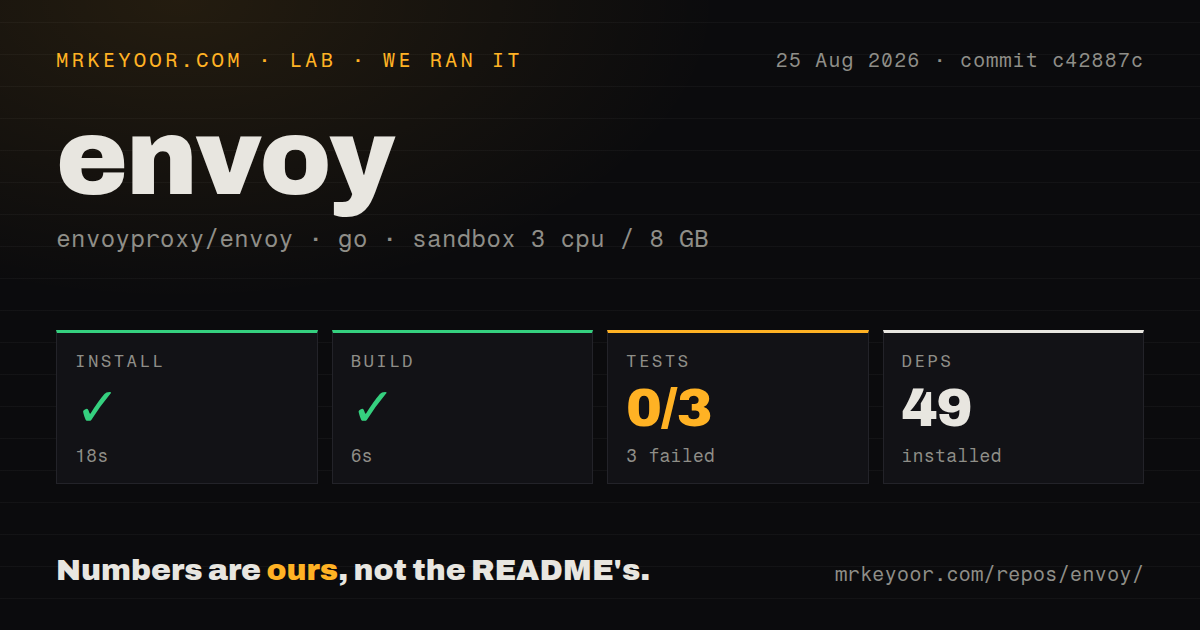
Our Go-path install succeeded in 18 seconds inside a fresh Debian container with 3 CPUs and 8 GB of RAM. It installed 49 packages. The detected build then succeeded in 6 seconds. Those results cover what the harness found in Envoy's Go ecosystem, including contributed extension code; they are not a timing claim for compiling the main C++ proxy through Bazel.
Tests failed after 18 seconds. The run attempted 3 Go tests, and all 3 failed. The final summary identifies github.com/envoyproxy/envoy/api/test/build as a setup failure, while several contributed packages report that they have no test files. The provided log tail ends at FAIL and does not include the setup exception, so blaming a missing package, network restriction, or code defect would be guesswork.
That boundary matters for evaluation. A 6-second detected build does not prove that a production Envoy binary, chosen extensions, bootstrap configuration, and control-plane interaction work together. Before rollout, build or obtain the exact distribution you intend to run, validate its configuration, send representative HTTP and gRPC traffic through it, and test rejected configuration. Our failed 3-test run says the generic Go test command was not a clean proof point on this checkout.
Release 1.39.0 demands careful upgrades
The latest release moves source builds to Bazel 8 and documents required flags because the project still uses WORKSPACE mode. It also changes behavior in TLS validation, tracing sampling, header matching, DNS clusters, and several routing paths. Some changes have runtime guards or opt-in migration steps. Operators should read the version-specific release notes and move through a staging fleet before production, especially when configuration depends on a default that changed.
The security section of v1.39.0 names fixes across more than 10 affected areas, including HTTP/2 cookie accounting, HTTP/3 QPACK handling, external authorization, OAuth2, DNS validation, internal redirects, TCP StatsD, and Zstd decompression. The OAuth2 cookie change has an explicit migration sequence rather than an automatic flip. A proxy at a trust boundary needs that release discipline. Pinning an old image because upgrades feel risky simply trades visible migration work for known exposure.
Current issues show why component-level tests matter
On 2026-08-25, one open bug reported that Cache V2 treats responses without a Date header as stale. Another current report says c-ares 1.34.8 query-ID reuse can permanently stall automatic DNS refresh for a cluster. These are narrow reports, not reasons to reject Envoy outright. They are good examples of proxy behavior that can look like an application or upstream outage unless dashboards and tests name the component involved.
GitHub reported 1,878 open issues and pull requests, while an issue-only search returned 1,599 open items. The repository was pushed on 2026-08-25, and those current reports were receiving updates. This is active maintenance with a large queue, not a quiet finished product. Buyers should search that queue for every filter, protocol, and platform they plan to enable, then track the relevant labels after deployment.
ppc64le does not get the normal security promise
Envoy documents third-party security audits from 2018 and 2021, ongoing fuzzing, a private GitHub advisory route, and a separate security release process. That is appropriate for a network proxy. The README also draws a sharp architecture boundary: ppc64le builds are best effort and are not covered by the Envoy security policy. An organization standardizing on that architecture should treat the exclusion as a purchasing constraint.
For supported platforms, the project offers serious engineering and an equally serious operating obligation. Our checkout's 59 workflows and 1.93 million source lines explain why a blanket health check says little about one deployment. Envoy pays off when a platform team can define configuration ownership, canary changes, watch protocol-level metrics, subscribe to security notices, and reproduce failures against its chosen build. Without that discipline, a smaller proxy is easier to reason about.