The repository follows 137 videos instead of one application
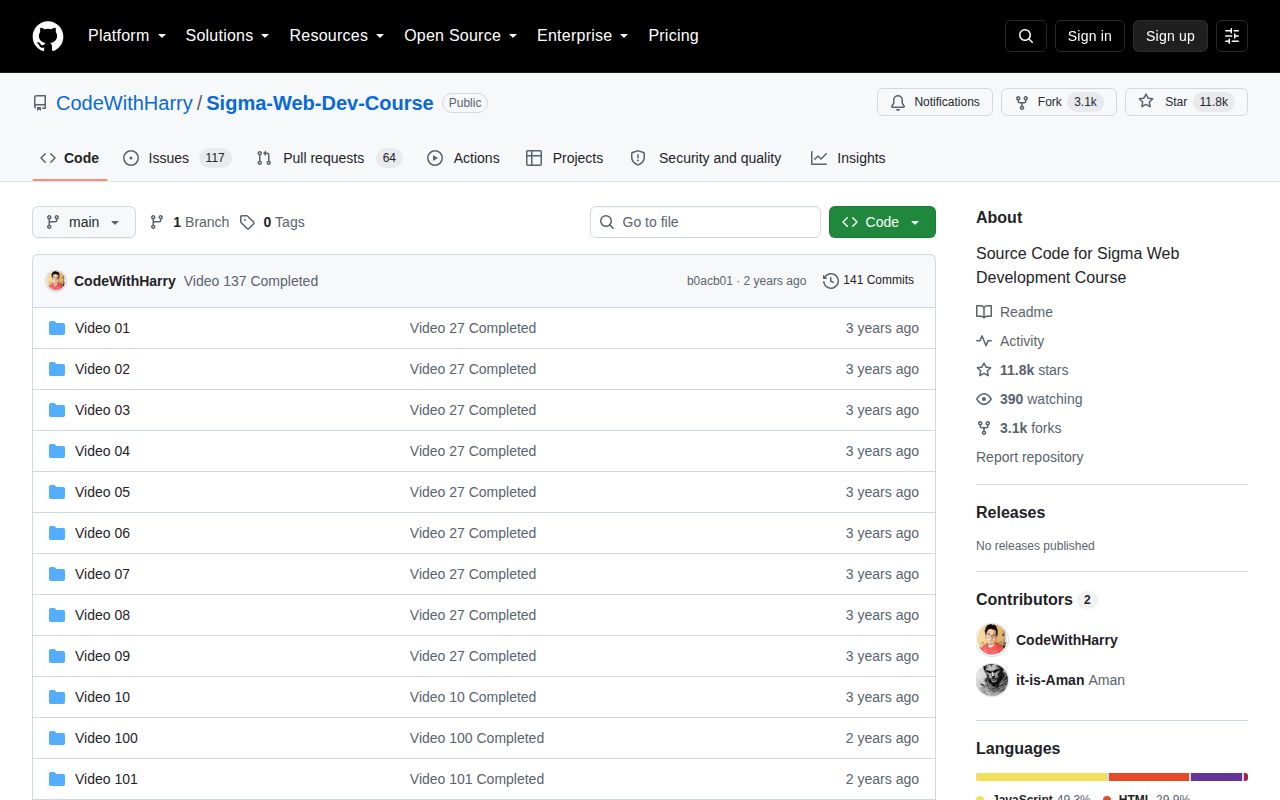
Sigma Web Dev Course is arranged as numbered lesson folders, starting with small HTML pages and moving through CSS, JavaScript, Tailwind, React, and backend examples. The tree reaches Video 137, with a separately named Spotify clone at Video 84. That layout makes sense beside the Hindi YouTube playlist because a learner can open the folder that matches the current lesson and compare files. Without the video, many folders are snapshots rather than explanations.
The root README is under 200 words and stays at the promise level: beginners through intermediate developers, frontend and backend work, databases, and projects. It does not list the 137 videos, link topics to folders, name software prerequisites, or explain which subprojects need an install. The page is written in English and explicitly says the course is exclusively in Hindi. English readers have a readable overview, not English course documentation.
Video 101 is a two-package frontend exercise
Our measured project lives in Video 101, not at the repository root. Its package file has Vite and Tailwind CSS as the 2 direct dependencies, a development command, and a Tailwind build command. This is a compact lesson project with an HTML file and input and output CSS. It should be judged as course material from one point in the sequence, not as an architecture chosen for all 911 files.
That distinction matters later in the tree. Other folders contain React applications, Express examples, a Spotify clone, and backend work with their own package files. There is no workspace manifest tying them together and no root command that prepares every lesson. A student should enter the folder named in the video and read its files before installing anything. Running npm at the repository root will not reproduce the Video 101 result.
What happened when we ran it
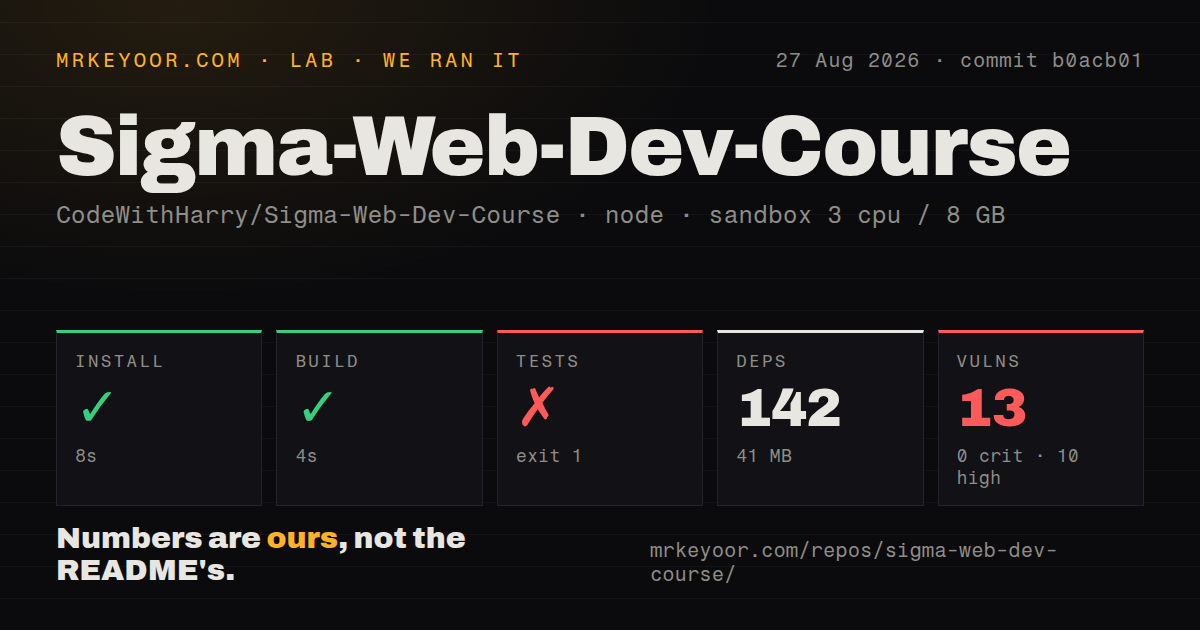
Our sandbox installed 142 packages in 8 seconds and used 41 MB on disk for Video 101. The build succeeded in 4 seconds. We tested commit b0acb01 in an unprivileged Debian container with 3 CPUs, 8 GB of RAM, no secrets, and the lab-node:22 image. Those figures apply only to the measured lesson directory.
The test command failed with exit code 1 after 2 seconds. Its complete message was the standard package placeholder: Error: no test specified. The log does not show a broken assertion or environment problem because no test suite ran. Our scan likewise found no tests directory, CI workflow, or Dockerfile. A successful lesson build therefore says the assets compile; it provides no automated check for the page's behavior.
npm audit reported 13 known vulnerabilities in the installed dependency tree: 10 high and 3 moderate, with none critical or low. That result belongs to the exact sandbox install, not every folder in the course. It is still a reason to avoid copying the lockfile into a public deployment without reviewing and updating dependencies. A learner following the historical video may need help separating the lesson's concept from an old package version.
Missing assets and answers can interrupt the playlist
Open issue 306 says the Netflix clone section images are missing and notes that the live Netflix site has changed. Issue 273 exists because a Video 73 challenge solution disappeared from YouTube comments; the reporter placed code and an attachment in the issue. These are specific costs of a video-linked archive. External pages, comments, and commercial-site assets do not remain fixed just because the matching source folder does.
Deployment questions also sit unresolved in the issue queue. Issue 243 reports that playlists and songs do not appear after a Spotify project is deployed to GitHub, while issue 198 points to the wrong main file in a backend password-manager package. A beginner can learn from diagnosing either problem, but the root documentation does not provide a troubleshooting index. Expect to search issues, video comments, and nearby folders when the lesson result differs from your machine.
The 181-item queue is active but poorly curated
GitHub listed 181 open issues and pull requests combined and 11,839 stars when fetched. The repository's last push was November 5, 2024, yet people were still opening issues and pull requests in 2026. That is ongoing learner activity without matching evidence of recent repository maintenance. Many open titles are vague, so the combined count is a support burden as much as a community signal.
There is no latest GitHub release, and the repository API reports no license. The Video 101 package declares ISC for that package, but it does not settle permission for the course repository, images, audio, or dozens of other lesson folders. Treat the code as material to study alongside the playlist. Ask before redistributing a derived course bundle or presenting the examples as your own template collection.
It works best as Hindi video companion code
Sigma lowers the friction of following a long video course because the exact files are already separated by lesson. The 8-second install and 4-second build in Video 101 show that at least the measured frontend exercise starts without ceremony. For a Hindi-speaking beginner who pauses the playlist, types the code, and compares the result, that is useful.
The repository is a weak choice for independent study or production reuse. Its short README cannot replace the videos, the measured package has no tests, and 13 audit findings need attention before deployment. Use each folder as a dated classroom snapshot, verify what you copied, and choose a maintained starter when the goal shifts from learning to shipping.