Servo is an engine project, not a finished browser
Servo implements web layout, scripting, graphics, networking, media, accessibility, and platform integration in a mostly Rust codebase. ServoShell is the demonstration browser around it, while embedders can target the engine APIs. The README uses the word prototype, which should frame every adoption decision. This is a place to develop browser technology and evaluate embedding, not a Chrome replacement for ordinary users.
Our checkout makes the scale plain: 194,738 files, about 5,217,779 source lines, and 777.5 MB on disk. Servo includes a large Web Platform Test tree alongside Rust crates, Python orchestration, platform projects, and generated or vendored material. Even a narrow contribution enters one of the largest kinds of software system.
Parallel Rust architecture is the reason to care
Servo began around the idea that browser work could be split more safely and concurrently than older engine designs allowed. Rust remains central, and current development covers layout, DOM behavior, graphics, WebGPU, media, networking, devtools, accessibility, WebDriver, Android, and OpenHarmony. Embedding work lets applications host web views without adopting ServoShell as their user interface.
That ambition does not erase standards gaps. An August 2026 tracking issue still lists unfinished DOM selection, word and paragraph selection, image selection, automatic scrolling, RTL caret placement, and user-select. Another issue covers how accessibility bounds should update after layout. For a 5.2-million-line tree, individual missing interactions can remain product-blocking even while broad standards work advances.
What happened when we ran it
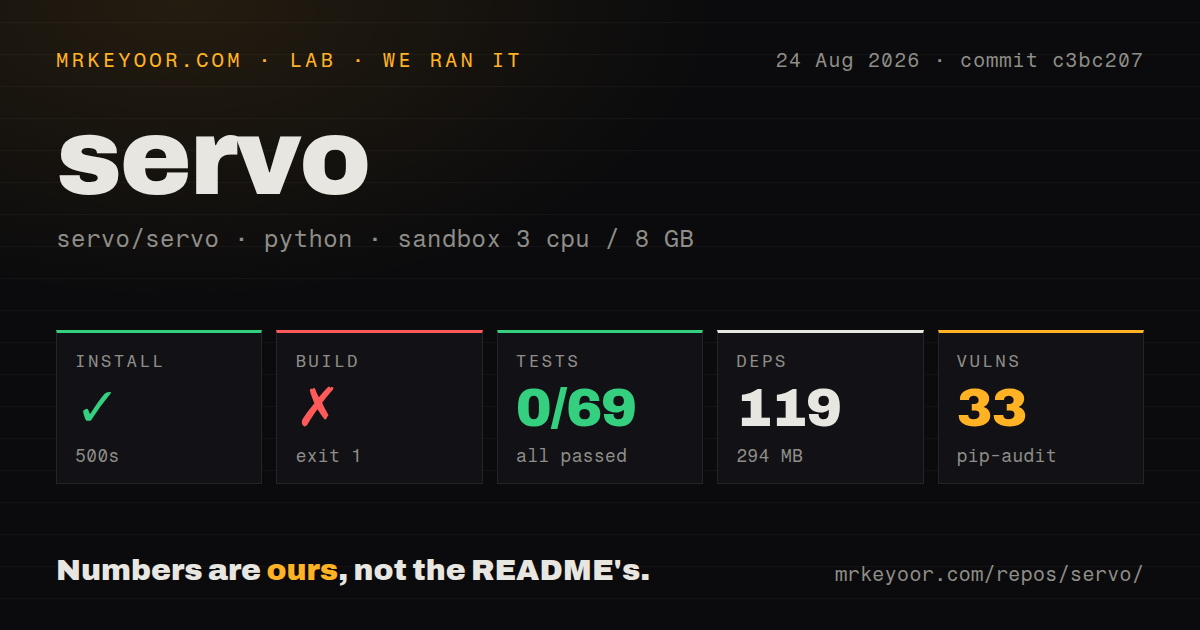
In our Python 3.12-oriented sandbox image, installing the mach tooling environment took 500 seconds. It added 119 packages and occupied 294 MB. The audit reported 33 known vulnerabilities. Those are findings from the Python environment our harness installed, not a claim that 33 exploitable defects exist in Servo's Rust engine.
The build stopped after 16 seconds with exit code 1. The only supplied tail lines were two SyntaxWarning messages in a Web Platform Test protocol server, both warning that is was used with the literal 1 where == may have been intended. Since the tail did not contain the terminating error, we cannot say those warnings caused the failure.
Pytest then exited 3 after 17 seconds. It reported zero passed and zero failed tests because all 69 entries ended as collection or setup errors. The traceback passed through Python 3.11 argparse, where parsing raised SystemExit: 2, and the summary said 69 errors in 3.79s. Our command never produced a substantive test result.
Bootstrap is a platform toolchain job
The normal desktop path installs uv, rustup, and native dependencies through ./mach bootstrap, then builds with ./mach build. macOS needs Xcode and Homebrew. Windows needs a recent SDK, Visual Studio 2022 C++ tools, and ATL. Linux begins with distribution packages before mach supplies the rest. No repository Dockerfile provides a common build box.
Android adds NDK 28.2.13676358, build-tools 36.0.0, platform 37, an emulator image, and SDK environment variables. OpenHarmony adds separate SDK paths, build flavors, and valid signing configuration. A tooling install that already took 500 seconds on our box is only the first layer. Pick one supported target and follow the Servo Book instead of improvising a universal setup.
The test tree needs project-specific commands
Servo carries Web Platform Tests because browser correctness is defined by a huge shared standards suite, not a handful of unit tests. The repository also has 24 CI workflow files and an active stream of intermittent-test issues. One current CSS Grid report says three alignment subtests often return width 70 when 100 is expected. That is a concrete layout discrepancy, not a generic flake label.
Our 69 pytest errors do not measure Web Platform Test conformance. They show that a generic pytest collection command is wrong or incomplete for this checkout and environment. Contributors should use mach commands and the documented suite selection. The lab result is still useful: calling pytest at the root produces internal argument parsing rather than a helpful redirect to the supported runner.
Version 0.4.0 is active across many platforms
Version 0.4.0 was published on August 4, 2026, and the repository was pushed on August 25. GitHub reported 3,149 open issues and pull requests combined. Same-day work covered navigation, live ranges, cursor images, input events, caching, accessibility, Android history, audio, WebView history, and devtools. The queue size reflects vast scope and should not be called 3,149 confirmed bugs.
The release ships demonstration binaries or libraries for Android, macOS, Linux, Windows, and OpenHarmony, plus checksums and a vendored source archive. The release notes say the macOS ServoShell binaries are signed. OpenHarmony packaging has a separate signing caveat. This is strong project activity, while the 777.5 MB checkout and prototype label remain more relevant to adopters than star count.
Embedding demands a controlled workload
A product team should define the exact pages, input methods, media, accessibility requirements, GPU backends, and target operating systems it expects Servo to handle. Run those pages continuously and track the specific standards gaps. A general promise to render the web is too broad when text selection and intermittent grid alignment still have open work.
WebKit is the conservative embedding choice where mature compatibility matters. Chromium offers the dominant engine behavior at a large cost. Ladybird is another independent engine worth watching, though it also represents a major product bet. Servo is the right choice only when its Rust design, governance, or embedding direction outweighs the work of owning prototype behavior.
Contributors face a steep entry cost
The lab outcome is the practical warning: 119 Python packages, 294 MB, 33 audit findings, no successful build, and no collected test result. Start with a release demo before spending a full day on source setup. For engine research, that effort may be worthwhile. For an ordinary embedded browser, production engines ask less risk from the team.