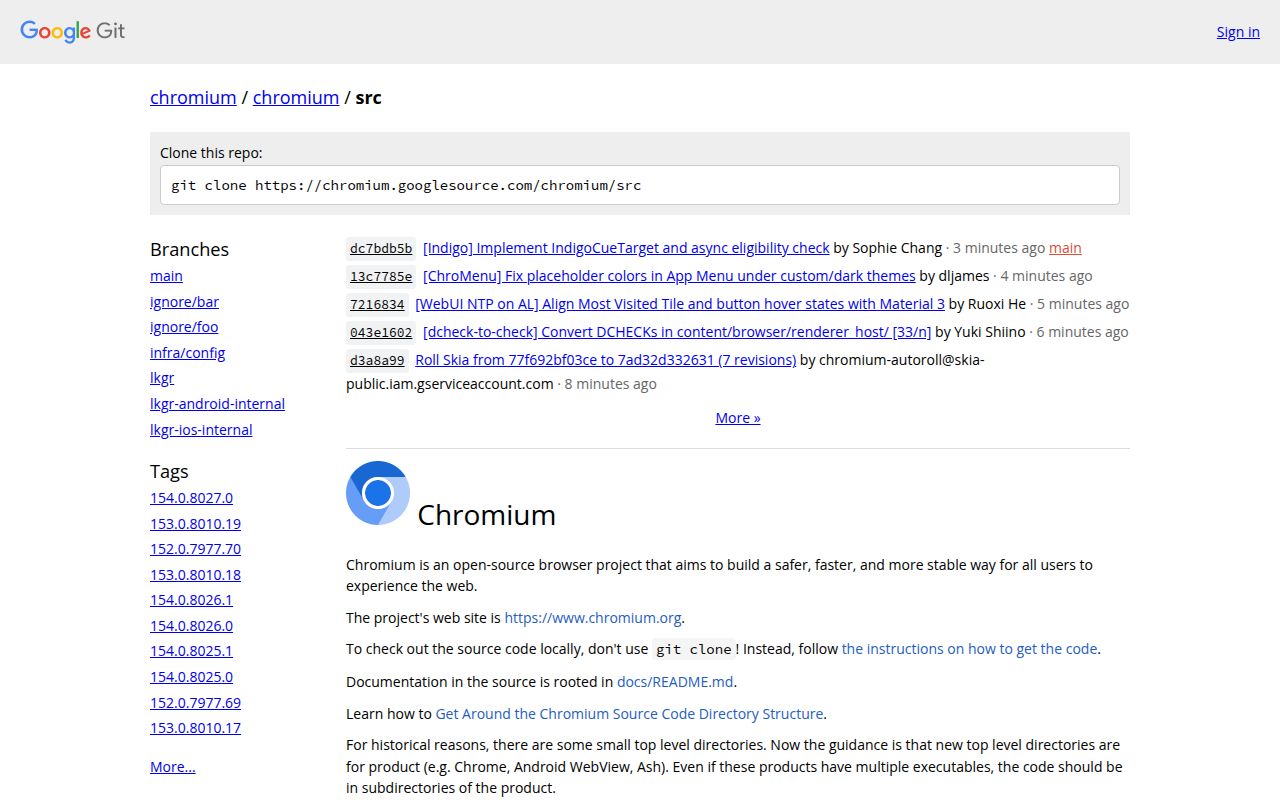
This GitHub repository is a mirror, not the normal checkout path
Chromium is a full browser project with rendering, networking, storage, media, UI, sandboxing, extensions, and platform-specific code in one source tree. The GitHub page is an official mirror, useful for browsing and linking. Its README immediately tells developers not to use git clone. Source acquisition, dependency syncing, build generation, review, and issue handling all live in Chromium's own toolchain and services. Treating the mirror like an ordinary GitHub project produces the wrong first impression.
That distinction explains why stars and the GitHub issue tab tell only part of the community story. GitHub showed 24,631 stars, 28 combined issues and pull requests, and a push on August 27, 2026. The README sends bug reports to crbug, while contribution docs send code reviews to Chromium's Gerrit. There is no latest GitHub release object. Health is visible in current pushes and the external workflow, rather than GitHub releases or issue traffic alone.
Linux development needs 100 GB of disk and Chromium's own tools
The Linux guide requires an x86-64 machine with at least 8 GB of RAM and 100 GB of free disk. More than 16 GB RAM is recommended, along with substantial swap on smaller machines. Chromium documents Ubuntu 22.04 as the environment used by its build infrastructure. Other Linux distributions have notes, but the project makes fewer promises about them. This is workstation-scale source development, not a checkout for a tiny cloud runner.
Setup begins by cloning depot_tools and placing it at the front of PATH. The fetch command obtains Chromium and its dependencies, then install-build-deps.sh adds Ubuntu packages and gclient runhooks downloads further binaries. GN generates the build directory, while Siso and Ninja perform the build work. Each target family, including Android, ChromeOS, Fuchsia, iOS, Linux, macOS, and Windows, has a separate path because host and product assumptions differ.
What happened when we ran it
Our sandbox could not clone chromium/chromium. The lab therefore recorded no commit and did not attempt an install, build, test suite, dependency audit, repository count, or source-line count. There is no responsible benchmark to infer from that result. We can say only that the clone step failed in an unprivileged environment with 3 CPUs, 8 GB of RAM, and no secrets.
The failure is still useful because the README explicitly says not to use git clone. It points to depot_tools and fetch, which also manage external dependencies and hooks. The supplied lab log does not state why the clone failed, so assigning the failure to repository size, network behavior, or the 8 GB memory limit would be guesswork. A second evaluation should follow the official checkout workflow on hardware meeting the 100 GB disk requirement.
Since nothing was checked out, this review does not imply that Chromium failed to compile or that its tests fail. It also does not turn documented resource guidance into our own measurement. The honest decision signal is narrower: an ordinary clone-based sandbox pipeline could not reach the stage where build quality was testable, and Chromium's own documentation had already warned against that route.
Contribution runs through Gerrit, owners, and a signed agreement
Chromium's contribution guide assumes a working local build. Contributors need Gerrit and Google accounts, must complete the appropriate contributor license agreement, and add themselves or their company to the AUTHORS file. Changes are uploaded with git cl upload, not opened as GitHub pull requests. Nontrivial work that affects a critical path or takes more than roughly one person-month needs a design document and discussion with the relevant owners.
The codebase also includes external projects with their own processes, such as V8 and Skia. A patch can cross boundaries that require different review or dependency handling. Chromium asks contributors to include tests, follow subsystem style, and keep changes reasonably sized. That process is a benefit for teams already building browsers, while it is needless overhead for an application developer who only wants to display a web page.
A custom browser may need service keys and product work
The Linux instructions say Google API keys are unnecessary for most development and testing. Some Google-connected services in a custom build do require a separate API-key setup. This matters because compiling Chromium does not reproduce Chrome as distributed by Google. Branding, service access, update delivery, crash reporting, codecs, policies, packaging, and operating-system integration all become product decisions for a downstream browser vendor.
Brave is a more direct starting point when the desired contribution belongs in an existing Chromium-based product. Firefox is the serious alternative for developers who want a separate browser engine and ecosystem. WebKit makes more sense for engine work centered on Safari or other WebKit ports. Each remains a very large project, but the technical direction is clearer than forking Chromium merely to change a few browser defaults.
Current source activity is strong, while local entry remains expensive
The official mirror was pushed on August 27, 2026, the same day we fetched its facts. Chromium's documentation index covers platform builds, code review, dependency management, test systems, security tools, UI frameworks, GPU work, and many subsystems. That breadth is appropriate for the codebase, though a new contributor will spend real time finding the correct guide and owner before changing code.
Chromium is the right source project when the browser itself is the product or research target. Our failed clone prevents a build-quality judgment from this sandbox, and the 100 GB Linux requirement rules out casual experimentation on many machines. Start with source.chromium.org when reading, then provision a suitable workstation and use depot_tools if a real patch or downstream build justifies the cost.