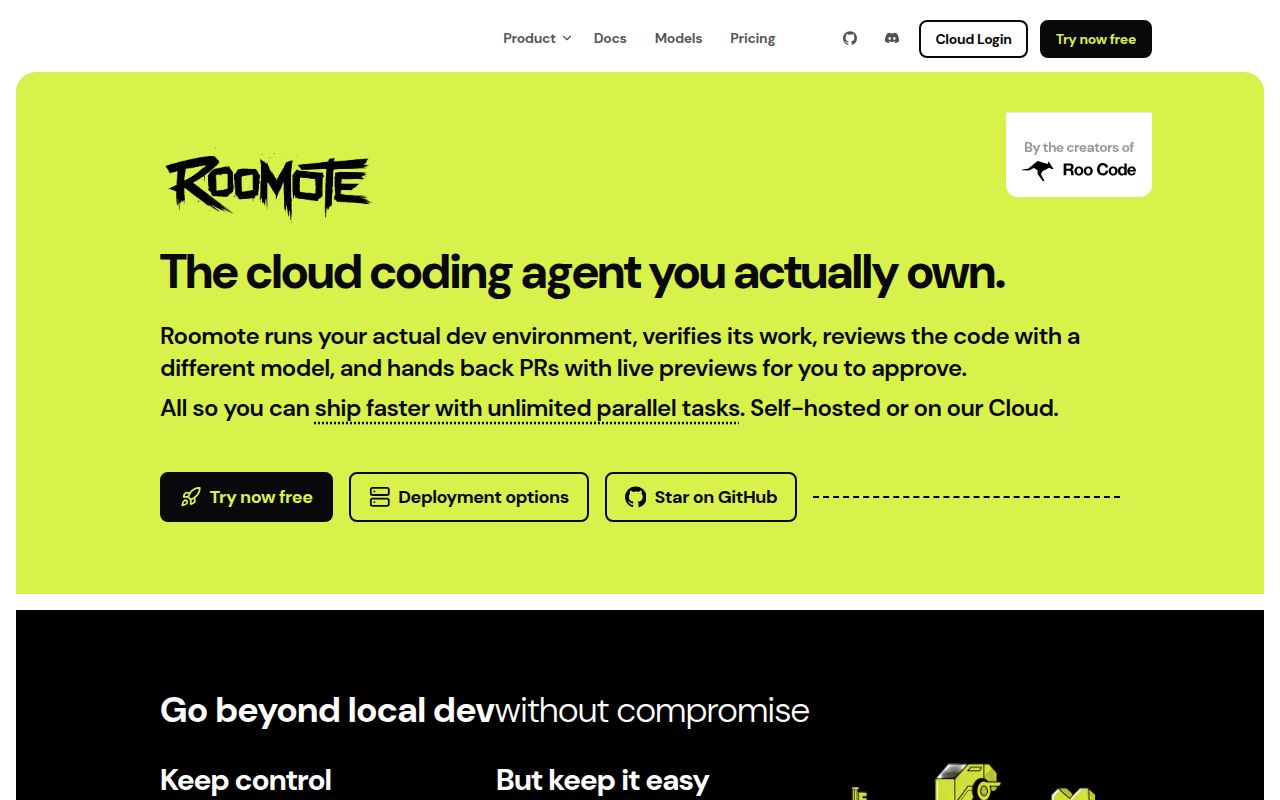
The extension was shut down on May 15, 2026
Roo Code put an agent inside VS Code and let it work in several named modes. Code mode handled edits and file operations, Architect mode focused on plans and migrations, Ask mode explained a codebase, and Debug mode traced faults. Custom modes let teams shape narrower workflows, while MCP support connected outside tools and context. The README is available in English and lists 17 additional translations. That capability list still describes the final extension, but the same page now opens the purchasing decision with a harder fact: Roo Code is no longer operating.
The repository is sizeable enough to be useful as source material. At commit b867ec9, our checkout contained 3,022 files, roughly 351,253 lines of source, and 306.7 MB before installation. It is a pnpm workspace monorepo, which makes sense for an editor extension with shared packages and supporting services. Seven CI workflow files are present. There is no Dockerfile, and our scan found no top-level tests directory, although the configured test command itself completed successfully.
Modes separate planning, editing, questions, and debugging
Five mode types give Roo Code a clearer mental model than a single chat box. A developer can ask for an explanation without granting the same behavior expected during an editing task, then move to Architect or Debug when the job changes. Custom modes extend that split for team conventions. MCP support matters for people who already connect coding agents to internal tools, although each server brings its own trust boundary and configuration. The README points to the documentation site for the detail needed to set those modes up.
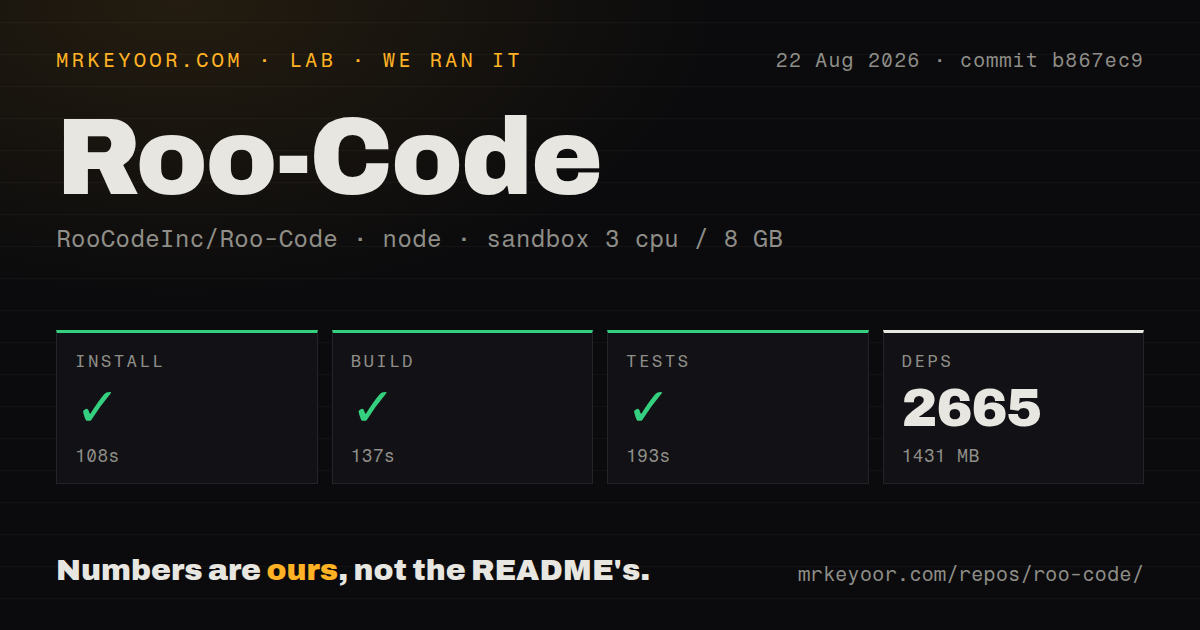
Running the source is heavier than installing a small VS Code helper. Our sandbox pulled 2,665 packages in 108 seconds and occupied 1,431 MB on disk. A team preserving Roo Code should pin the package manager state and the extension build it has already tested. Provider credentials remain separate operational inputs, and codebase indexing can add an embedding endpoint plus related settings. A clean compile proves the final tree is buildable; it does not keep external model APIs or MCP servers compatible after the archive date.
What happened when we ran it
Our sandbox installed Roo Code successfully in 108 seconds. The build then passed in 137 seconds, and the test command passed in 193 seconds. We ran commit b867ec9 in an unprivileged Debian container with 3 CPUs, 8 GB of RAM, Node 22, and no secrets. Those results are unusually clean for a 351,253-line monorepo. They also describe repository mechanics only: we did not connect a paid model provider, drive the VS Code interface, or exercise an MCP server.
The final on-disk dependency footprint was 1,431 MB for 2,665 installed packages, on top of a 306.7 MB checkout. That is manageable on a developer workstation and material in a disposable CI job. The absence of a Dockerfile means the repository does not hand you the same Debian environment we used. Its 7 workflow files provide a better place to inspect the project's intended checks, while the passing local commands show that the archived commit can still be reproduced under the stated sandbox conditions.
Open provider bugs will remain part of the final release
Issue 12366 reports three failures around OpenAI-compatible embeddings in v3.53.0: no saved API key for the indexer, a fixed model list that omitted the reporter's chosen model, and settings that reset or conflicted. Issue 12062 describes a custom Anthropic-compatible endpoint receiving claude-sonnet-4-5 instead of the model name entered by the user. These are specific compatibility reports, not proof that every custom provider fails. With the repository archived, buyers should treat the affected paths as frozen unless a fork carries fixes forward.
Process control has its own warning. Issue 12357 says the stop button failed to end a Python task started by the agent in v3.50.0. That report has a narrow reproduction and no diagnostic log, so it does not establish how often the fault occurs. It still matters when an agent can execute commands. Our 193-second test run passed, but it did not reproduce that interactive VS Code path. Keep an independent terminal or process monitor available if you maintain the old extension.
The community fork is the practical migration path
GitHub listed 24,325 stars and 1,035 combined issues and pull requests when fetched. The last push and v3.54.0 release both landed on May 15, 2026, the shutdown date, and the repository is archived. A few pull requests show later update timestamps, but they do not change the repository's read-only status. The README directs users to Zoo Code, a community fork, and to Cline, the project from which Roo Code originated. That instruction is stronger evidence than an old star count about where a new installation should begin.
The technical finish is respectable: 2,665 packages installed, the 137-second build passed, and the 193-second tests passed on our box. The product finish is conclusive for a different reason. There will be no official Roo Code updates, and its own maintainers recommend alternatives. Preserve it when an existing workflow depends on its exact modes or when you want to study a large editor-agent codebase. For a fresh deployment, compare the active fork with Cline and Continue, then test provider handling and command cancellation before moving real work.