Reef is a release system for learning loops
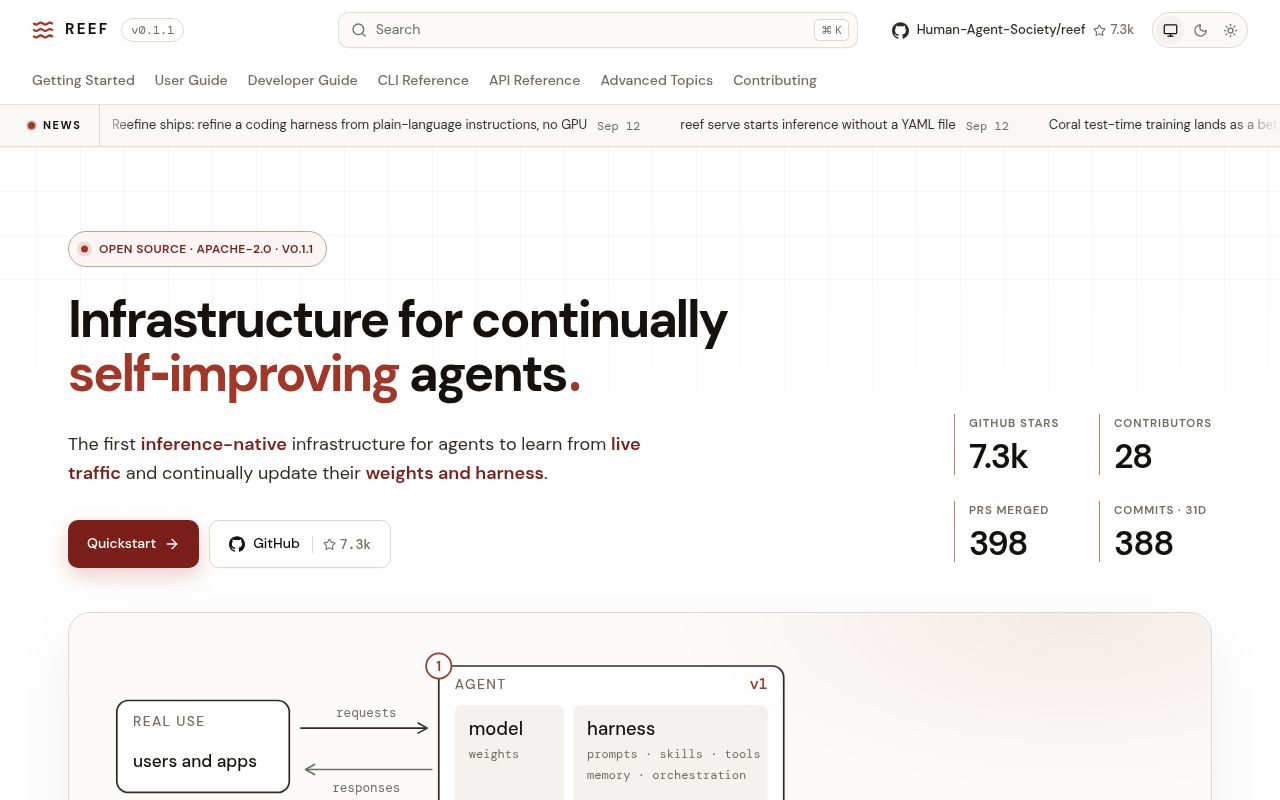
The phrase continually self-improving agent sounds more magical than the machinery. Reef records a request, attaches later feedback to that record, gives eligible records to a recipe, evaluates a candidate update, and publishes an accepted artifact. The artifact may be model weights or an agent harness such as prompts, rules, skills, and commands. That is closer to a deployment and change-management system than an agent that wakes up smarter on its own.
The distinction matters because Reef does not create the definition of improvement. Weight training needs scored or otherwise useful feedback. Scientific tasks need a correctness checker and measurable objective. Harness changes need representative work plus an evaluator that can reject a persuasive but harmful edit. Reef supplies the 4-stage path from serving through commit, with version history and runtime updates, while the user supplies the signal and policy.
Weight changes and harness changes share one control plane
For model evolution, Reef can sit in front of an inference engine, issue OpenAI-compatible or Anthropic-compatible responses, and return a record ID in a response header. A later report sends a score, richer feedback, and that receipt back to Reef. Eligible records enter a recipe, and an accepted checkpoint can be synchronized to the serving runtime without restarting the service.
Harness evolution follows a different path. The built-in Reefine recipe points at an upstream model endpoint and turns a plain-language change request into a skill, rule, command, or extension. Version pages let a person inspect the proposal and install a selected result. This route does not require local training GPUs, but it still runs generated harness code and depends on the quality of the tasks used to judge it.
What happened when we ran it
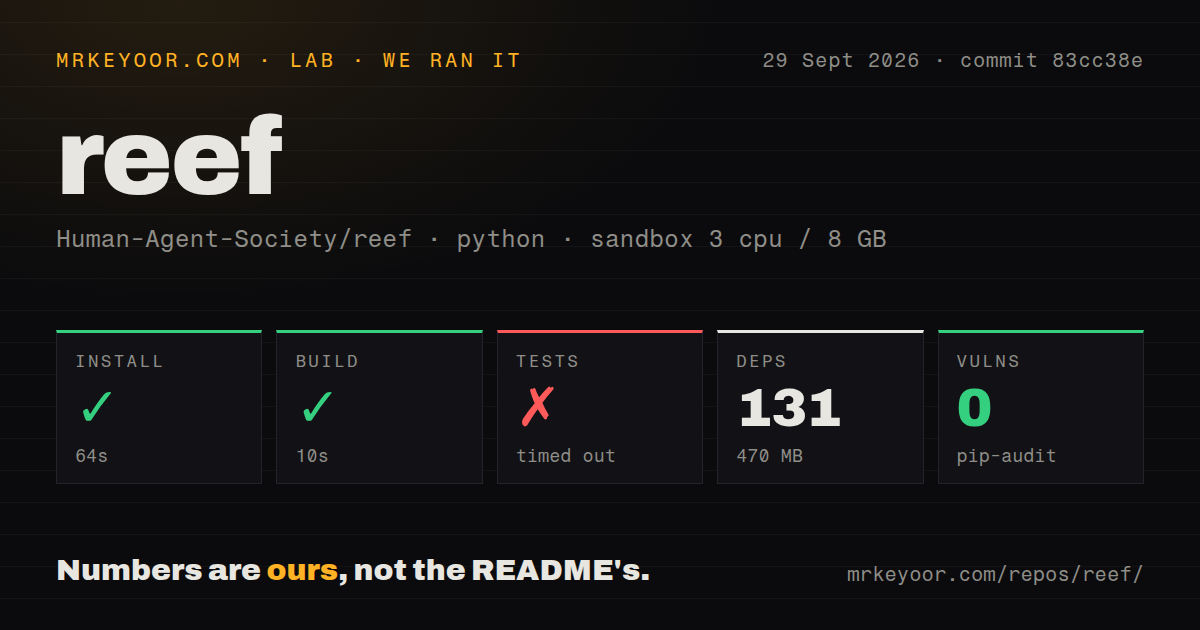
Our fresh Debian sandbox installed commit 83cc38e in 64 seconds. The 131 packages occupied 470 MB, and the build completed in 10 seconds. Pip-audit found 0 known vulnerabilities. The checkout was substantial: 2,007 files, roughly 242,762 lines of source, 19.9 MB before dependencies, 13 CI workflow files, and a tests directory. It had no Dockerfile.
The test command did not finish within the 900-second cap. Progress reached 33%. Before the timeout, the log showed failures in test_harness_proposals.py, test_harness_render.py, and test_harness_step_record.py. The tail does not include the assertion messages, so we cannot say whether those failures came from timing, missing services, or code defects. The defensible result is a timed-out suite with visible failures, not a pass with slow tests.
Harness installation can become executable persistence
Reef's documentation gives a blunt warning that should survive every trial. The installed harness must live outside the project the agent can edit. If an agent session can modify its own install root, Python environment, or Reef checkout, it can change what the next session executes. For Codex and dsh, the README also warns against putting that installation under /tmp because their sandbox may write there.
Linux can isolate the proposer with bwrap and pasta when Reef runs as a non-root user. The documented escape hatch, REEF_PROPOSER_SANDBOX=none, is for a trusted machine. The pi adapter runs commands without a sandbox. Those details rule out casual installation on a developer laptop that also holds valuable credentials. A separate user, restricted workspace, reviewed updates, and a tested rollback path belong in the design.
Model training turns the quick start into a GPU service
The minimal inference command hides little, but training does. The SAO example adds the Slime extra, a runtime dependency group, a model path, a token, serving configuration, and the GPU requirements in a separate guide. Reef also needs Git LFS for artifacts and checkpoints. Versioned delivery helps keep training output attached to a release, yet someone still owns storage, GPU scheduling, failed jobs, and the selection policy.
The repository tries to keep recipes honest by linking measured results and limitations for tasks such as AIME 2025, IMOAnswerBench, Terminal-Bench, circle packing, and a GSM8K stream. These are recipe-specific experiments. They do not establish that an arbitrary production agent will improve from ordinary user interactions. Your evaluator, workload, and feedback delay determine whether the loop learns anything worth publishing.
Current activity is high, while v0.1.1 remains young
GitHub showed 7,329 stars, 86 combined issues and pull requests, and a push on September 30, 2026. Release v0.1.1 arrived on September 25 with work on vLLM token capture, record storage, harness adapters, and multi-component recipes. The repository itself was created on August 31, so the code and issue traffic are moving quickly within a short public history.
Reef deserves a trial when feedback-driven updates are already a concrete engineering requirement. Start with a record-only deployment or harness experiment, keep installation roots outside writable projects, and require a human to inspect every accepted artifact. Our 470 MB install and successful build show the package can be assembled. The failures before the 900-second timeout mean the full checkout still needs a clean run in your environment before it controls live model or harness releases.