Pion WebRTC lets your Go program become a WebRTC peer. You can send an existing media stream to a browser or exchange application data without embedding a browser in the server. That is a useful building block when you want control over the connection. It also leaves a larger application to design, and our lab run did not validate the Go implementation.
Pion gives Go programs access to media and data channels
The Pion README lists audio and video exchange, data channels and direct access to RTP/RTCP, the packets and feedback used by media streams. Its examples include forwarding RTP into a browser and saving incoming media. This suits a Go service that already handles a stream and needs to connect it to a WebRTC client.
The same interface lets you choose ordered or unordered data channels and reliable or lossy delivery. That is useful when a robot's latest state matters more than replaying every stale update. It is a design option, not a latency result: our sandbox did not measure delivery delay, media quality or connection capacity. Choose the delivery behavior around your application's data rather than treating every message as interchangeable.
What happened when we ran it
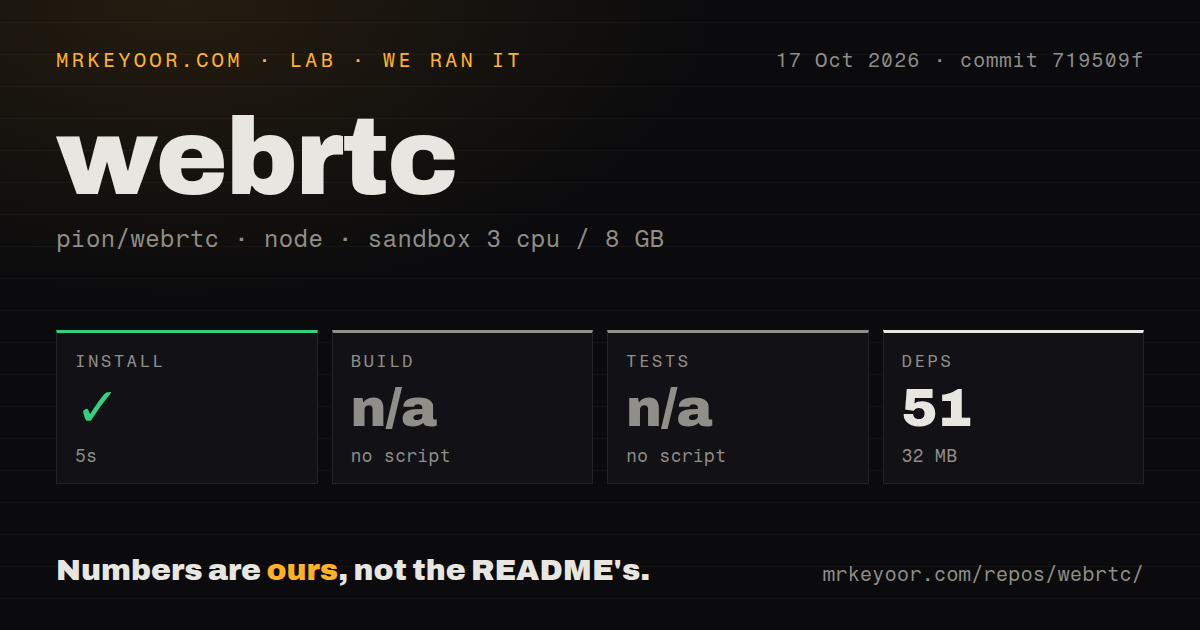
Our sandbox installed 51 dependencies in 5 seconds and recorded 32 MB on disk at Pion WebRTC commit 719509f. The October 17, 2026 run used 3 CPUs and 8 GB of RAM under the image label lab-node:22. The runner classified its path as Node with Yarn. The image label does not establish actual runtime or operating-system versions.
The harness found no build script or target and skipped the build. It also found no tests script or target and skipped tests. Pion describes itself as a pure Go implementation, and GitHub reports Go as its primary language. Those facts make the measurement boundary decisive: the successful dependency step did not establish that the Go library compiles or that a peer connection works.
Our checkout contained 398 files, roughly 76,662 source lines and 2.5 MB before installation. The scan detected 14 CI workflow files, with no Dockerfile or tests directory detected. A missing tests directory in this scan is not evidence of absent Go coverage. We have no passing-test count from this run and no basis for adopting the README's own timing examples as our results.
Network examples address decisions your application still owns
The examples catalog includes ICE restart, single-port operation and a TCP connection path. ICE is the connection-establishment machinery WebRTC uses to find a usable route between peers. Pion's default behavior listens on a new port for each PeerConnection; the single-port example shows a configuration for sharing one port across connections.
That matters on hosts where firewall rules constrain the available ports. The TCP example says the default is UDP and demonstrates an alternative. The README also lists STUN and TURN support. You still need to select and verify the connectivity path for the networks you serve. Our install does not establish whether a corporate network can reach your deployment or whether a relay is configured correctly.
Use a small browser-to-Go example as the first evaluation, then repeat it on the intended network with the intended fallback. A successful loopback demonstration would leave remote reachability unresolved. For an embedded device, include a disconnect and reconnection in that check. The existence of an ICE-restart example helps you find the relevant integration, without proving your application's reconnect behavior.
Pure Go transport does not include a Cgo-free camera path
The main README describes the core as pure Go with no Cgo usage, while its linked getUserMedia implementation explicitly requires Cgo. Camera acquisition and WebRTC transport therefore deserve separate dependency decisions. If your deployment policy excludes C bindings, confirm where media comes from before choosing a camera example. An existing RTP source and local device capture are different integration jobs.
WebAssembly has another clear boundary. The examples documentation says that Pion compiled for the browser acts as a wrapper around the JavaScript WebRTC API. That can help a Go application share interface code across server and browser. It does not give browser code an independent replacement for the browser's transport implementation. Teams choosing Pion specifically to bypass browser WebRTC behavior should walk away from that assumption.
LiveKit supplies a server, while libdatachannel serves C++ callers
LiveKit provides a distributed WebRTC selective forwarding unit, a server that forwards media between participants. Its server uses Pion and adds a room model, SDKs and authentication support. Pick that higher layer when your product needs multi-participant sessions and you prefer to adopt server behavior rather than assemble it around peer connections.
libdatachannel implements WebRTC data channels, media transport and WebSockets in C++ with C bindings. Pick it when your native application already lives in C or C++. Neither alternative has comparative measurements in our run. The choice here is which application layer and language you intend to own.
October activity supports an evaluation, not a capacity claim
GitHub records Pion's last push as October 21, 2026, and the issue list includes an October 20 report alongside an ongoing v5 release discussion. That combination shows current development. It does not turn a roadmap discussion into a shipped version, or establish support response quality. The README directs consumers to versioned Go module imports; choose a release deliberately instead of inferring compatibility from the default branch.
Documentation earns 4/5 for pairing the API overview with examples for packet forwarding, flow control and constrained networking. We did not run those examples, so setup and deployment maturity remain unassessed. Start with Pion when a custom Go peer is the component you need. Before committing, require the Go path to run, exchange the actual media or data format, and reconnect across your intended network.