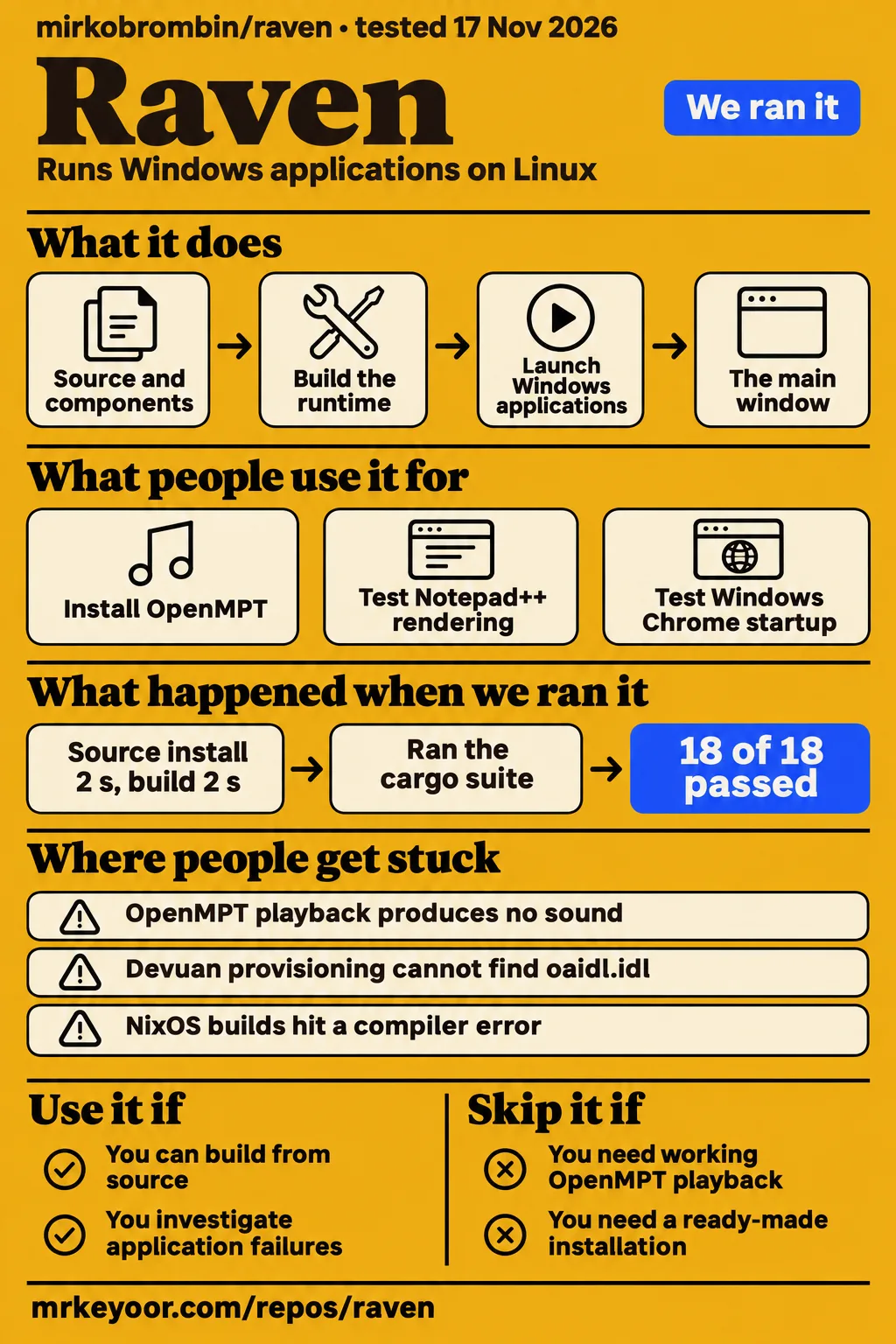
Short answer: use Raven to investigate a particular app
Our Raven run passed 18 cargo tests in native/waits, while contributor application reports describe outcomes ranging from a first dialog to module creation. Use mirkobrombin/raven if you can build from source, collect logs and investigate the next failing stage of a Windows application. Skip it for work that depends on OpenMPT playback or a demonstrated Chief Architect project workflow: the supplied reports end at silent playback and a first Qt dialog respectively.
Raven's README describes a runtime for Windows applications on Linux, using their existing installers. This page identifies mirkobrombin/raven by repository because other software shares its name. The decision here is practical: which application operation has someone completed, on which revision and configuration? Installation, startup, a drawn window and a saved document are different milestones. Keeping those milestones visible makes the reports useful to someone choosing their next compatibility task.
What people use raven for
Contributors report Chief Architect installation, OpenMPT module creation, Notepad++ rendering and Windows Chrome startup under Raven. These are specific development targets with identifiable outcomes. The table keeps the reporter's branch or revision beside the result, so a reader can choose a relevant investigation and return to the supporting discussion rather than treating every successful stage as the same level of compatibility.
| What someone tried | Who and configuration | Reported outcome |
|---|---|---|
| Chief Architect Premier X17 | rayzorben, CachyOS with niri, chief-architect-support branch based on fb18bca | The 64-bit MSI installed, including its 32-bit custom actions, and reached its first Qt dialog. Chief Architect report |
| OpenMPT 1.32.12 | ReefProctor, Fedora 44, e737a75 | Module loading and File > New worked; Play (F5) produced no sound. OpenMPT report |
| Notepad++ rendering | Detritus78, KWin, abf33f8, fresh prefix | The complete interface drew; the build also contained local API patches outside painting and Wayland. Notepad++ retest |
| Windows Chrome startup | mirkobrombin, updates including 9be1b634 and 62ccbe74 | The browser showed its main window; the GPU process still needed a Direct3D implementation. Chrome update |
| SurrounDead through DX11 and DXVK | Issue #153 reporter, local skip-uncached-read-back experiment | The experiment reached the title screen and gameplay; a later intermediate main build stayed loading. SurrounDead investigation |
OpenMPT shows why the last completed operation matters. The discussion progresses through installer trouble, startup, menus and crashes when opening or creating modules. ReefProctor's e737a75 report says that a module loads from a file and File > New creates one, through both Ctrl+N and the menu. The same report says F5 produces no sound and identifies missing MFStartup and an audio-resampler COM registration problem. That gives a contributor a concrete next failure to investigate.
Chief Architect reached a different milestone. rayzorben's report describes a patched branch based on fb18bca, where the MSI's 32-bit custom actions ran and the application initialized Qt 6. Its first dialog had text, theming, input and a text cursor. Notepad++ supplies a compositor-specific outcome: Detritus78 rebuilt abf33f8 and reported the complete interface on KWin with a fresh prefix, while disclosing local registry, shell, CRT and kernel32 patches.
What happened when we ran it
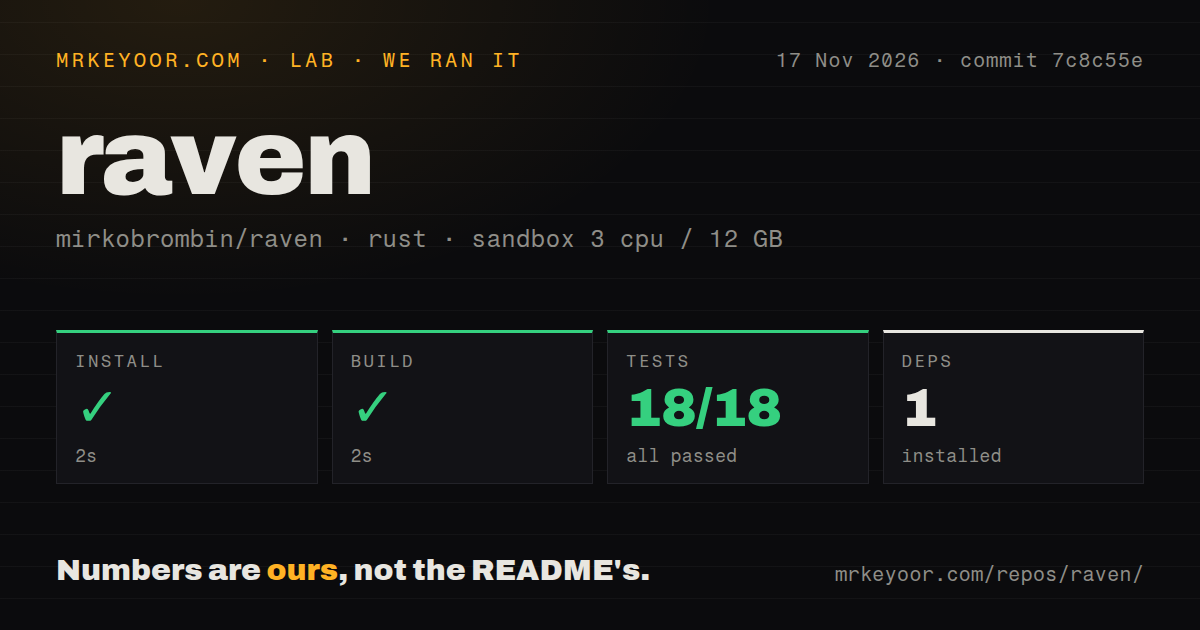
Our run at commit 7c8c55e on 2026-11-17 recorded 18 passed and 0 failed cargo tests in native/waits. Install, build and tests each succeeded in 2 seconds. The harness selected that Rust component; Raven's README describes the main runtime's CMake build. Keeping the selected directory in the result explains exactly which work produced the passing count.
| Recorded question or step | Answer | Verdict | Why |
|---|---|---|---|
| Did the selected install step finish? | Yes, in 2 seconds; 1 dependency recorded | Passed | The harness recorded a successful exit for native/waits |
| Did the selected build finish? | Yes, in 2 seconds | Passed | The harness recorded a successful build exit |
| Did the selected tests pass? | 18 passed, 0 failed of 18, in 2 seconds | Passed | Cargo test supplied the recorded component result |
| What sandbox was allocated? | 3 CPUs, 12g RAM, image lab-rust:1 | Recorded | These are the harness's configuration fields |
| Did the separate quickstart clone finish? | Yes, in 3 seconds at d8cfe1f13ca8 | Completed | The clone step records that duration |
| Could that quickstart select an installation method? | No; planning failed | Failed | Its recipe excludes source builds and found no accepted installation command |
| Did the separate quickstart deploy Raven? | Its summary claims Docker Compose and ports bound to 127.0.0.1, while its steps stop at planning | Conflicting records | The deployment statement contradicts the recorded stopping point |
| Did teardown finish? | Yes | Completed | The teardown record says teardown: ok |
The checkout contained 1,690 files, approximately 499,600 source lines and occupied 28 MB. The scan found seven CI workflow files, a tests directory and no Dockerfile. GitHub metadata identified C as the primary language. These observations describe the repository and the harness selection together: the repository's size and language are separate from the small Rust component that supplied our measured test result.
The second attempt used the quickstart-cli recipe at d8cfe1f13ca8 on 2026-11-17. Its clone record gives 3 seconds. The failed planning step found no accepted apt, npm global, pipx, uv tool, cargo install or go install route and excluded brew, source builds and pipe-to-shell scripts. The run summary nevertheless claims a Compose deployment. The planning failure describes that recipe's stopping point, rather than a Raven executable crashing.
Installation starts with CMake and separate components
The supplied README requires Linux on x86_64, CMake 3.20 or newer, a C++20 compiler and Python 3.11 or newer. It also lists MinGW-w64 13 or newer for x86_64 and i686 Windows test programs, plus clang, widl, bison and patch for installer components. Its desktop requirements include Wayland, xkbcommon, pixman, FreeType and Vulkan; the experimental X11 route has additional XCB-related requirements.
The README's first build produces support for console programs and simple windows. Installers and most desktop programs also need common controls, shell dialogs and installer services, supplied through separate provision scripts and CMake paths. Graphics provisioning supplies DXVK and vkd3d-proton for Direct3D workloads. This distinction answers a common packaging question: the maintainer says the build itself downloads nothing, while provisioning writes downloaded components into directories passed to CMake. Build and provisioning explanation.
Where people get stuck: source and components update separately
Issue #136 reports a rebuild expecting raven-picker.exe after a source update, and ReefProctor directs the user to rerun the README's provisioning commands before rebuilding. The failure concerns previously generated components alongside newer source. It is a useful first distinction when an update breaks configuration: identify whether the missing item belongs to system development packages, provisioned components or the configured build.
| Reported symptom | Supplied response | Attribution |
|---|---|---|
| Rebuild expects raven-picker.exe | Rerun the README's provision scripts after pulling, then rebuild | ReefProctor in issue #136 |
| Devuan provisioning cannot find oaidl.idl | Try libwine-dev, then provision again | ReefProctor's suggestion in issue #136 |
| NixOS MinGW internal compiler error | Add -fno-stack-clash-protection | Contributor workaround in issue #23 |
| Clang fixture cannot find windows.h | Configure with -DRAVEN_CLANG=OFF to skip clang fixtures | Maintainer response in issue #10 |
| Launch reports native X11 presentation was not built | The launched binary lacks that backend | Launch report in issue #10 |
The Nix packaging discussion describes separate derivations for components and two flakes in progress, #132 and an FHS-based effort. The maintainer asks contributors to merge the work into one PR. The X11 discussion announces an experimental backend at 5ca60c6e, with --desktop=x11 for launch and -DRAVEN_DESKTOP_WAYLAND=OFF for builds without Wayland. The same discussion records the missing windows.h fixture error.
The binary packaging discussion proposes one packaging path through scripts/package-native.py, gathering guest components, licenses, notices and sources for AppImage, Flatpak, .deb and .rpm outputs. In issue #8, the maintainer explains a Flatpak conflict: Raven uses ptrace to control Windows child processes, while Flatpak's default seccomp policy blocks ptrace without --allow=devel, a permission Flathub discourages.
NVIDIA: one presentation benchmark reached about 100 fps
Detritus78 reported 2,000 frames in 20.05 seconds, approximately 100 fps, for present_rate.exe at revision 89a8af8 on an RTX 3080 using nvidia-open 615.78.08. This is the contributor's final benchmark retest in issue #153. The same reply reports about 5 fps at abf33f8 and says the earlier version never finished, keeping the improvement attached to a named workload and revision.
The investigation followed expensive copies from shadowed GPU memory back to the host during synchronization. The original reporter's local experiment skipped read-back for uncached memory and reached SurrounDead gameplay. A later intermediate main revision stayed loading at 0.1 to 0.4 fps after 150 seconds. In the final presentation-benchmark reply, shadow-from-device work disappeared from the timing rows while remaining in call counts. The sequence separates the local gameplay experiment, intermediate failure and final benchmark recovery.
Security: the README documents grants and confinement
The supplied README describes host-file grants, a control panel and Landlock confinement on kernels that support it. Programs receive access to their own folder, host paths supplied on the command line and files or folders selected through separate file dialogs. The README says refused access is recorded in sandbox.log, and sandbox.conf holds settings managed through the control panel. Raven's documented permissions.
The current prefix description also allows programs installed in one prefix to see each other. It describes shared documents, temporary folders and certain registry keys, alongside program-specific layers for other changes. The older issue #8 instead discusses per-program prefixes and calls an isolation layer for untrusted programs separate design work. The current documentation supplies the more detailed account of prefix behavior, while the older thread explains the historical packaging and isolation discussion.
Raven vs Proton and Bottles: choose by the documented job
Proton targets Windows games through Steam, while Bottles describes Windows software on Linux and identifies Flatpak as its primary official distribution. Raven's supplied README starts with a source build. These documented roles provide a useful initial choice: Steam gaming, a packaged application, or source-level compatibility work. The table compares those starting points and the corresponding upstream instructions.
| Option | Documented role | When to choose it |
|---|---|---|
| Raven | Windows applications on Linux; source build and separate desktop components | You want to investigate a specific application's failure and can rebuild the runtime |
| Proton | Wine-based support for Windows games through the Steam client | You want the upstream-recommended Steam-provided version for Steam gaming |
| Bottles | Windows software on Linux; primarily and officially distributed as a Flatpak | You want to start with its packaged distribution and stable Flathub manifest |
Proton's README recommends the version provided by Steam for most users and presents its source for advanced users who want changes. Bottles' README distinguishes its development manifest from the authoritative stable manifest maintained by Flathub. Raven issue #8 contains a user's proposal to add Raven as a Bottles runner; the wording is a request for integration, separate from either project's documented installation route.
FAQ
Raven's supplied installation instructions require a source build, while its Nix discussion records packaging efforts in progress. The questions below come from the pack's GitHub discussions, including installation, graphical backends, application failures and isolation. Their answers identify the relevant documentation or reported outcome so a first-time reader can find the right starting point without treating all installation requests as equivalent.
Can Raven get an easier installation path on NixOS through a flake or nixpkgs package?
The maintainer names two flakes in progress, #132 and an FHS-based effort, and asks contributors to consolidate them into a single PR. Another contributor describes separate component derivations and work aimed at nixpkgs. The discussion therefore points a Nix contributor toward ongoing packaging work and its component structure. Nix packaging discussion.
Are provisioning downloads required just to build Raven?
The maintainer says the build itself downloads nothing; downloads happen in separate provisioning steps whose output directories CMake receives. That reply distinguishes the minimal build for console programs and simple windows from additional desktop components. For packaging, this identifies the build inputs and the separate work needed to produce them. Build-input explanation.
Can Raven run graphical applications on X11 without Wayland?
The maintainer announced an experimental X11 backend at 5ca60c6e, using --desktop=x11 at launch. The documented -DRAVEN_DESKTOP_WAYLAND=OFF option removes the Wayland build dependency, with libxcb extensions and xkbcommon-x11 required for X11. The thread also records a missing windows.h build error and a launch reporting that native X11 presentation was absent. X11 discussion.
Will Raven be available as an AppImage or Flatpak?
The maintainer describes planned binary formats built from scripts/package-native.py output and directs users to source builds in the meantime. The Flatpak reply separately identifies the ptrace and --allow=devel permission conflict. Those answers explain both the proposed packaging path and the specific permission issue raised by the requested Flatpak distribution. Binary packaging plan, Flatpak discussion.
Does Raven have a graphical interface?
The supplied README documents control.exe in the prefix as a control panel for folder permissions, network access, refusals, snapshots and Linux programs exposed to Windows applications. The older issue #8 also links rayzorben's ravens-nest GUI. These references identify an upstream control panel and a separate contributor project. README control panel, GUI discussion.
Why do the OpenMPT installer and application fail under Raven?
ReefProctor's e737a75 report for OpenMPT 1.32.12 says module loading and creation work after the #173 crash fix, while F5 still gives no sound. It identifies missing MFStartup and an unregistered audio-resampler COM class as playback blockers, and says #178 adds MFStartup. The reported failure has moved from module creation to audio. OpenMPT investigation.
Why does the Windows Chrome standalone installer fail after a clean Raven build?
The Chrome discussion documents registry and out-of-process COM work, followed by a maintainer update that chrome.exe gets past startup and shows its main window with 9be1b634 and 62ccbe74. That update identifies a Direct3D implementation for the GPU process as the next step. The revision and failing stage determine which part of the discussion applies. Chrome investigation.
Why does D3D11 through DXVK run at roughly 1 fps on NVIDIA?
The issue reporter traced expensive synchronization to read-back from uncached shadowed memory. Detritus78's later present_rate.exe retest at 89a8af8 reported 2,000 frames in 20.05 seconds on an RTX 3080 with nvidia-open 615.78.08. The thread records both the original memory-copy investigation and the later presentation-benchmark outcome. NVIDIA read-back investigation.
What we have not tested yet
Our 18 passing tests cover native/waits at 7c8c55e; the supplied lab record contains no complete Raven desktop session, full CMake build, provisioning cycle or Windows application workflow. Actual compiler and operating-system versions require raw logs: lab-rust:1 is an image label. The separate d8cfe1f13ca8 quickstart stopped at installation-method planning, and its contradictory Compose summary cannot support a deployment result.
Our lab has no OpenMPT audio, Chrome browsing or DRM playback, Chief Architect project editing and saving, cage, or experimental X11 result. The supplied issue extracts also lack successful cage and Rakuten playback outcomes. The final NVIDIA retest covers present_rate.exe rather than an upstream SurrounDead gameplay retest. The Devuan libwine-dev suggestion explicitly lacks a Debian retest; completed Nix packaging, ready-made Raven binary availability and a working Bottles runner configuration are also absent from the supplied evidence.
The rendering evidence includes blank visible windows despite headless success, followed by the KWin retest with disclosed local API patches. Our run supplies no comparative performance, memory or compatibility measurements against Proton, Wine or Bottles. It also supplies no hostile-program assessment of file grants, network controls or Landlock, protection between application environments, long-session reliability or broad adoption. For a workflow decision, the next useful result is the application's real output: a saved and reopened document, audible playback or another completed operation.