Qwik serializes the work hydration normally repeats
Qwik serializes 3 categories of runtime information into HTML: event handlers, component boundaries, and application state. A small loader can catch an interaction and request the matching function without downloading and executing every component first. This is Qwik's central bet: page startup should not grow in direct proportion to all the interactive code present on that page.
That architecture matters only if your application has a startup problem worth changing frameworks for. Our checkout contained 4,227 files and roughly 292,787 lines of source, so adopting Qwik means buying into a sizable framework rather than adding a small optimization library. The reward is automatic splitting around QRLs and deferred code. The price is a programming model designed around code that may execute later, in another environment, after its surrounding scope has been serialized.
Dollar-sign boundaries rule out custom class instances
Qwik's $ boundaries allow only serializable data, and the docs exclude custom class instances and streams. component$, onClick$, and useTask$ are visible reminders that a closure may cross from server work into browser work. Qwik handles promises, dates, URLs, maps, sets, DOM references, and QRL-wrapped closures. A captured unsupported value can survive static analysis and then fail at runtime.
This is more than punctuation to memorize. State shape, module boundaries, side effects, and browser-only work all need to fit the resumability rules. React developers will recognize JSX and components, while the execution model remains different enough to warrant a real feature spike. The 34.7 MB checkout includes an optimizer, router, React integration, CLI, documentation, and end-to-end packages in one workspace. Debugging can therefore cross generated chunks and serialization boundaries that a conventional client-rendered component never creates.
What happened when we ran it
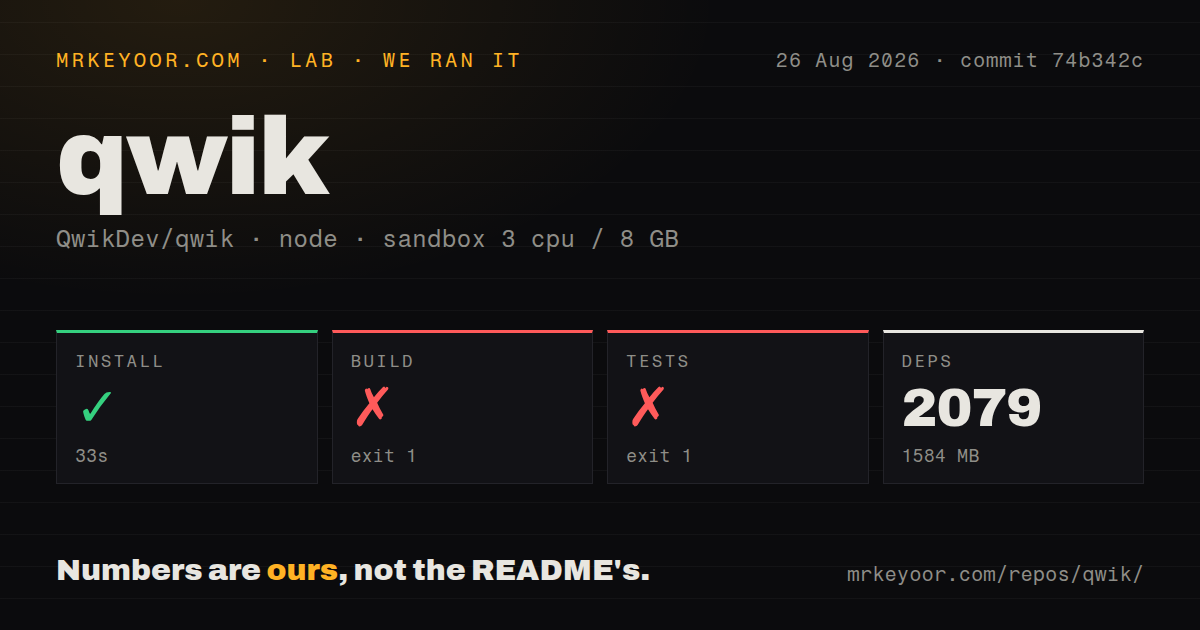
Our sandbox installed the commit 74b342c checkout in 33 seconds. Pnpm added 2,079 packages, and the installed tree occupied 1,584 MB. Installation was successful in the fresh Debian container with 3 CPUs and 8 GB of RAM. That is a heavy contributor environment before an editor cache or browser test artifact enters the picture, even though someone creating a normal Qwik application will install a smaller project than the framework monorepo.
The build exited 1 after 5 seconds. Its final output was a list of flags followed by Use pnpm build.local for initial build, which means the root pnpm build command behaves as a command dispatcher rather than the documented first build. The test command also exited 1 after 28 seconds. Its tail contained an execution wrapper with exit code 1 and Test failed, but no failed test name or assertion. We cannot tell more from that log, and we will not assign it a cause.
The contribution guide confirms the intended sequence: install dependencies, run pnpm build.local, then choose narrower build or test commands. A full build adds Rust and WebAssembly work; build.local copies optimizer binaries instead. The repository declares Node 22.18 or newer and pnpm 11.22 or newer. Five CI workflow files and a Dockerfile are present, while our scan found no directory literally named tests; test code instead lives across package and end-to-end workspaces.
Qwik 2 beta has open router and reactivity defects
Open issue 8966 reports that Qwik 2 beta.38 through beta.40 refetch route loaders from previously visited pages during later SPA navigations. Issue 8968 gives a beta.41 reproduction where a render crash in one sibling leaves an unrelated sibling's task and DOM updates frozen after the first click. Both reports include reproductions, but neither had a maintainer resolution when fetched. The main README labels Qwik 2 as beta and sends Qwik 1 users to a separate branch.
Project activity is not the concern. GitHub recorded a push on August 26, 2026, showed 22,050 stars, and listed 122 combined issues and pull requests. The latest GitHub release endpoint returned @qwik.dev/core@2.0.0-beta.38, published July 16, 2026. Its notes include changes to resume responsiveness, server rendering, async computed state, and error handling. The 5 CI workflows also indicate active automation. Those signals describe a maintained beta whose next major release is still unsettled.
The 1,584 MB checkout makes a prototype mandatory
Start with one route that resembles the hardest page you intend to ship. Include authenticated loaders, third-party components, error boundaries, analytics, and the deployment adapter you would use in production. Inspect shipped JavaScript and interaction behavior on a slower phone. Qwik's architecture can reduce eager browser work, but the repository run does not measure user-facing speed, and the project's broad performance claims are no substitute for your own page and traffic pattern.
The framework is easiest to recommend for a team that has already found hydration or eager JavaScript in a profile. A content-heavy site with a few interactive islands should compare Astro. A company whose risk sits in ecosystem coverage and staffing should compare Next.js. Qwik becomes the interesting choice when resumability addresses a known cost and the team is ready to design around serialization. Our 33-second install got the source onto disk, but the two exit-1 commands and current beta defects make a contained trial the sensible next decision.