One agent spans terminal, IDE, daemon, and SDK use
Qwen Code begins as a terminal application, with an interactive interface and a headless -p mode for scripts. The same project also documents VS Code, JetBrains, and Zed integrations, a desktop app, TypeScript, Python, and Java SDKs, chat channels, and an experimental shared daemon. That breadth lets a team reuse familiar agent behavior across several entry points. It also means a trial should name the interface being judged instead of treating every surface as equally mature.
Provider choice is one of its strongest reasons to exist. The README lists Qwen, OpenAI, Anthropic, Gemini, third-party compatible endpoints, Ollama, and vLLM. Authentication starts through /auth, and the active model can be changed during use. This is useful for comparing cost, privacy, tool calling, and code quality without replacing the whole client. Compatibility still needs a real task because providers can differ in schemas, reasoning controls, context limits, and tool behavior.
The feature list carries real permission consequences
Qwen Code includes subagents, agent teams, auto-memory, skills, hooks, MCP, language-server integration, worktrees, sandboxing, computer use, and an automatic mode. Those are meaningful capabilities, yet each one enlarges the set of actions a prompt may trigger. A safe rollout begins with read-only repository work, a narrow command allowlist, disposable branches, and inspection of every requested credential. Headless use in CI deserves an even tighter boundary because no person is present to catch an unexpected tool call.
Release v0.22.2 was published on August 26, 2026, and calls one change breaking: the persistent Node REPL moved to a standalone MCP server. The release also added explicit workflow opt-in triggers, a bearer-auth option for the loopback Web Shell, and several permission and credential fixes. That record shows active attention to boundaries, while the breaking change warns against installing latest into an unattended workflow. Pin the version and read release notes before upgrades.
What happened when we ran it
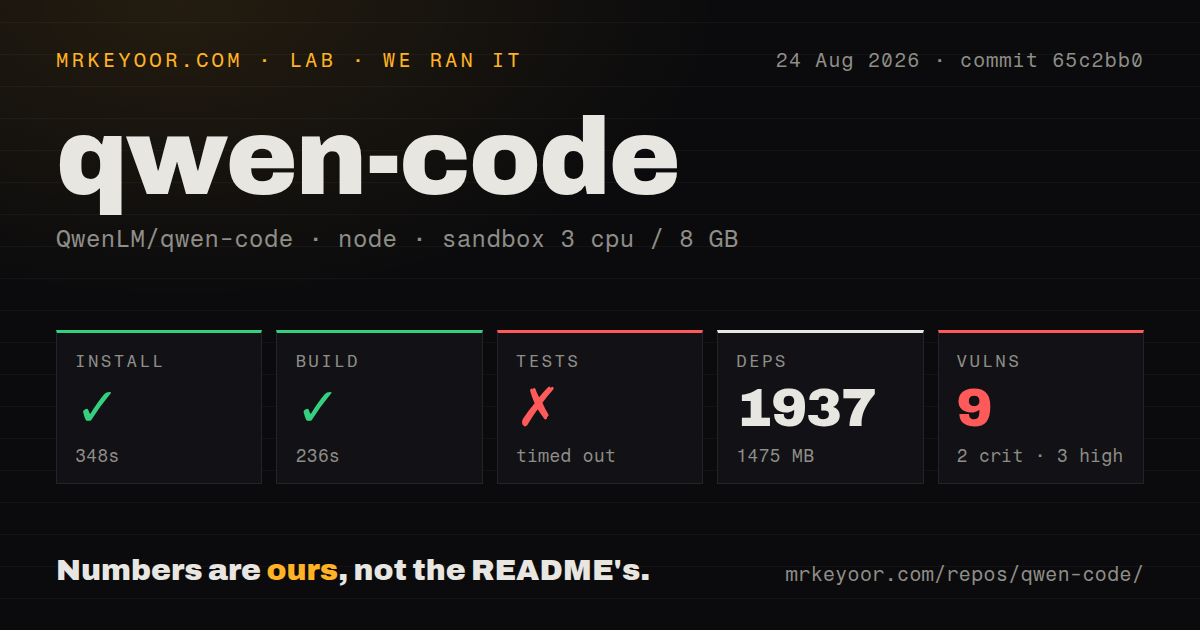
Our fresh Node 22 sandbox installed the npm workspace in 348 seconds. It added 1,937 packages and consumed 1,475 MB on disk. Building then succeeded in 236 seconds. The checkout already contained 8,636 files, about 3,302,842 source lines, and 163.2 MB, so this is a large development tree before dependencies. The repository had 51 CI workflow files, a Dockerfile, and npm workspaces.
The test command did not finish before our 900-second cap. Its last output showed passing files for CPU profiling, repository context, server lifecycle, workspace skills, fast-path opening, hook management, and qualified voice routes. A line saying runtime startup failed after listener was ready: runtime boom appeared among those passes, which looks like test output, not proof of an unhandled product crash. Since the suite never printed a final result, we cannot claim a pass count or a clean run.
Npm audit reported 9 known vulnerabilities in the installed dependency graph: 2 critical, 3 high, 3 moderate, and 1 low. The supplied measurement does not identify the affected packages or whether each path is reachable in normal use. It is still enough to require review before this agent receives repository credentials, shell access, or message-channel tokens. The build passing does not cancel advisories, and the timeout leaves the complete test state unresolved.
Model freedom still requires provider-specific testing
The multi-protocol approach is practical for teams that cannot settle on one hosted model. A local Ollama or vLLM endpoint can keep prompts inside a controlled network, while a hosted provider may offer stronger coding performance or easier scaling. Qwen Code supplies the client framework, but it does not make those choices equivalent. Tool-call formatting, image support, rate limits, and model-specific settings should be checked with the exact endpoint and model name intended for production.
The documented SDK example streams messages from a Python query while invoking the installed executable. Headless mode can summarize a repository or take part in CI. qwen serve shares one agent session over HTTP and server-sent events, though the README labels it experimental. A shared session raises questions about authentication, workspace ownership, concurrent commands, and transcript visibility. Version 0.22.2 added an authenticated loopback opening option, which is preferable to an unauthenticated local Web Shell.
MCP and skills make extension easy and review necessary
MCP support lets the agent call external tools and data services, while built-in skills cover review, batches, loops, and bug fixing. These extensions can turn a coding client into a much wider workstation agent. Treat every server and skill as code with authority, inspect its instructions, and separate read credentials from write credentials. A local model does not protect data once an MCP tool sends it to another service.
Qwen Code was derived from Gemini CLI v0.8.2 and then moved into independent development from its own v0.1 release. On August 26, GitHub showed 27,400 stars and 1,249 combined open issues and pull requests. The repository was pushed that day. This is very active software with a large queue, so star count says more about attention than stability. Current release notes and issue activity should be checked together before each upgrade.
A pinned, constrained trial is the sensible adoption test
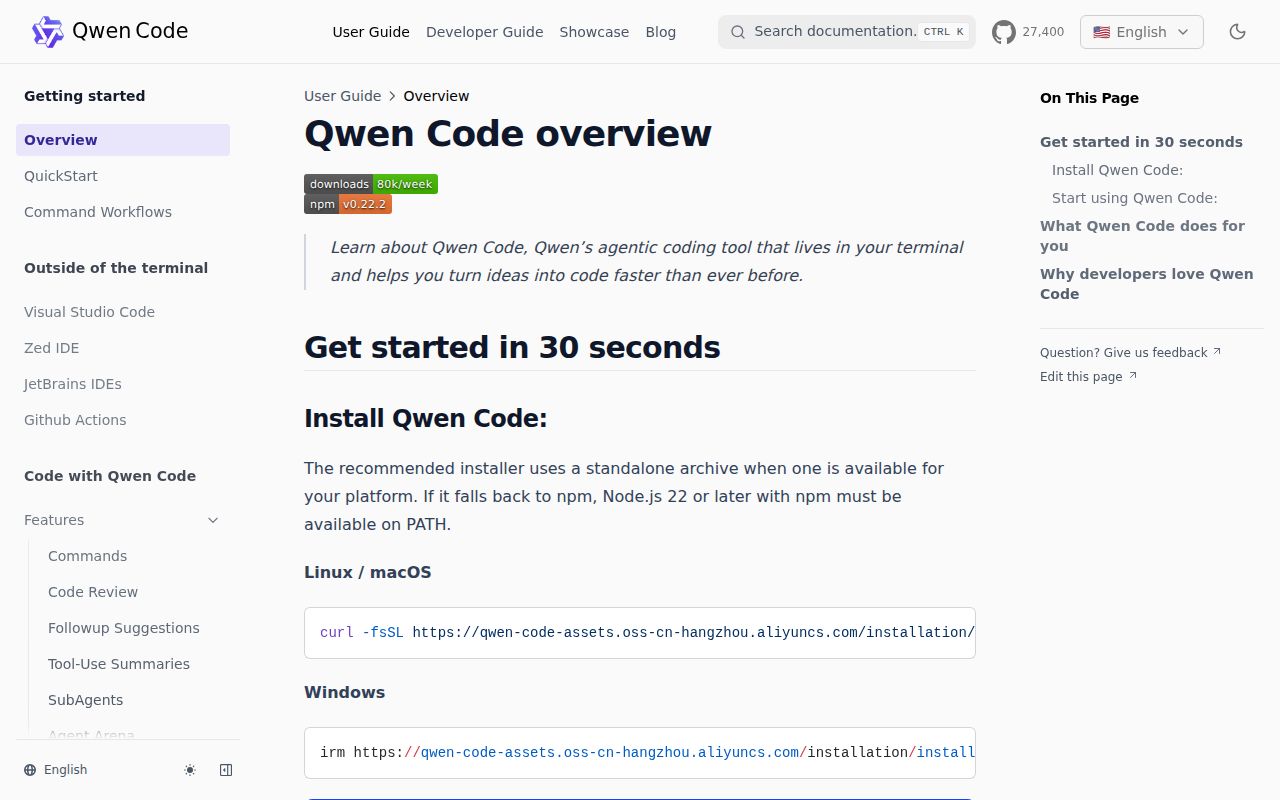
The packaged installer, Homebrew formula, and global npm command make first launch straightforward, assuming Node 22 or a standalone build and a provider credential. Source work is heavier: our install and build consumed 584 seconds combined, and the test command exceeded another 900 seconds. That cost matters for contributors, CI images, and teams that rebuild often.
Qwen Code is worth testing for developers who genuinely need several providers or several interfaces around one agent. Give it a representative issue in a disposable repository and score the resulting diff, commands, token use, and permission prompts. Keep the pinned version only if that run beats a narrower alternative. The unresolved test completion and 9 audit findings make unrestricted adoption hard to justify from the repository evidence alone.