The maintainer reserves YOLOv5 for legacy work
The repository's latest release is v7.0, and maintainer issue 13796 says YOLOv5 remains available for legacy projects, reproducibility, and users who specifically need this codebase. The same notice sends new projects to ultralytics/ultralytics for newer models, features, fixes, and releases. That is the cleanest adoption rule. A working YOLOv5 model has a reason to stay. A new application should begin by comparing the current package.
Maintenance has not stopped. The repository was pushed on September 16, 2026, and an August change updated deprecated PyTorch AMP usage. Dependency bumps and documentation edits also continue. Those changes keep older projects working, and GitHub does not mark the repo as archived. The distinction matters because the latest tagged release is still v7.0 from November 22, 2022, while current model development happens elsewhere.
Three vision tasks remain available in v7.0
YOLOv5 v7.0 covers object detection, instance segmentation, and image classification. The repository includes separate training, validation, and prediction scripts, plus a PyTorch Hub entry point for pretrained or custom weights. Detection accepts local media, webcams, screens, directories, URL lists, and network streams. That range is useful when an older application already depends on the script layout or result objects.
Export is a large part of the appeal. The documentation covers ONNX, TensorRT, CoreML, TensorFlow Lite, OpenVINO, and other targets, while v7.0 introduced the segmentation workflow. Each target still needs its own acceptance run. A successful PyTorch prediction does not prove numerical agreement, operator support, or acceptable resource use after conversion, and our lab did not benchmark inference or export any model.
What happened when we ran it
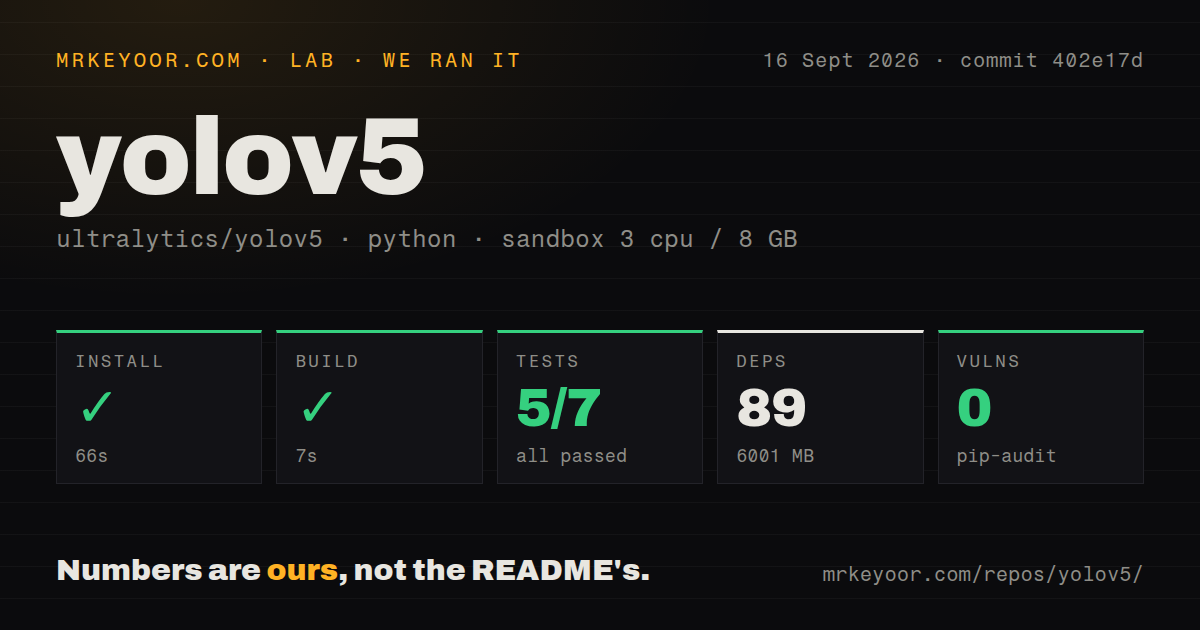
We measured a 66-second install of 89 packages, with 6,001 MB used on disk. The build completed in 7 seconds. Pytest ran for 32 seconds and reported 5 passed, 0 failed, and 2 collection or setup errors out of 7. Pip-audit reported 0 known vulnerabilities in the installed Python packages.
The two errors occurred while pytest imported tests/test_flask_rest_api.py and tests/test_invariant_common.py. Importing cv2 raised ImportError: libGL.so.1: cannot open shared object file. The log does not show a failed assertion or another cause. Our measurement setup used commit 402e17d in an unprivileged Python 3.12 Debian container with 3 CPUs, 8 GB of RAM, and no secrets.
A 6,001 MB install changes what easy setup means
The 143-file checkout occupied only 1.9 MB and contained about 16,707 lines of source, but its installed environment reached 6,001 MB. That is a sharp difference on CI runners, edge devices, or small cloud disks. The repository build itself took 7 seconds, so source compilation was not the expensive part of our run. Dependencies and their runtime libraries deserve their own capacity check.
The README asks for Python 3.8 or newer and PyTorch 1.8 or newer. Model weights download automatically for common inference paths, and training examples can fetch datasets as well. No hosted credential is required for the core local path, but network access and cache placement matter. Our checkout had 7 CI workflow files and a tests directory, yet no Dockerfile. The project instead links a published container image, Colab, Kaggle, and other prepared environments.
AGPL-3.0 may settle the commercial decision
YOLOv5 uses AGPL-3.0, and the README offers a separate Enterprise License for commercial applications that want to avoid those open-source obligations. A company embedding the code or models into a closed product should have counsel evaluate the intended distribution and service architecture. The popularity of the repository does not soften the license terms. Decide that point before building a training pipeline around it.
Apache-2.0 alternatives such as Detectron2 and MMDetection may be easier for organizations with policies against AGPL code, though they do not preserve YOLOv5 APIs or checkpoints. The main ultralytics/ultralytics repository uses the same AGPL and enterprise-license approach. Moving there addresses the legacy issue. The licensing choice stays the same. For a proprietary product, model quality and developer familiarity come after permission to ship.
September 2026 activity maintains the compatibility branch
GitHub showed 58,021 stars and 31 open issues when fetched, with no open pull requests. The last push was September 16, 2026, one day before this review, but the latest release tag remained the 2022 v7.0 release. Recent commits include dependency updates, a PyTorch API migration, repository configuration, and links to newer YOLO generations. Those are useful maintenance signals without changing the maintainer's stated direction for new work.
YOLOv5 still makes sense when an existing dependency requires it. Keep it for a trained v5 checkpoint, a paper reproduction, or an application whose post-processing expects these result objects. For a blank repository, start with the main Ultralytics package and compare alternatives before writing integration code. If you do stay, reproduce the 5 passing tests after adding the required system library and test every export on its real device.