Four harness modes share one agent workspace
OpenBitFun's 7,985-file checkout presents 4 harness modes inside the same desktop workspace. Minimal handles direct tasks, Standard adds planned steps, Ultimate coordinates agents, and Creative extends the product. Sessions can continue while you check them from a browser or phone. This is a wider brief than an editor plug-in. It is trying to be the place where the work runs.
That width is visible in the checkout. Our copy contained 7,985 files and roughly 1,760,928 lines of source before dependencies. A Rust runtime sits under desktop, CLI, web, mobile, Relay, marketplace, and design-system packages. The repo also connects MCP tools, skills, hooks, custom agents, and Mini Apps. If you only want code completion or one chat panel, much of this structure becomes upkeep rather than benefit.
Remote workspaces keep execution on the selected machine
The 158.8 MB checkout keeps file operations and agent commands on the selected SSH host or Docker container. A workspace can sit behind jump hosts or run inside a local or remote container. The remote-workspace guide says session history, permissions, and credentials remain on the OpenBitFun host. That separation lets a laptop control work on a server without installing the full product on the target.
Cross-device control is more confusing in the top-level documentation. The README says account synchronization uses a Relay server you deploy. The Relay's own current README says regular users sign in through GitHub and use the official endpoint, while same-network mode can run locally. Self-hosting is for community forks and requires endpoint edits plus a matching client build. A buyer can use the official path, but an operator should read the deeper document before planning infrastructure.
What happened when we ran it
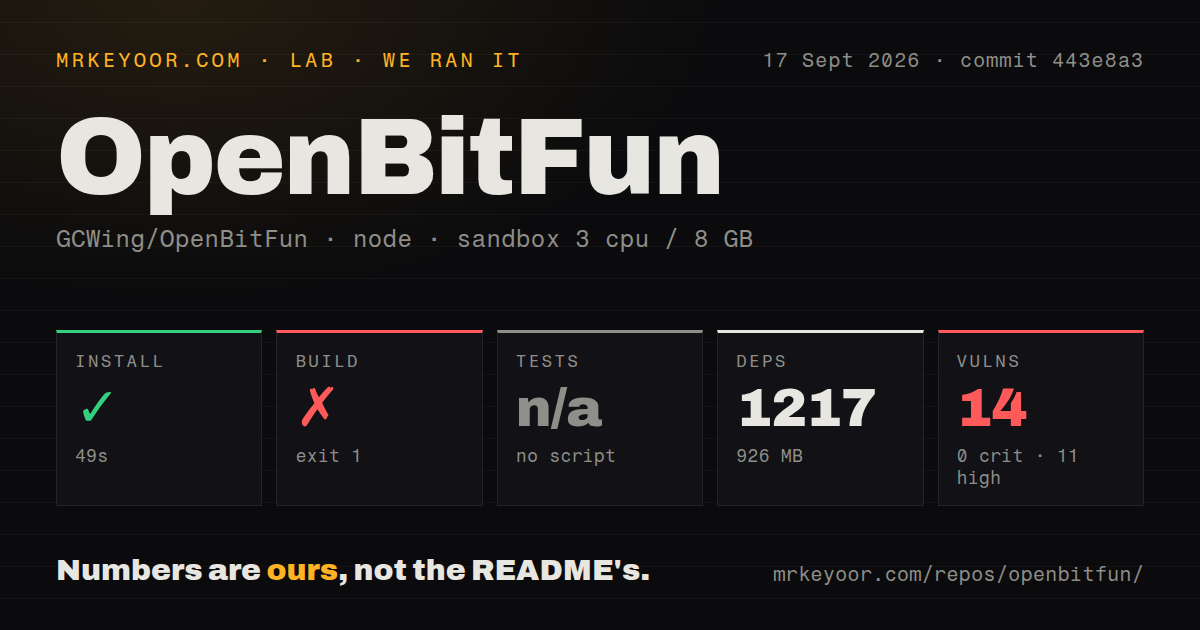
Our measurement setup used commit 443e8a3 in an unprivileged Debian sandbox with 3 CPUs, 8 GB of RAM, Node 22, and no secrets. Our run installed 1,217 pnpm packages in 49 seconds and used 926 MB on disk. The repository was 158.8 MB before that install, which completed without an error.
The build failed after 30 seconds with exit code 1. Node reported ERR_MODULE_NOT_FOUND for design-system/packages/theme-openbitfun/dist/index.js, followed by repeated lifecycle failures. The log tail proves that the expected built module was absent at import time. It does not prove why the file was absent, so we would not label this a pnpm, Node, or ordering bug without a narrower reproduction.
There was no tests script or target, so the lab skipped tests rather than claiming a pass. The repository does contain a tests directory and 11 CI workflow files. Npm audit reported 14 known vulnerabilities: 11 high, 1 moderate, and 2 low, with none classified as critical. That is too much unresolved dependency risk for a clean internal approval, even though severity counts alone do not establish whether each path is reachable in the shipped app.
The packaged app avoids the failed source build
Release 1.0.0, published on September 15, supplies Windows installers, macOS builds for Intel and Apple Silicon, Linux AppImages, and DEB and RPM packages for x64 and ARM64. That is the quickest route to a product trial. Source development asks for Node.js 22.12 or newer, pnpm 10.15.0, Rust, and Tauri's operating-system prerequisites before pnpm run desktop:dev. Our 30-second failure came after the dependency install, so satisfying those named prerequisites did not produce a complete build at the measured commit.
You still have to choose and configure a model. Remote projects add SSH keys, passwords, Docker access, or jump-host settings as appropriate. Agents can edit files and execute commands, which makes the approval model part of setup rather than a preference to revisit later. Open issue 3084 gives one concrete reason: on Windows 10, a non-TTY Python process launched through a Windows App Execution Alias survived both kill and interrupt even though the control call reported success.
Version 1.0 draws a hard migration line
The 1.0.0 README says its data is incompatible with legacy 0.2.x releases. The supplied migrator covers stable releases 0.2.17 through 0.2.19. Users on an older build need to resolve that gap before treating an upgrade as routine. This matters because OpenBitFun stores durable sessions and workspace state, the material most likely to make an agent workspace worth keeping.
Remote behavior is still settling as well. Open issue 3072 reports a large memory increase and an unresponsive interface while loading two remote sessions, though the report does not identify an operating system or provide a minimal reproduction. That thin evidence should not be stretched into a universal defect. It does justify testing your own long sessions and switching between devices before trusting remote control during important work.
September activity is fast, while the measured build remains the gate
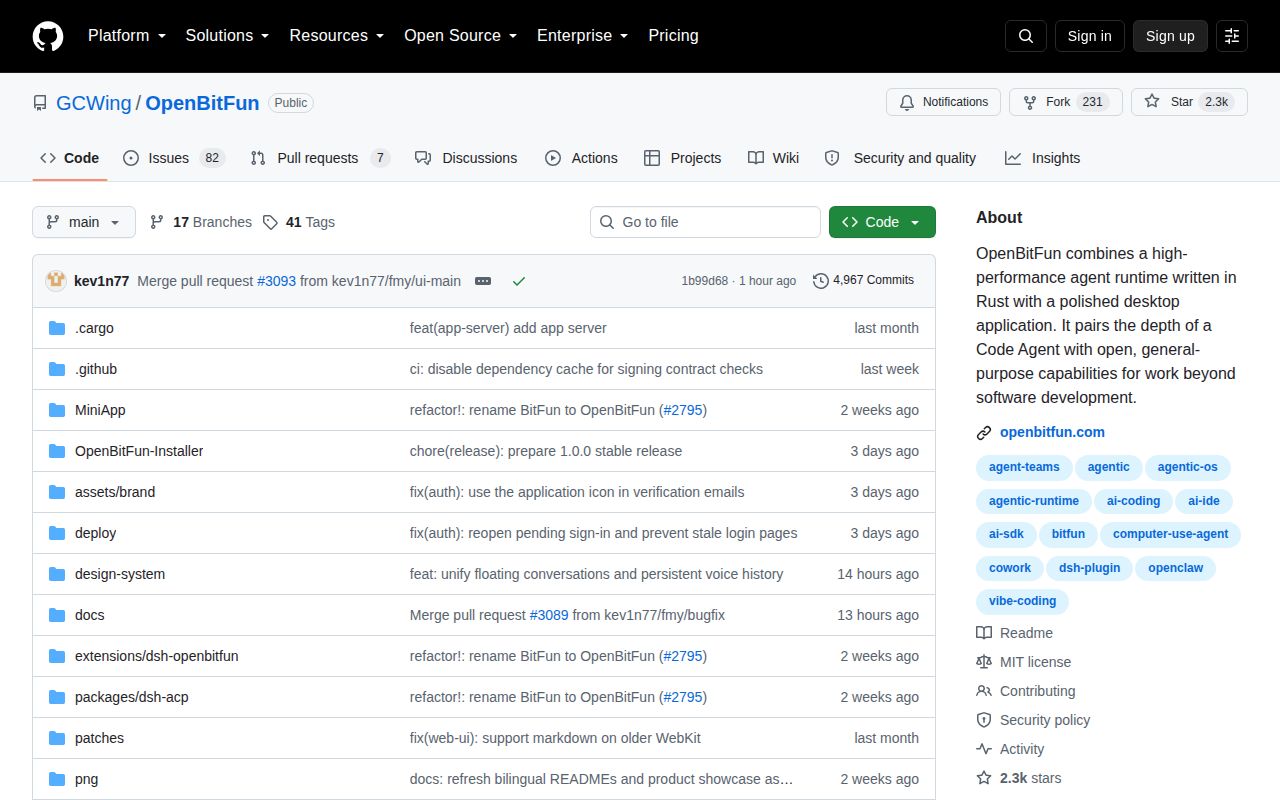
GitHub showed 2,272 stars, 231 forks, and 89 open issues and pull requests when fetched. Search separated 82 open issues from that combined count. The last push was September 18, 2026, three days after the 1.0.0 release, and the Windows process-control report was updated on September 17. This is active maintenance, not a repository coasting on an old tag.
OpenBitFun earns a trial if its cross-machine workspace solves a problem you already have. Start with the packaged app, test command cancellation and remote sessions on your own machines, and decide which Relay trust model fits. Teams building from source should hold approval until the missing design-system module is understood and the 14 audit findings have been triaged.