OpenTofu manages infrastructure through plans and state
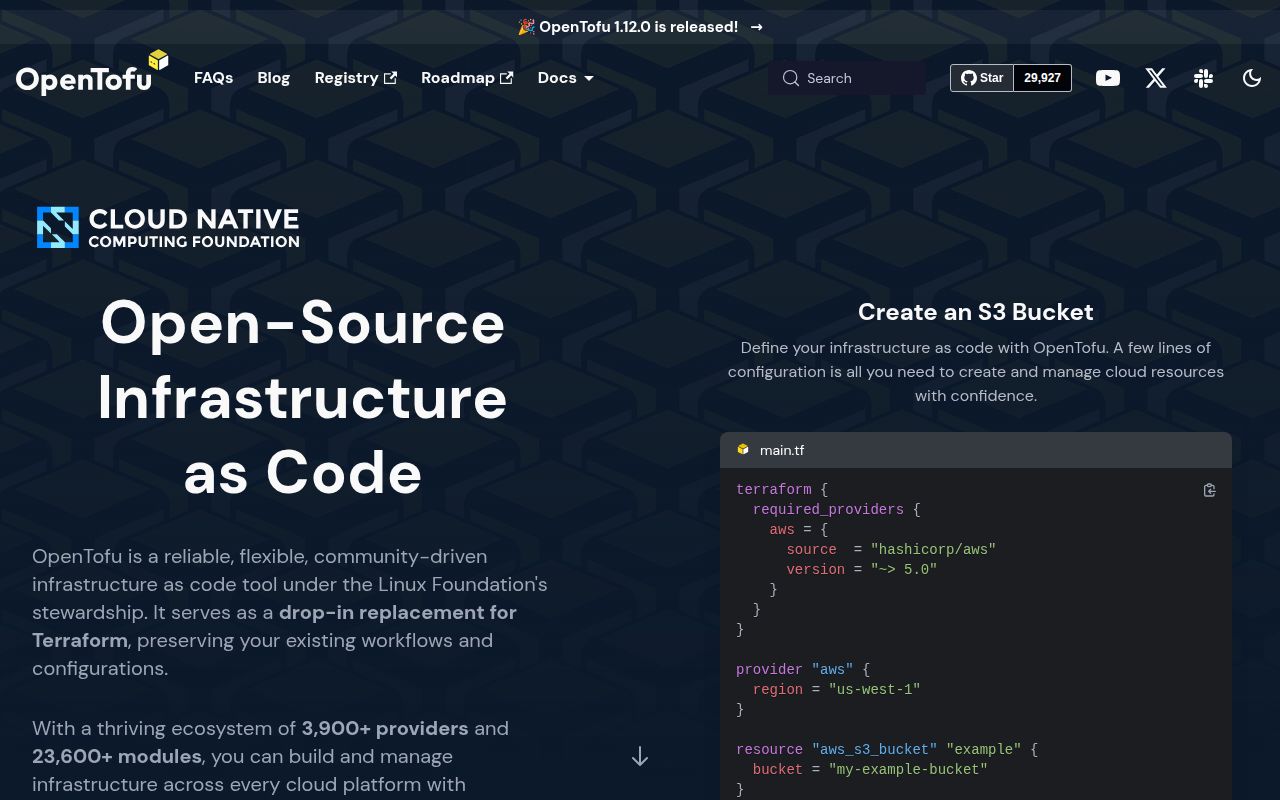
OpenTofu reads declarative configuration, builds a dependency graph, previews the intended work, and creates or changes infrastructure through providers. The workflow will be immediately familiar to Terraform users: initialize a directory, inspect a plan, then apply it. That familiarity is the main reason to consider OpenTofu. A team can evaluate a different implementation without first rewriting every module in a programming language or moving infrastructure control into Kubernetes.
The tool covers existing public providers as well as custom internal ones. Its MPL-2.0 license and community governance distinguish it from HashiCorp's current Terraform distribution, while the OpenTofu registry supplies provider and module packages. The registry is an operational dependency, not a footnote. The README says access is blocked from specified countries of origin to comply with sanctions, which can rule out the default distribution path for affected users.
Migration requires a backup and matching plans
OpenTofu's migration guide starts with state and configuration backups. It requires access to the existing Terraform state plus the ability to run both terraform and tofu. After tofu init, the guide expects tofu plan to show no changes or the same changes as Terraform. If the plans differ, its instruction is direct: do not apply. That is sensible advice because state is the record connecting configuration to real resources.
The rollback path is equally concrete. Stop using OpenTofu, restore state if it changed, run Terraform initialization and planning, then confirm that no surprise changes appear. Interdependent configurations need extra care because terraform_remote_state can pass data between separate states. A simple module may migrate in a short session, but an estate with several state files needs an ordered rehearsal and a recovery point for each one.
What happened when we ran it
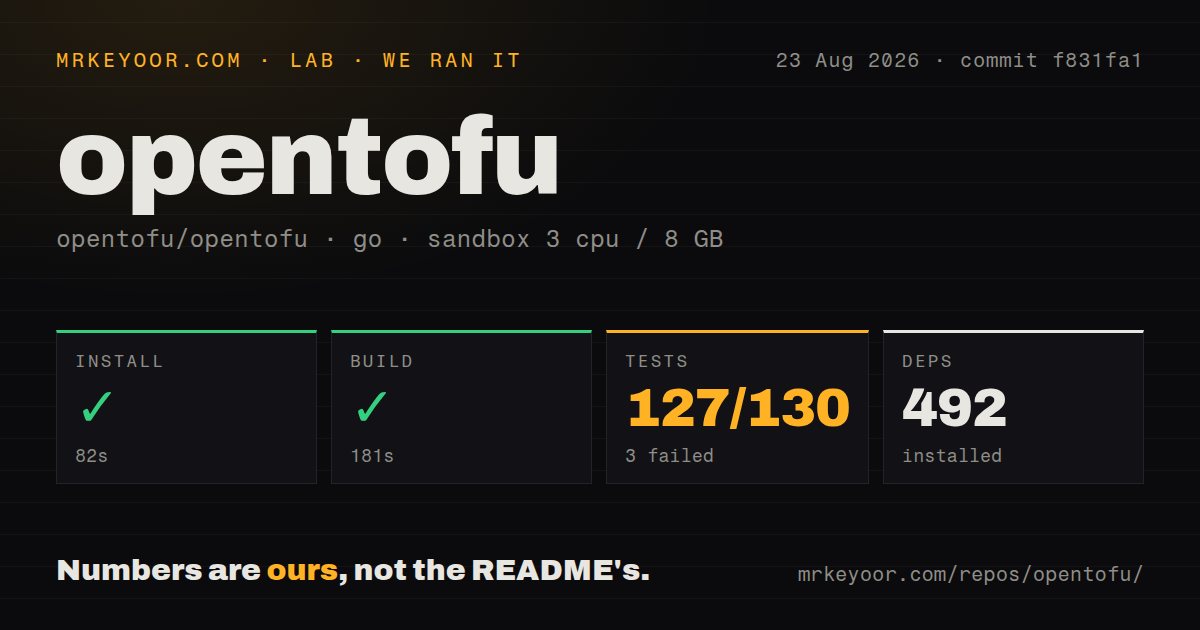
Our sandbox installed 492 Go packages in 82 seconds and built commit f831fa1 in 181 seconds. The fresh checkout had 5,107 files, about 575,910 lines of source, and occupied 24.3 MB before dependencies. That is a large compiler and infrastructure codebase, although its successful build means the standard source path worked in the supplied Go 1.24 Debian environment without privileged access or secrets.
The test command failed after 279 seconds with exit code 1. Go reported 127 passed package results and 3 failed out of 130. The tail identified internal/tracing/traceattrs and said that, if the preceding error concerned conflicting schema versions, the semantic-convention package imported by semconv.go should match the package imported elsewhere. The log excerpt does not prove why those versions conflicted, so we would reproduce the failure before changing dependencies.
Eleven CI workflow files and a Dockerfile were present, while there was no top-level tests directory. Go projects commonly keep tests beside source files, so that directory signal alone says little. The failed command matters more: anyone building this exact commit should expect investigation before treating a green local suite as a release gate. Our result covers the stated 3-CPU, 8 GB sandbox, not provider behavior against live cloud accounts.
Plans reduce surprise, but they do not remove credentials or risk
An execution plan shows proposed operations before an apply, and the resource graph can run independent changes in parallel. Those mechanics help reviewers see order and scope. They cannot verify every external effect. Provider credentials, backend permissions, account quotas, policy controls, and eventual API behavior still determine what happens when the plan reaches a service. Production adoption needs isolated credentials and a noncritical project for the first apply.
Source setup is also different from day-to-day CLI installation. Our 82-second dependency step and 181-second build describe contributors compiling the repository. Most operators should use a documented package or release artifact, verify it, then spend their time testing modules, providers, and backend access. Nightly builds are available for current main-branch behavior, but the README calls them experimental and removes each build after 30 days. They belong in compatibility checks, not pinned production automation.
Current maintenance is visible in pushes and security releases
GitHub showed 29,927 stars, 326 combined open issues and pull requests, and a last push on August 26, 2026. Those figures show attention and a substantial user base, but the combined count is not a defect total. Recent open work includes string-handling performance, legacy CLI restructuring, lifecycle expression support, and a report about mathematical functions surfacing an internal panic instead of a clean error. Buyers should inspect the issues that overlap their modules rather than judging by the headline count.
Release v1.12.6 arrived on August 19, 2026 with 2 security fixes. One concerned credentials being resent to an HTTP redirect target during OCI registry interactions. The other addressed high CPU or memory use triggered by crafted relative URLs from an attacker-controlled backend or registry. That release history is evidence of active response, and also a reason to keep infrastructure CLIs patched: initialization processes network responses and credentials before a plan ever changes a resource.
OpenTofu is best when governance justifies migration work
OpenTofu makes the strongest case to Terraform users who like the existing configuration model but want a community-run implementation and registry. The migration guide is careful, releases are current, and the 181-second build passed in our clean environment. The 3 failing package results keep us from calling commit f831fa1 clean, though they do not erase the 127 passing results or establish a production defect.
Choose Terraform when exact HashiCorp behavior, its hosted workflow, or vendor support is mandatory. Choose Pulumi when general-purpose languages are the main draw, and Crossplane when Kubernetes reconciliation should own infrastructure. For OpenTofu, back up state, compare both plans, test one low-risk change, and pin a stable release. That procedure is more important than whether replacing the executable itself feels easy.