A useful answer to agent overbuilding
Ponytail gives a coding agent a seven-step decision ladder. First ask whether the change needs to exist. Then look for code already in the repository, the standard library, a native platform feature, or an installed dependency. Only after those options fail should the agent write the minimum new implementation. The memorable example is a browser date input replacing a new date-picker dependency and wrapper component.
The idea works because coding agents often optimize for producing an impressive patch rather than minimizing the maintenance surface. A generated abstraction can look tidy while adding configuration, tests, upgrade work, and another place for behavior to drift. Ponytail makes reuse and deletion explicit parts of the task. Its review, audit, and debt commands extend that pressure beyond initial generation.
Minimal code can become careless code, so the skill says validation at trust boundaries, data-loss handling, security, and accessibility are exempt from cuts. That is the right rule, but an instruction cannot verify its own judgment. A human or independent reviewer still has to check whether the agent labeled a necessary safeguard as unnecessary ceremony.
The project tests its own claim
The README includes a reproducible benchmark rather than only before-and-after anecdotes. Its newer agentic study compares the same agent with and without the skill across feature tickets in a FastAPI and React repository. The maintainers also preserve an older single-shot study and explain why its conversational baseline exaggerated the line reduction. That correction is more persuasive than presenting the larger number without context.
Treat those results as the project's measurements, not ours and not a promise for every model or codebase. The effect was largest on tasks with an obvious overbuild trap and small when the baseline solution was already compact. The README also notes that a reasoning-heavy model can spend more thought on the ladder. Your useful metric is whether accepted patches become smaller without more escaped defects, review time, or later rework.
Installation ranges from a plugin to a copied file
Claude Code and Codex have native marketplace installations. Their plugins use two Node lifecycle hooks to activate the selected mode and carry instructions into supported subagents. Codex asks the user to inspect and trust those hooks. If Node is missing from the shell environment, the instructions can still work while automatic activation does not.
Other hosts vary. OpenCode and Gemini have plugin or extension routes. Copilot CLI, Pi, Hermes, Devin, Qoder, and several newer agents get dedicated instructions. Cursor, Windsurf, Cline, editor Copilot, Kiro, Zed, and similar tools may only load a copied rule file. This breadth is handy, but the feature set is not equal. Check whether your host gets mode switches, commands, hooks, subagent injection, or just the static ladder.
Uninstalling also has an order. Ponytail writes a small mode flag and optional config outside the plugin directory. Its cleanup script must run before the host removes the plugin, because removal deletes the script itself. The README documents this and says the cleanup should preserve an unrelated status line, but an open report describes an older uninstall path removing a combined status-line setting. Back up agent configuration before testing global installation.
What happened when we ran it
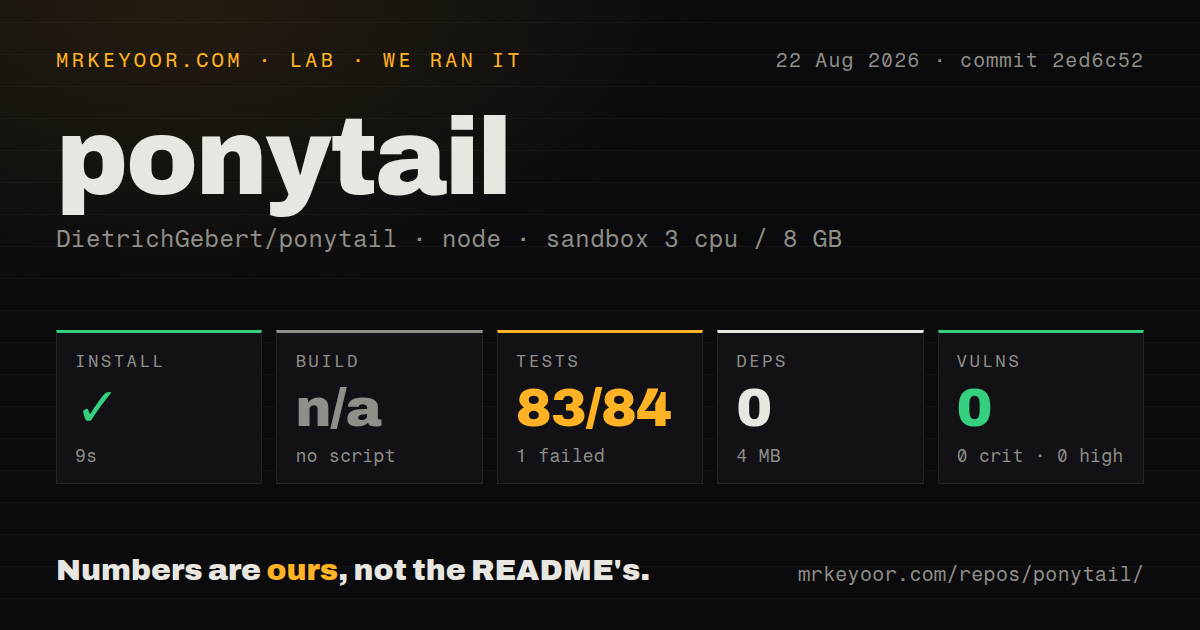
We cloned commit 2ed6c52 into a fresh unprivileged Debian container with three CPUs and 8 GB of RAM. The checkout contained 159 files, about 6,554 lines of source, and occupied 1.6 MB. Installation completed in 9 seconds, added zero packages, and used 4 MB on disk.
There was no build script or target, so our harness skipped the build. Node's test runner finished in 20 seconds with 84 tests: 83 passed and 1 failed. The provided tail showed only the final counts and duration. It did not name the failed test or show its assertion, so we cannot say what broke. Npm audit found zero known vulnerabilities at every reported severity.
The repository has a tests directory and two CI workflow files, with no Dockerfile. The small dependency footprint fits the project's theme. The single test failure still matters because lifecycle hooks, mode state, and adapter copies are exactly the sort of small integration details that can alter agent behavior without an obvious application crash.
Current rough edges change how to use it
One open report says the always-on instruction to read every touched file fully caused an agent to stall on a very large Markdown file, then repeat the same attempt after follow-up prompts. Another says /ponytail-review persisted a review mode that replaced the normal ruleset with a pointer for the rest of the session. Both reports concern the mechanism that keeps the guidance active, not the minimal-code principle itself.
Subagent injection needs a deliberate boundary. An open report found that review and security subagents received the same pressure toward shorter output, which can reduce the independence and depth of the check. Ponytail now documents a matcher for selecting agent types, but another report says an invalid regular expression can crash that hook. The safest setup keeps search, review, and security agents outside the minimal-output instruction unless you have tested the matcher.
Health and choice
The repository was pushed and version 4.9.0 was released on August 7, 2026. GitHub's count of 158 combines issues and pull requests, with adapter and behavior reports updated later in August. The project is active, candid about its benchmark limits, and MIT licensed.
Choose Ponytail when overbuilding is a repeated, observed problem. Caveman targets verbose agent speech instead. Superpowers supplies a fuller engineering method, while ECC brings a much larger catalog and runtime. Ponytail is best as one narrow rule with an independent acceptance check: fewer moving parts are good only when the remaining parts still solve the whole task.