One 13.6B model covers generation and continuation
LongCat-Video packages several related jobs around one main model. It can start a clip from text, animate a still image, continue an existing video, generate longer sequences in segments, and accept interactive controls. Separate Avatar weights add speech-driven characters, including a two-audio mode for conversations. That breadth is useful for a research group that wants common code and checkpoints instead of a different repository for each experiment.
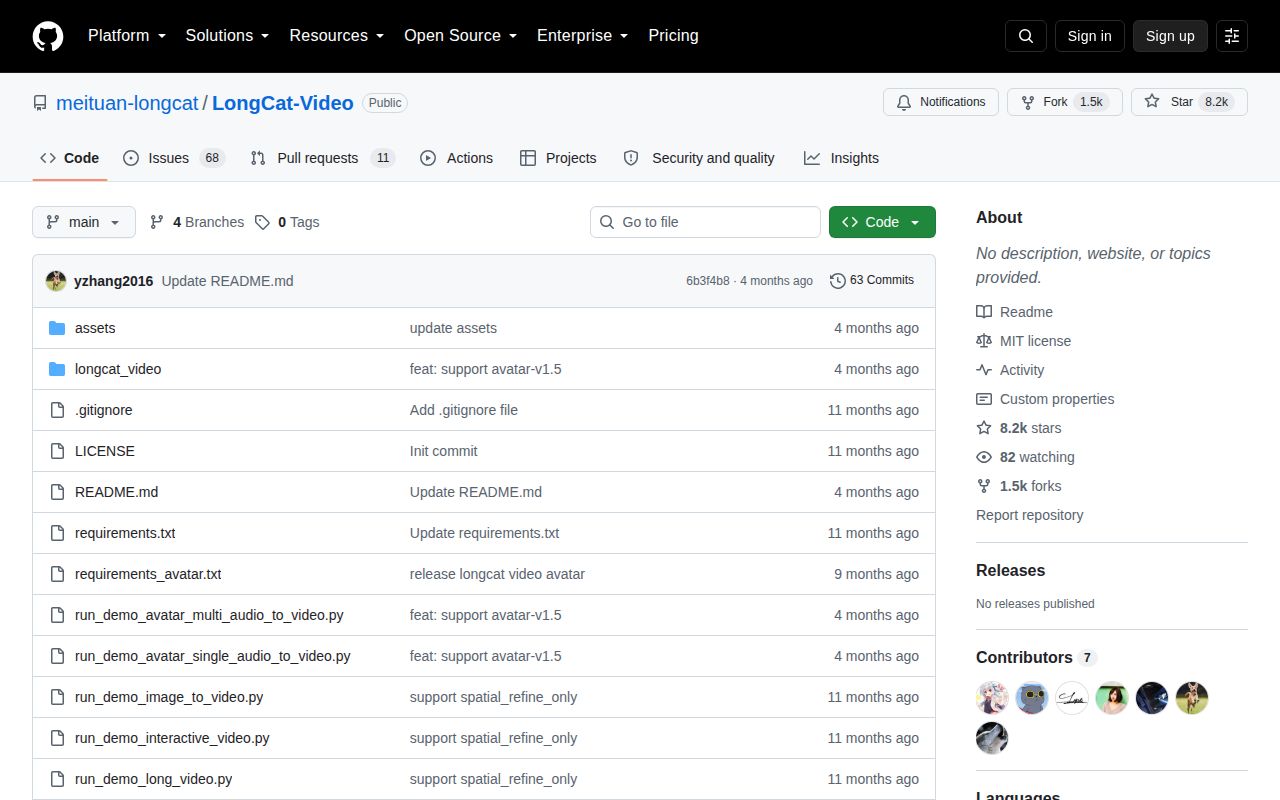
The repository itself is small beside the model: our checkout contained 58 files, about 12,868 source lines, and 49.5 MB. Most of the real payload arrives later through Hugging Face downloads. The README lists separate weights for the foundational generator, Avatar, and Avatar 1.5. A developer evaluating every path is therefore managing several model packages, configuration trees, and input formats even though the Python source is compact.
The 23-second install does not measure video inference
Our clean Python environment installed without an error. That is good news for the package surface, yet it covers only the part a normal dependency resolver can see. The README's actual generation commands assume downloaded checkpoints, a CUDA-aware PyTorch installation, FlashAttention, and torchrun. None of those requirements becomes cheap merely because the repository's basic dependencies resolve.
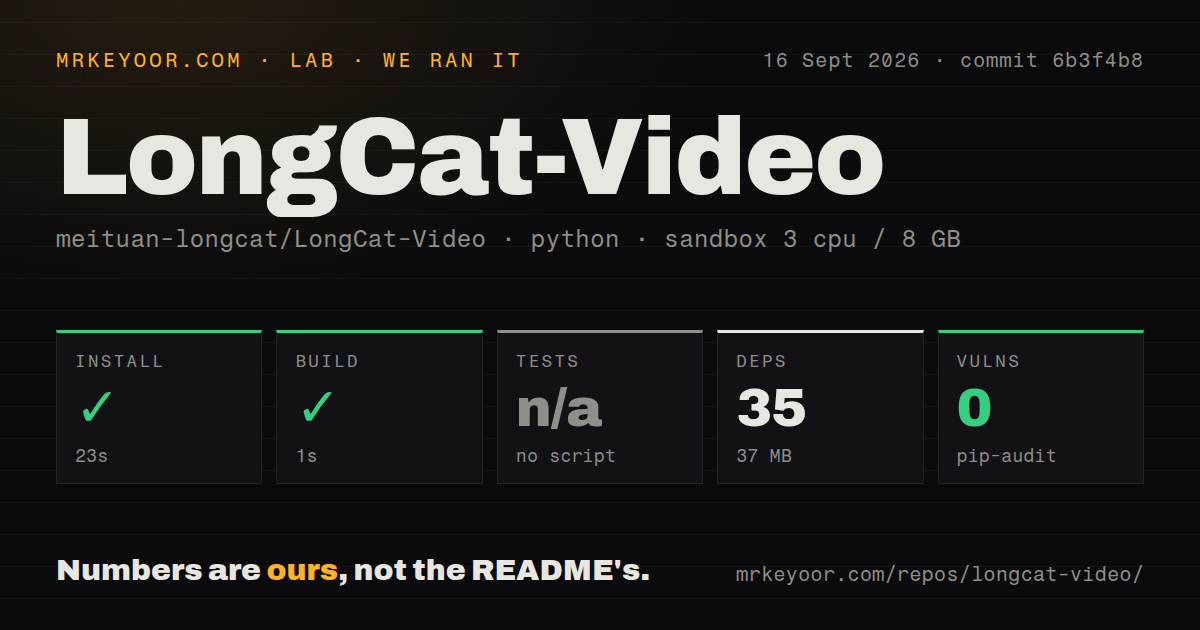
Our run installed 35 packages in 23 seconds and occupied 37 MB. The recorded build step passed in 1 second. Pip-audit reported 0 known vulnerabilities in the installed set. Those are useful packaging results, not a speed or quality benchmark for LongCat-Video. The measured steps did not download the model weights or exercise text-to-video, image-to-video, continuation, interactive generation, or Avatar output.
What happened when we ran it
The install and build both completed in the fresh Debian container, with 3 CPUs and 8 GB of RAM. No credentials or secrets were present. When the pipeline looked for a test script or target, it found none and skipped the test stage. That leaves us with a successful environment check and no automated evidence from the repository about whether its generation paths agree with one another.
The scan found 0 CI workflow files, no Dockerfile, and no tests directory across 58 files. The absence of a root test target matters more here because several backends and model variants share the codebase. A change can affect FlashAttention, multi-GPU context parallelism, audio preprocessing, or continuation without a visible repository gate catching it. Teams adopting the code should create their own fixed prompts, reference images, audio clips, and output checks.
CUDA 12.4 and FlashAttention narrow the supported path
The setup guide starts with Python 3.10, then pins PyTorch 2.6.0, torchvision 0.21.0, and CUDA 12.4 wheels. It separately installs Ninja, psutil, packaging, and FlashAttention 2.7.4.post1. FlashAttention 2 is enabled in the model configuration by default. FlashAttention 3 and xformers are options only after you install them and change the weight directory's configuration file.
That stack is more particular than our 35-package, 37 MB result suggests. Open issue 88 says the FlashAttention command may need --no-build-isolation, while issue 79 reports the official demo running out of memory on a nominal 48 GB GPU setup. Those reports do not establish one universal memory requirement. They do establish that GPU model, attention build, resolution, parallelism, and chosen pipeline belong in the first proof of concept.
Avatar 1.5 adds faster sampling and more tuning knobs
Avatar 1.5 swaps in a Whisper large audio encoder, requires its distilled sampling mode, and offers optional INT8 loading for its diffusion transformer. The README exposes controls for audio guidance, reference-image position, mask-frame range, resolution, and segment count. Two-speaker work can mix equal-length audio or concatenate clips with silence. This is research code with useful controls, not a single upload button with fixed behavior.
The 49.5 MB checkout also asks Avatar users to install librosa, FFmpeg, and another requirements file before downloading separate weights. Open issue 125 reports that this avatar dependency path failed at libsndfile1==0.0.1 under the documented Python 3.10 environment. Open issue 120 describes excessive mouth movement, head motion, and facial drift in v1.5. A production avatar trial needs both a repeatable environment and reviewers watching complete clips, especially across multiple continued segments.
May's code push trails September's issue activity
GitHub recorded the last code push on May 27, 2026. The repository had 8,174 stars and 79 combined issues and pull requests when fetched. New issues were still arriving in September, including questions about evaluation and hardware compatibility, but user activity does not prove maintainer response time. The GitHub API returned no latest release object, so the README and commit history are more useful update signals than a release badge here.
LongCat-Video earns a research trial when its task mix matches the work and the GPU budget already exists. Our 23-second install and 1-second build make the source easy to inspect, while the missing test target prevents that result from carrying much weight. Pin one hardware configuration, choose one model variant, and judge full clips with your own prompts before building a service around it.