A whole engineering system for an agent
ECC goes far beyond a prompt file. It packages specialized agents, task skills, slash-command compatibility, rule packs, hooks, memory, security scanning, and adapters for several coding assistants. Its preferred loop asks the agent to plan, test, implement, review, verify, and retain useful context. The practical appeal is consistency: a developer installs the workflow once instead of rebuilding a checklist in every session.
Claude Code gets the deepest integration. ECC installs through a native marketplace plugin and can use plugin-managed hooks. Codex has a native plugin route and a deprecated sync route for older setups. Cursor, OpenCode, Gemini, Zed, Copilot, Kimi, Hermes, and other tools receive different subsets because their extension systems differ. The README is unusually direct about this. Its support matrix shows where skills, agents, hooks, delegation, and project files do or do not exist.
That honesty prevents the worst marketing mistake, assuming a copied folder creates parity. A GitHub Copilot installation is instruction-only. Codex does not use Claude Code's hook profiles. Some optional cross-platform features still need Bash or Python. If your team moves among several assistants, decide which behavior must remain consistent and which behavior is allowed to vary.
Installation has one important rule
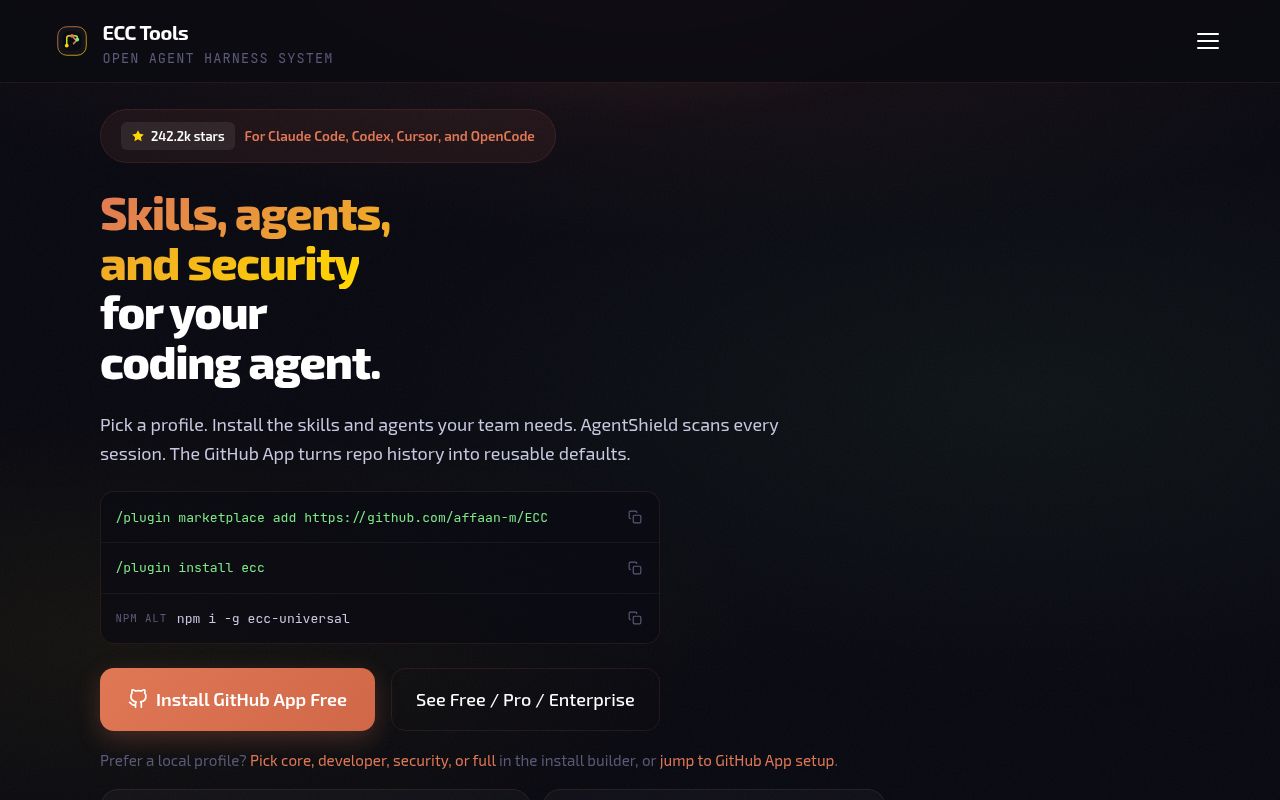
For Claude Code, ECC recommends adding its marketplace and installing ecc@ecc. The README repeatedly says to choose one path per harness. Do not combine the plugin with a full manual install, and do not combine Codex's native plugin with the legacy sync process. Layering paths can duplicate commands, skills, hooks, or configuration, which is hard to diagnose because the duplicate files may live in different scopes.
The project has doctor, repair, dry-run, and uninstall commands, plus selective profiles for users who do not want the entire surface. That makes a cautious rollout possible. Begin with common rules and one language pack, or choose a low-context path without runtime hooks. Read the generated changes before enabling a profile across every repository. Agent instructions are operational configuration, and hooks may run on ordinary tool calls.
An open issue reports a concrete packaging problem in a Claude marketplace checkout: scripts that need ajv or sql.js failed because the plugin clone had no node_modules. The report identifies install planning, the control pane, and the memory MCP entry among affected paths. Check the current issue state and run the project's diagnostics on the exact revision you install. A two-command setup is only successful when the workflows you need can execute afterward.
What happened when we ran it
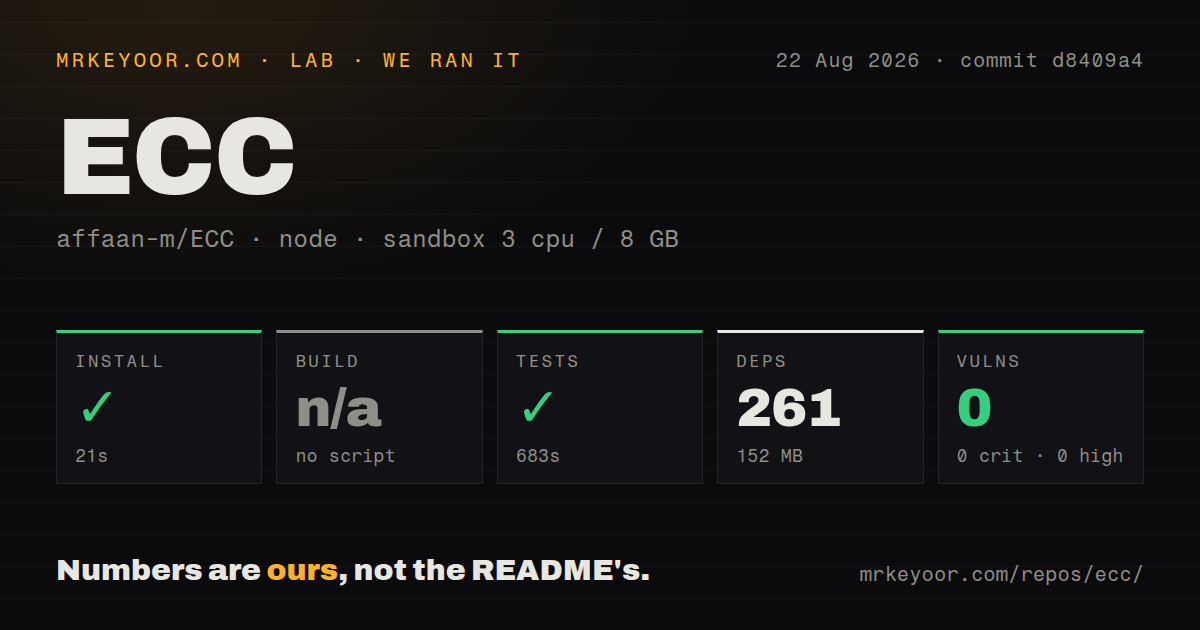
We cloned commit d8409a4 into a fresh unprivileged Debian container with three CPUs and 8 GB of RAM. The repository held 3,493 files, about 245,284 lines of source, and occupied 51.5 MB. Yarn installation succeeded in 21 seconds, adding 261 packages and using 152 MB on disk.
The project had no build script or target, so our harness skipped the build. Its tests succeeded in 683 seconds. The measurement did not provide a test count, so the pass says the configured command exited successfully and nothing more. Npm audit found zero known vulnerabilities: none critical, high, moderate, or low.
ECC includes a tests directory and 11 CI workflow files, with no Dockerfile. The long successful test step is a stronger signal than a package that merely installs, especially for a repository full of installers and hooks. It cannot prove that every host version, operating system, plugin scope, and optional adapter behaves the same. Those combinations still need a small acceptance check on the machines where developers work.
Hooks and memory deserve close inspection
Hooks can enforce useful habits or add friction to every command. ECC includes checks around dangerous shell operations, configuration changes, formatting, session summaries, and other events. An open report says the wrapper around a configuration-protection hook passed the wrong input shape and then discarded its blocking exit code. Another reporter profiled roughly 1.6 seconds of synchronous overhead per Bash call, much of it from processes that quickly decided they had nothing to do. These reports are version-specific, but they show why a hook must be tested through the host, not only as a standalone script.
The Memory Vault is a better-shaped feature. It stores handoffs and context as inspectable Markdown under explicit project, team, or user scopes. The README labels recalled memory unreviewed context and tells agents to verify important claims before promoting them into governed documentation. An optional MCP server exposes bounded save, search, read, and doctor operations. One open compatibility report says Codex metadata parameters caused its tool discovery and calls to fail until _meta was accepted. Test that route if cross-harness memory is part of the purchase decision.
AgentShield scans agent configuration, permissions, hooks, MCP entries, and possible secrets. This is useful hygiene, though a scanner packaged with the same system cannot turn every hook into a security boundary. Keep sandboxing and least privilege in the host, review executable changes, and treat hook checks as an extra layer.
Who should adopt it
The repository was pushed on August 21, 2026. Release 2.1.0 arrived on July 27, and GitHub's open count of 149 combines issues and pull requests. Recent activity covers installation, hook performance, adapter behavior, privacy, and memory compatibility. ECC is moving quickly under an MIT license, with English documentation and several translations.
Choose ECC when you want its opinionated system and will maintain that system as part of developer tooling. Superpowers is easier to reason about when planning and test discipline are the main goals. Anthropic Skills is better for selecting individual examples, while Awesome Claude Code helps you assemble independent parts. ECC earns its footprint only when several of its workflows replace repeated team effort.