One pyproject.toml replaces 5 packaging files
Poetry folds the jobs once spread across 5 files into one project definition. Its README explicitly names setup.py, requirements.txt, setup.cfg, MANIFEST.in, and Pipfile, then shows standard project metadata beside Poetry-specific dependency settings. The command line can create a package skeleton, add dependencies, update the lock, build a wheel or source distribution, and publish it. That is the appeal: one tool owns the path from a new checkout to a released Python package.
This breadth comes with a sizeable codebase. Our commit e33ce99 checkout contained 1,003 files, about 79,923 lines of source, and 8.7 MB before installation. The repository has a tests directory and 6 CI workflow files, which fits a mature packaging tool whose behavior crosses operating systems, Python releases, indexes, and archive formats. There is no Dockerfile, so container users still have to translate the installation and credential guidance into their own base image.
Python 3.10 or newer gets package and non-package modes
Poetry's source at commit e33ce99 requires Python 3.10 or newer, while projects declare their own supported Python range. Package mode expects build metadata and installs the project itself in editable form. Non-package mode skips the distribution metadata and installs only dependencies. That split lets an application team use the resolver and environment handling without pretending every repository will become a wheel, while library maintainers keep the build and publish path.
A lock file is the practical center of the workflow. Poetry resolves declared constraints and records exact selections so another poetry install can recreate them. Dependency groups can separate test or documentation tools, and optional groups can be layered for CI jobs or development roles. Our sandbox added 70 packages and used 86 MB, a modest result for the tool itself. Your project dependencies are a separate cost, and Poetry still needs a compatible interpreter on the machine.
What happened when we ran it
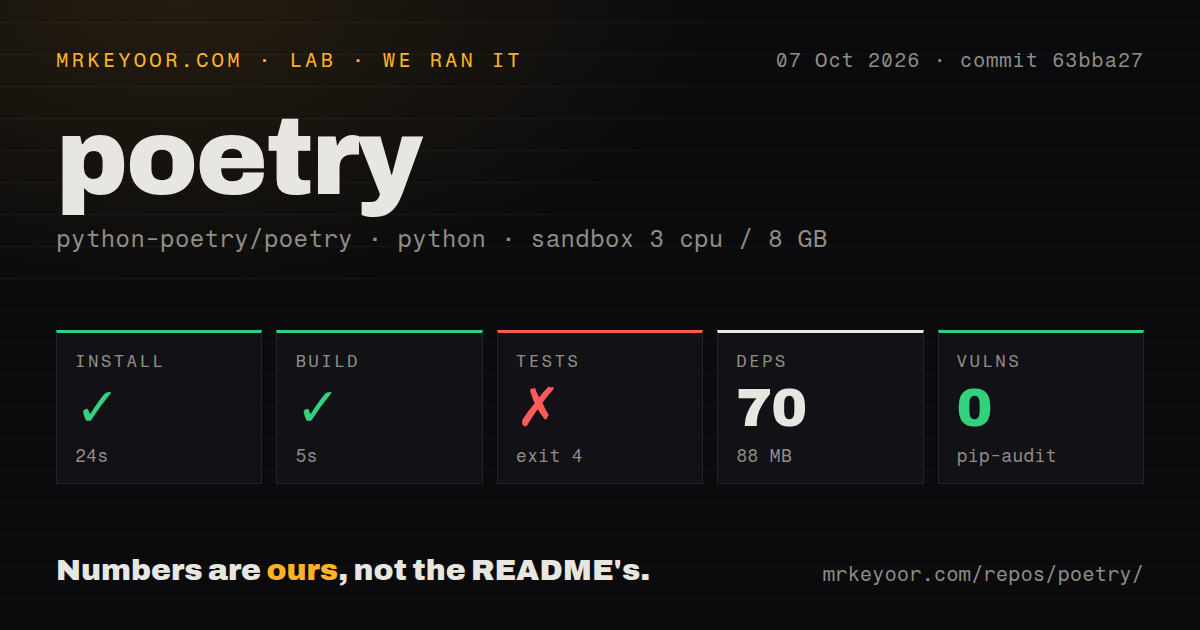
Our sandbox installed Poetry in 67 seconds and built it in 9 seconds. The measurement setup used commit e33ce99, 3 CPUs, 8 GB of RAM, Python 3.12 on Debian, an unprivileged container, and no secrets. Installation added 70 packages and occupied 86 MB. Those figures describe working on Poetry's own repository, not the time needed to install dependencies for an unrelated Python application.
The test command failed with exit 4 after 6 seconds. Pytest did not reach the suite because importing tests/conftest.py raised ModuleNotFoundError: No module named 'responses'. The log establishes the missing module and nothing more, so we are not assigning a cause beyond that import failure. Pip-audit reported 0 known vulnerabilities in the installed environment. The build result is useful, but this checkout did not produce a passing test run in our stated container.
Poetry 2.4.2 needs explicit private-index policy
Poetry 2.4.2 can use PyPI without credentials and can add private package sources with primary, supplemental, or explicit priority. Authenticated sources need HTTP credentials, a token, or certificates, while publish targets are configured separately. The docs also warn that shell history can retain credentials and that a netrc file may conflict with Poetry's configured authentication. Teams should decide where repository routing lives and how CI supplies secrets before adopting the commands wholesale.
Source routing has a portability catch. The documentation says Poetry's project source entries do not become core package metadata, so pip ignores them when it installs the resulting project. A dependency expected from a private or explicit source may therefore be looked up elsewhere by another installer. The repository has 6 CI workflow files but no Dockerfile to prescribe secret handling. Mixed Poetry and pip environments need an independent index policy rather than assuming pyproject.toml carries the whole decision.
1 open plugin report matters to non-root images
One open issue, number 10341, reports that a project-required export plugin appeared to install under a non-root Amazon Linux container but the export command remained unavailable. The report is specific to its image and Poetry 2.1.2, so it does not prove every plugin install is broken. It does show why a container test should invoke each required plugin command instead of trusting the preceding installation message. Poetry plugins run inside Poetry's environment, separate from the project environment.
Solver behavior also deserves a representative lock case. Open issue 10965 describes an infinite loop under Poetry 2.4.1 when a project combined architecture-specific Torch sources with another dependency; poetry lock --regenerate was the reported workaround. That is a narrow configuration, yet it is exactly the sort of configuration that makes teams choose Poetry. Our 9-second build says nothing about resolver time on a large application graph, so CI should put a timeout around lock regeneration and retain the last known-good lock file.
34,296 stars accompany current fixes and regressions
GitHub showed Poetry at 34,296 stars, with the last push on August 31, 2026. The same week had active issues and pull requests, and release 2.4.2 was published on August 29. Its notes include fixes for 2 path-traversal problems in download and source-distribution extraction. That release history and the recent issue updates show active maintenance rather than a repository coasting on an old tag.
The combined open count was 571 issues and pull requests, which is a work queue rather than a bug total. One fresh report describes a 2.4.2 source-distribution extraction failure when running as root on older Python 3.10 and 3.11 patch versions. Mature does not mean uneventful here. Poetry is still the conservative choice for teams that value its packaging model, provided they pin its version, test private sources and plugins in CI, and treat lock-file changes as reviewed artifacts.