Python packaging under one command
uv combines jobs that Python projects have traditionally split across several tools. It can create a project, resolve and lock dependencies, build a virtual environment, synchronize it, run commands, execute one-file scripts with inline metadata, install command-line tools, download Python interpreters, build distributions, and publish them. The binary is written in Rust, but normal users do not need Rust or even an existing Python installation.
That consolidation is the reason to consider uv. A new contributor can install one executable, run uv sync, and receive the Python version and environment described by the project. Tool execution through uvx replaces many pipx uses, while uv pip gives established requirements-file projects a gentler migration path. Workspaces cover repositories with several related packages.
The replacement claim needs some restraint. Python packaging has years of special cases involving indexes, editable installs, build backends, platform markers, credentials, and old setup conventions. uv covers a broad portion of that work, but teams should test the parts they depend on rather than assuming every pip or Poetry detail transfers unchanged.
What happened when we ran it
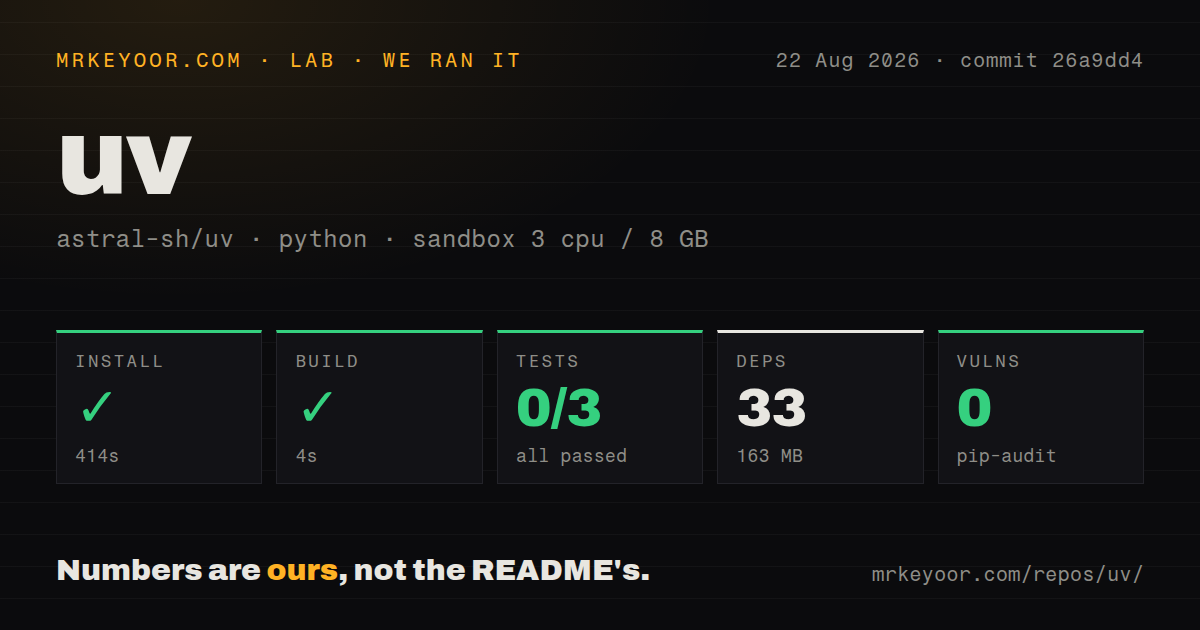
We cloned commit 26a9dd4 into a fresh, unprivileged Python 3.12 Bookworm container with three CPUs, 8 GB of RAM, and no secrets. The checkout contained 1,701 files, about 533,676 lines of source, and occupied 39.6 MB.
The selected install step succeeded in 414 seconds. It added 33 packages using 163 MB on disk. The build succeeded in 4 seconds, and pip-audit found 0 known vulnerabilities. The repository has 41 CI workflow files, a Dockerfile, and a tests directory.
Pytest failed after 5 seconds with exit code 1. It reported 0 passed, 0 failed, and 3 collection or setup errors. The final trace shows test/packages/keyring_test_plugin/keyrings/test_keyring.py importing keyring, followed by ModuleNotFoundError: No module named 'keyring'. The summary also names publish and package fixture tests among the three errors. This means our generic Python test command did not assemble the repository's required test environment; it does not show a failing uv behavior assertion.
Installing the product is far easier than building the repository
Astral provides shell and PowerShell installers, a PyPI package, and prebuilt release archives across common desktop and server platforms. Standalone installations can update themselves. Release 0.12.6 also publishes checksums and GitHub artifact attestations, with verification commands in the release notes. That gives security-conscious teams a better path than piping an installer straight into a shell without inspection.
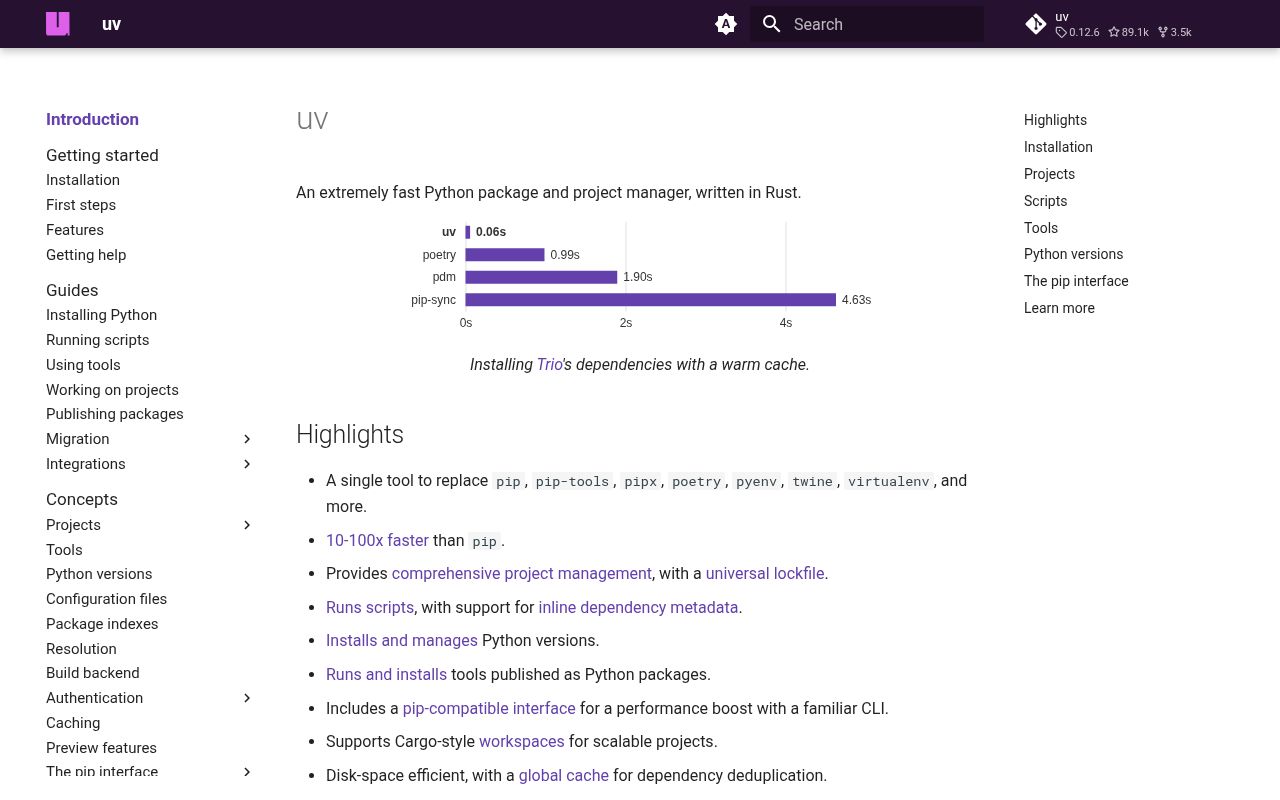
Once installed, uv can fetch managed Python builds and pin a version in the project. uv init, uv add, uv lock, uv sync, and uv run form a coherent daily loop. A global cache deduplicates downloaded and built artifacts across environments. The README publishes performance comparisons, but our lab did not reproduce those benchmarks, so our recommendation rests on workflow coverage and the measured source checks above, not a speed claim.
Adoption still deserves a branch. Generate the lockfile, compare resolved versions with the existing environment, check editable installs and optional groups, then run the application's own test suite. CI should pin uv rather than silently following the newest release, especially when a lockfile or resolver change could alter the environment.
Indexes, upgrades, and version requests have edges
Private indexes combine configuration and credential handling. Release 0.12.6 fixed credential reuse during tool upgrades when a receipt points at the same configured index. Teams should still avoid putting secrets in tool receipts. Teams should test authentication for sync, tool install, and tool upgrade separately because they may follow different paths.
Upgrade intent also needs inspection. Issue 21273 reports that uv sync --upgrade, including a highest-resolution request, left a transitive setuptools pin unchanged. The exact resolver reasoning matters, but the practical lesson is simple: review the lockfile diff and run a dependency scanner instead of treating an upgrade command as proof that every indirect package moved.
Python selection is similarly precise rather than magical. Issue 21274 asks for the 3.x convention used by another CI action. The report says uv rejects that syntax, while a bare major version may reuse an already installed interpreter instead of fetching the newest minor. Pinning an exact supported line is clearer for repeatable CI anyway.
Supply-chain details deserve close review
uv records hashes in its lockfile and isolates builds, both useful foundations. Open pull request 21223 identifies a sharper edge: when resolving from an existing lockfile, a replaced source archive could provide build metadata before its recorded digest was compared, with rejection happening later. Related pull requests split archive validation from cache persistence and add earlier checks.
That work is active rather than theoretical cleanup. Build backends execute code, so verification order matters for hostile or replaced source archives. High-assurance environments should follow those changes, verify which release contains the fix, prefer trusted indexes and wheels where policy allows, and keep network and credential exposure limited during builds.
Health and the recommendation
The repository was pushed on August 27, 2026. Release 0.12.6 arrived on August 25 with Python build updates, cache accounting changes, profile-guided binaries, and fixes for Git pins, recursive extras, and index credentials. GitHub showed 2,854 open issues and pull requests, while August 27 work covered Python markers and new target platforms. The queue is huge, but the activity is immediate and detailed.
For a new Python service or library, uv is the first project manager I would trial. For an established build, its value is still strong, but migration should be proven against the project's oddest dependency and index cases. Keep the old lock and CI path available until uv reproduces the environment you intend, not merely one that installs successfully.