Python 3.10+ gets one command for environments and dependencies
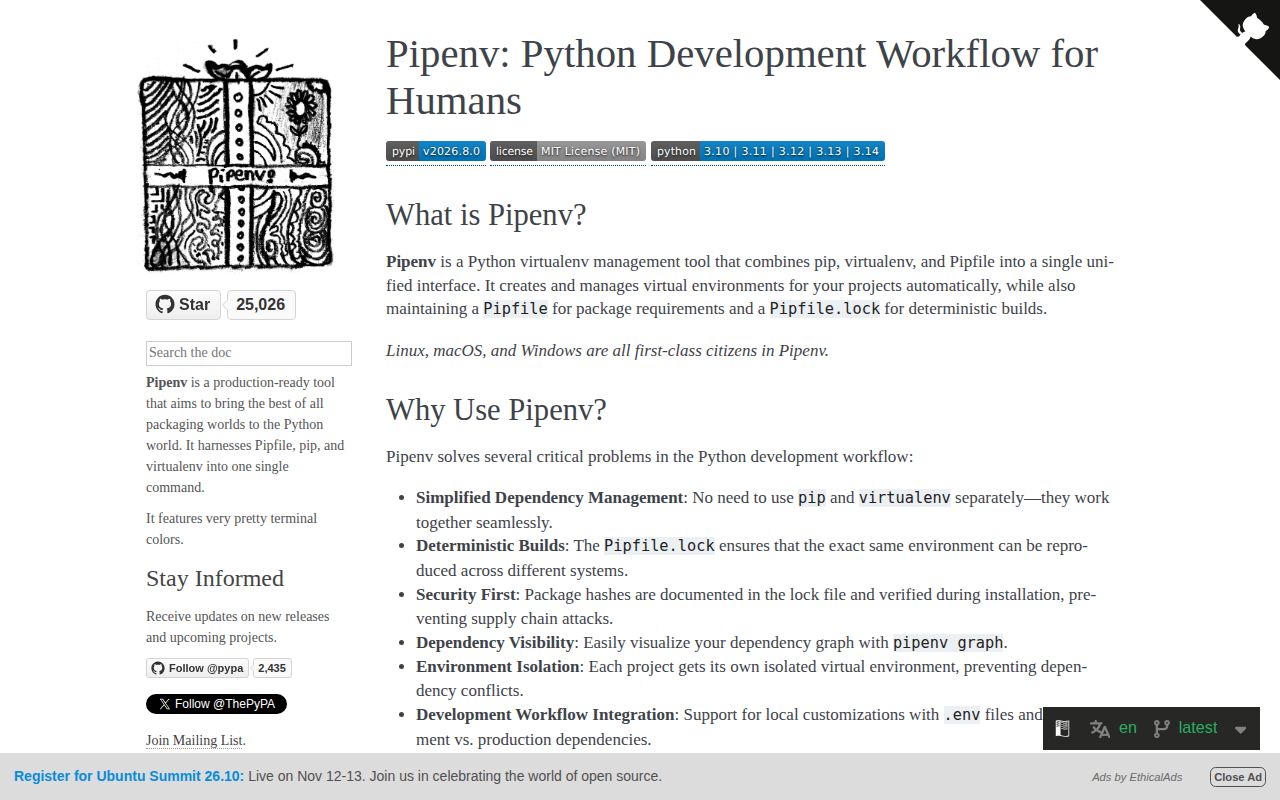
Pipenv supports Python 3.10 and newer and puts package installation and virtual-environment management in one command-line interface. Running pipenv install creates an environment when needed, records direct requirements in Pipfile, and resolves a Pipfile.lock. pipenv run executes a command inside that environment, while shell, graph, clean, sync, and requirements cover the jobs developers otherwise spread across pip, virtualenv, and hand-edited files.
The practical appeal is consistency. Linux, macOS, and Windows are documented as first-class platforms, and Pipenv can look for interpreters through the system, pyenv, or asdf. It finds a Pipfile by walking up the directory tree, which is handy in a large application. It also loads .env automatically. That last feature deserves an explicit team rule because a convenient local secret-loading behavior can surprise a script or CI job.
A 283.7 MB checkout is a contributor project, not a tiny wrapper
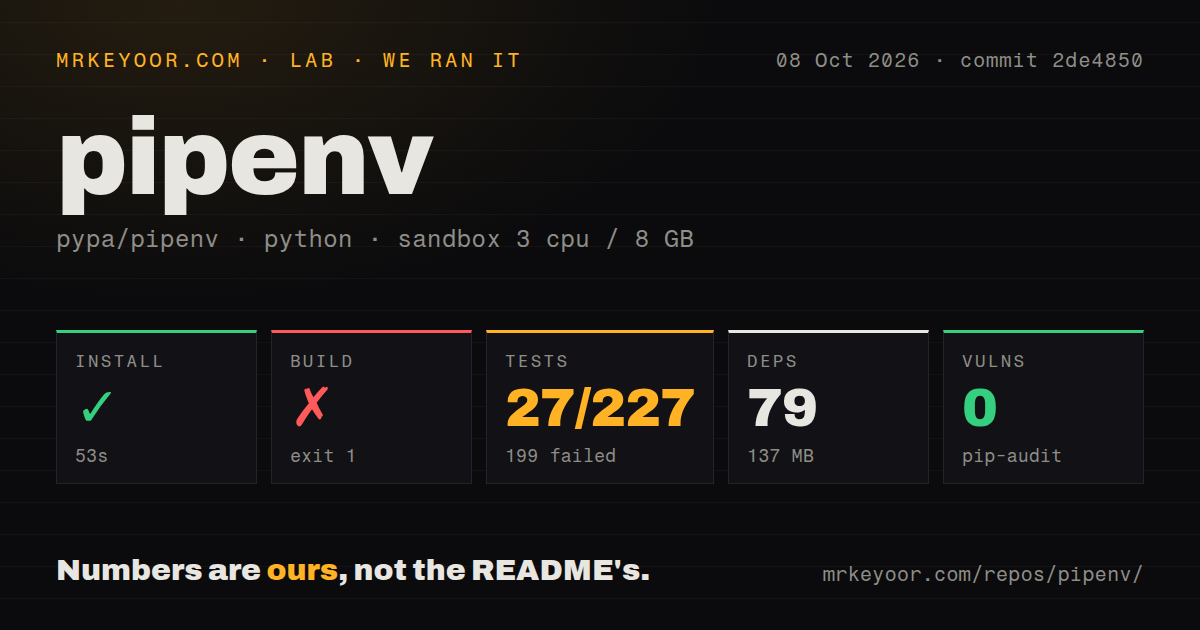
Our clone at commit 2de4850 contained 3,254 files and about 328,711 lines of source before installation. The checkout occupied 283.7 MB, and the installed environment added 79 packages and reached 137 MB. Pipenv may feel like a small front end when used from a terminal, but its repository vendors or carries enough code and test artifacts to make source work a different proposition from installing the published tool.
The repository has 3 CI workflow files, a tests directory, and no Dockerfile. A contributor therefore gets automation to inspect but no checked-in container recipe matching our Debian setup. The README's user path is much lighter: install with pip, pipx, or an operating-system package, then run commands in an application directory. That distinction matters. A developer adopting Pipenv as a user should not treat our source-build failure as proof that the published command cannot run.
What happened when we ran it
Our sandbox installed commit 2de4850 in 53 seconds on 3 CPUs with 8 GB of RAM. It ran in an unprivileged Debian container based on Python 3.12, with no secrets. Installation succeeded, pulled 79 packages, and used 137 MB on disk. Pip-audit found 0 known vulnerabilities. We measured repository setup only, not dependency-resolution speed for an application or performance against a large private index.
The build exited 1 after 5 seconds. The supplied log tail shows SyntaxWarning messages inside test artifacts for Jinja2 and PyInstaller, including invalid escape sequences and a string comparison using is not. It does not include the final exception or another line that explains the nonzero exit. We can report the failure and those warnings, but assigning a cause would go beyond the log.
Pytest also exited 1 after 33 seconds. The summary was 27 passed, 199 failed, 14 skipped, 1 warning, and 1 collection/setup error out of 227 tests, with 8 reruns. Many failures shown at the end came from integration tests for run, sync, and uninstall. Several expected a zero exit code and got 127, while another printed /bin/sh: 1: pipenv: not found. The log does not establish why the command was unavailable.
Pipfile.lock is the main reason to choose Pipenv
Pipenv v2026.8.0 separates declared dependencies in Pipfile from the resolved package set in Pipfile.lock. The lock records hashes, and sync installs what the lock specifies without first changing it. verify checks whether the lock matches the Pipfile. For an application team that reviews both files, this is a legible model: developers state what the app needs, then commit the exact resolution used for repeatable installs.
That model comes with a format choice. A project already using pyproject.toml for build metadata may not want another dependency file beside it. Pipenv can export a requirements file and import one during migration, but its normal workflow remains centered on Pipfile. New projects should decide whether that separation is useful before standardizing commands and CI around it. Existing Pipfile users have a much easier case because replacement carries migration work without changing the application's purpose.
Release v2026.8.0 improved indexes while a private-registry issue stays open
Release v2026.8.0 added PEP 691 JSON index responses, an experimental parallel manifest prefetcher, a disk cache, and per-source SSL settings for that prefetch path. It also updated the vendored pip to 26.2.1 and fixed handling for quote-only netrc credentials. Those changes show that package-index behavior is receiving direct work rather than only documentation maintenance.
Private sources still merit a trial with the registry your company runs. Open issue 5932 describes a package from a private GitLab index that installs but cannot be resolved when locking. The report is configuration-specific and does not prove every private index fails. It is enough reason to test authentication, certificate settings, lock generation, and a clean sync before moving a team's dependency process.
An October 8 push and 13 issues and PRs show active maintenance
GitHub reported 25,026 stars, 13 combined open issues and pull requests, and a last push on October 8, 2026. The latest release, v2026.8.0, was published on August 20, 2026. The recently updated queue included an October 8 maintenance pull request and an October 4 connectivity report, so both code work and user reports were moving.
Our failed build and 199 test failures still belong in the buying decision. For an established Pipfile application, Pipenv provides a broad, documented command set and current maintenance. For a new project, its extra file format needs to earn its place against uv, Poetry, or pip-tools. Start by reproducing your actual lock and sync path in CI. If that clean job cannot find pipenv, our sandbox has already shown how quickly the rest of the suite becomes noise.