PipesHub combines search, connectors, and agents in one stack
PipesHub is an internal context platform rather than a single chat application. It pulls records from workplace systems, parses and indexes them, enforces source permissions, and returns answers with block-level citations. The same context can feed search, agents, RAG applications, workflows, SDK clients, or an MCP server. That scope makes sense for a platform team trying to stop each AI project from building its own connector and retrieval layer.
The architecture is correspondingly broad. The README lists Neo4j or ArangoDB for graphs, Qdrant, OpenSearch, or Redis for vectors, MongoDB for documents, Redis for cache, Kafka or Redis Streams for messaging, Celery for work, and local or cloud blob storage. A slim profile reduces some choices but does not turn PipesHub into one process. Every datastore adds backup, upgrade, access-control, and observability work.
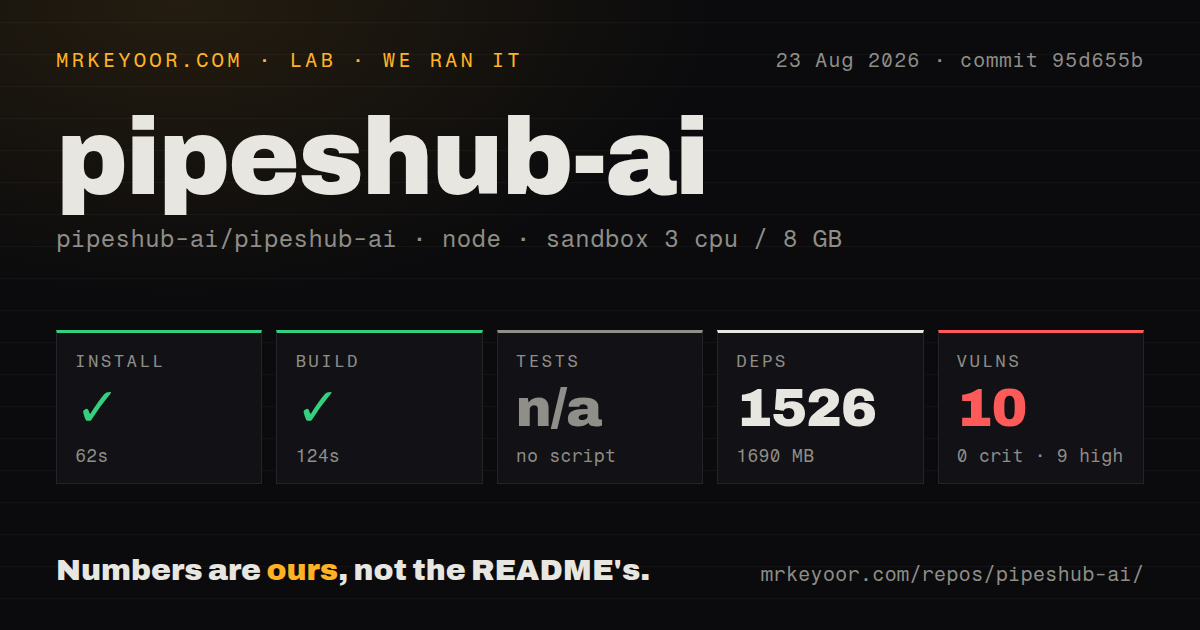
The frontend alone occupied 1,690 MB
Our sandbox cloned commit 95d655b and worked inside frontend/, the measured Node project. Npm installed 1,526 packages in 62 seconds and used 1,690 MB on disk. The build then passed in 124 seconds. That is a large dependency surface before Docker images, model weights, databases, indexed documents, or connector caches enter the deployment.
The repository checkout contained 4,694 files, about 2,147,045 lines of source, and 105.3 MB. Our scan found 11 CI workflow files, no Dockerfile at the scanned location, and a tests directory. These signals describe the repository layout, while the documented product installer relies on Compose profiles and published images. A source contributor will need to understand both the frontend package and the separate Python and Node backend services.
What happened when we ran it
Our frontend build completed, but there was no test script or target to run. We therefore skipped tests instead of treating the presence of a tests directory as an executable suite. Npm audit reported 10 known vulnerabilities: 0 critical, 9 high, 0 moderate, and 1 low. The measured facts apply to commit 95d655b in a Node 22 Debian container with 3 CPUs, 8 GB of RAM, and no secrets.
We did not start the whole Compose stack, connect a data source, provision a graph or vector database, or ask a model a question. The 124-second build does not validate permission propagation, citation accuracy, connector completeness, queue recovery, or production upgrades. Those are the parts that decide whether an enterprise search system is trustworthy, so they require a separate proof using real permission shapes and known document counts.
The installer creates a deployment, not a maintenance plan
The recommended script checks Docker, memory, and disk, asks for slim or full mode, generates secrets, writes .env, pulls images, and waits for health checks. Source builds use the cloned repository and an explicit build option. Cloud hosts need HTTPS because browsers can block requests from an insecure origin. Teams should inspect the downloaded script and pin v0.7.0 or another chosen image tag rather than always accepting the newest release.
Health endpoints cover service availability, but a healthy process can still have a dead consumer or partial data. Issue 3046 reports empty-string concurrency variables crashing embedding and indexing services in a slim deployment. One failure left the health endpoint reporting indexing as healthy after the consumer had died. The issue gives explicit environment values as a workaround, yet a production configuration should validate consumer membership, broker lag, and completed work as well as HTTP health.
A green connector sync can still omit most records
Issue 2994 documents a Notion full sync that retrieved about 40 pages while the same token could see 1,175. The connector logged successful completion after 4 search requests, while a direct pagination check needed 12 calls. The report does not claim a confirmed root cause, but it demonstrates the buyer's problem: success status did not mean source coverage. Count reconciliation belongs in the rollout checklist for every connector.
Issue 2997 describes 7,385 connector HTTP failures during another Notion run. Timeout exceptions became empty error messages, were not retried, and the sync still finished successfully with much content unfetched. These are individual reports, not our reproduced benchmark. They are specific enough to justify a test corpus with expected pages, attachments, deletions, permissions, and revisions, plus alerts on gaps between source totals and indexed totals.
Lost events can leave records queued indefinitely
Issue 2799 found a Jira attachment sitting in QUEUED from November 2025 to July 2026. Its handler had never run, and there was no sweeper to detect the stale non-terminal state. The report traces a non-atomic sequence: graph state is written first, then a message is published. A failure between them leaves no event to consume and no automatic recovery path.
This matters beyond one attachment. Connector UIs can keep saying records are processing when no worker owns them, and failed-item retry controls may not include a record that never reached failure. Before adoption, test broker restarts and process termination between state changes, define a maximum queue age, and build a reconciliation query. Permission-aware answers are only as complete as the records that reach a terminal indexed state.
v0.7.0 shipped amid active reliability work
GitHub recorded 3,692 stars, 110 combined issues and pull requests, and a last push on August 26, 2026. Release v0.7.0 was published the same day. Recent work touched first-run installation, image context, streamed citations, reindexing, connector fixes, MCP arguments, and integration-test timeouts. This is active software with a large change surface.
Apache-2.0 licensing, multiple SDKs, and broad documentation make a structured pilot feasible. The missing frontend test target, 9 high advisories, and connector recovery reports keep it out of the low-risk category. PipesHub is worth comparing when the alternative is building the same enterprise plumbing yourself, provided the pilot measures completeness and authorization rather than stopping at a healthy dashboard.