PicoClaw puts an agent on small Linux and Android devices
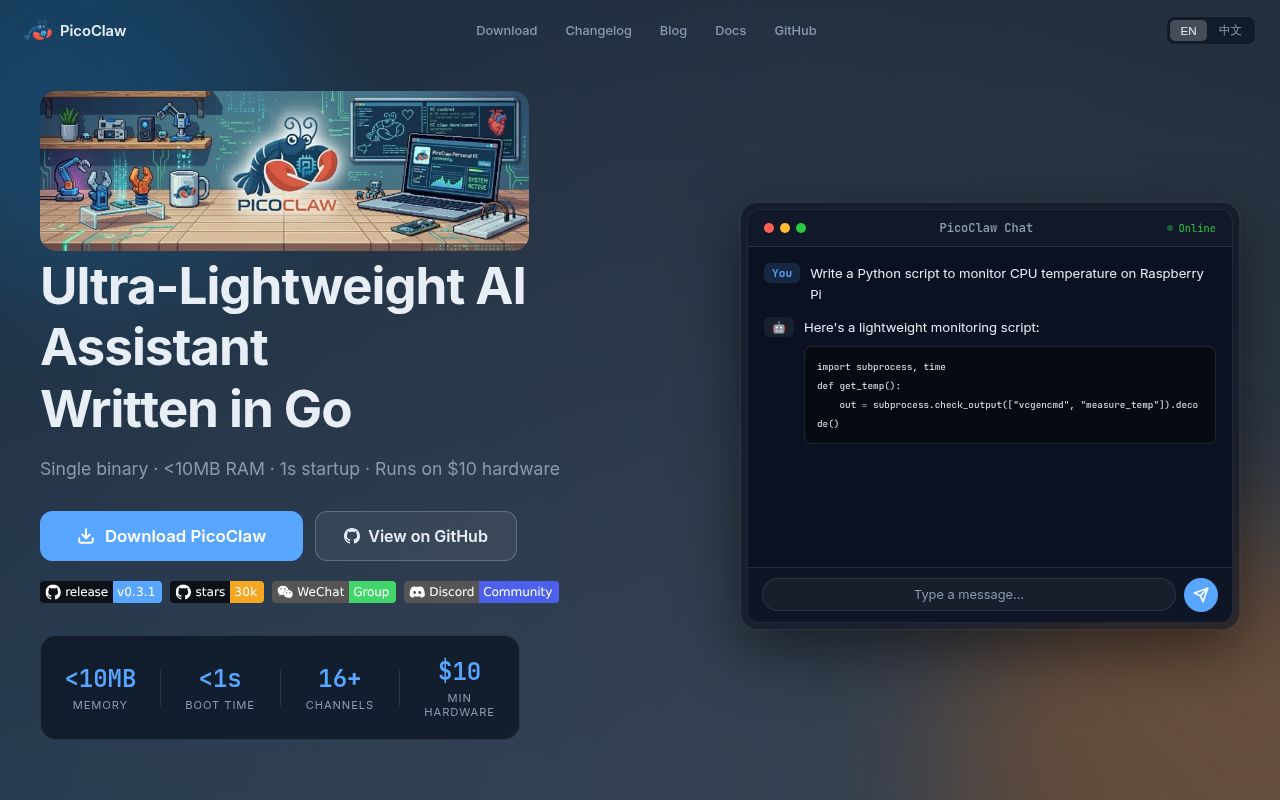
PicoClaw packages a personal AI agent as a Go application for x86, ARM, RISC-V, MIPS, LoongArch, and Android targets. It supports terminal and Web chats, messaging channels, tools, memory, and scheduled jobs. It targets always-on boards that cannot carry a desktop agent stack.
The repository is no longer tiny in source terms. Our commit bbf6893 checkout contained 1,392 files, about 302,463 source lines, and occupied 24.4 MB. The README says the core was written in Go through an agent-driven process and claims 95% of core code was generated by an agent with human review. Strict code-provenance teams should inspect that process and the security-sensitive packages.
Thirty-plus providers reduce lock-in and multiply configuration
The documented model list covers more than 30 providers, including OpenAI, Anthropic, Gemini, Bedrock, Azure, and several OpenAI-compatible services. Ollama and vLLM can supply local inference without a hosted-provider API key. Rule-based routing can send different requests to different models. That breadth suits experiments with changing models or hardware.
Every provider still brings its own credentials, endpoint behavior, model names, and failure modes. Chat apps add bot tokens and webhook or polling configuration. PicoClaw moves sensitive values from the main JSON file into .security.yml after configuration migration, according to the README. File permissions, backups, logs, and channel authorization remain the operator's responsibility.
What happened when we ran it
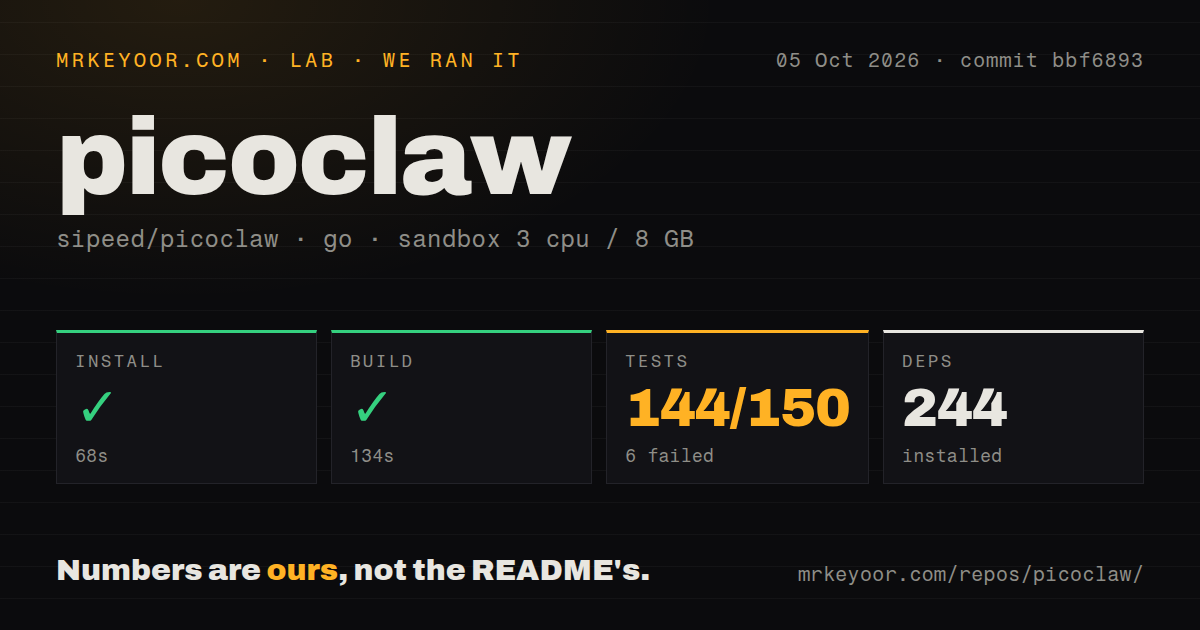
Our sandbox installed 244 Go packages in 68 seconds, then completed the build in 137 seconds. The environment was a fresh unprivileged Debian container with 3 CPUs and 8 GB of RAM. The measured checkout had 9 CI workflow files and no Dockerfile or top-level tests directory. The README does provide Docker Compose commands, which can use published images without a root Dockerfile in the checkout.
The Go test run lasted 766 seconds and exited 1. Its summary counted 127 passed and 7 failed out of 134. The supplied tail shows successful packages including filesystem tools, hardware tools, integrations, the updater, utilities, and several Web backend packages, followed only by FAIL. It does not show the seven failing case names or their errors, so we cannot attribute them to timing, network access, missing services, or code defects.
That failed suite is the main lab finding. A 137-second successful build proves that commit bbf6893 compiled in our stated image; it does not cancel 7 test failures. We also did not measure the README's memory, boot-speed, or hardware-price comparisons. Those remain project claims. The README itself notes that recent builds may consume 10 to 20 MB while feature work continues.
MCP and command tools need failure containment
PicoClaw can register MCP servers through its CLI, discover their tools, and invoke them from the agent loop. It also has shell, file, search, schedule, and messaging abilities depending on configuration. This is the appeal of the project and its largest risk boundary. A prompt received from a chat channel can reach local processes or files unless the operator narrows permissions and separates the host from valuable systems.
Open issue 3269 reports that an unreachable MCP server caused the agent loop to exit on Android, leaving the chat interface without replies after the gateway restarted. The report identifies the error-return path in agent.go; it does not establish that every transport fails this way. For an unattended assistant, one optional tool should not take down the message loop. Test startup with each MCP server offline before relying on the gateway.
Session compression can remove the original conversation
Issue 3351 examines the JSONL session store and reports that automatic summarization rewrites the file with a summary and retained recent messages. According to the issue, the original messages are then absent from disk, and forced compression can discard older turns as well. That behavior is consequential for anyone expecting an append-only conversation record, audit history, or later recovery from a bad summary.
Keep a separate transcript if the original conversation matters. A personal assistant may reasonably compress context sent to a model, but storage retention is a different policy. Until the project documents or implements preservation, do not use its working session file as the only record of approvals, operational changes, research, or support conversations. The issue was opened on August 30, 2026 and remained open when researched.
One Telegram failure produced 228,419 edit attempts
Issue 3343 documents a tool-feedback animation that continued editing one Telegram message every 3 seconds after its agent turn failed. The reporter counted 228,419 edit attempts, including 43,165 successful edits, before restarting the gateway. Telegram responded with a rate limit of nearly an hour. The reporter says v0.3.1 and the then-current main branch lacked a lifetime limit and ignored edit errors in that animation path.
This is one reported incident, yet it illustrates why agent side effects need bounded retries and cleanup on every exit. Disable cosmetic feedback on important bots until the path is fixed, set request monitoring, and keep a way to stop the gateway. Issue 3281 separately reports laggy Web UI input after a session accumulates history, which matters on the same low-powered devices PicoClaw targets.
Active development has not reached the project's production bar
GitHub showed 29,917 stars and 35 combined issues and pull requests when fetched. The last push was August 27, 2026, and issue activity continued through August 30. The latest release, v0.3.1, was published July 3 with provider additions, dependency updates, request guards, and many error-handling fixes. The release date alone does not suggest inactivity.
The README supplies the clearest maturity judgment: PicoClaw is in early rapid development, may have unresolved security issues, and should not be deployed to production before v1.0. Our 7 failing tests reinforce that caution. Use it on a separated personal device with limited credentials and narrowly enabled tools. Its hardware reach, provider catalog, and MCP support make for a worthwhile lab, while production authority should wait for evidence stronger than a successful compile.