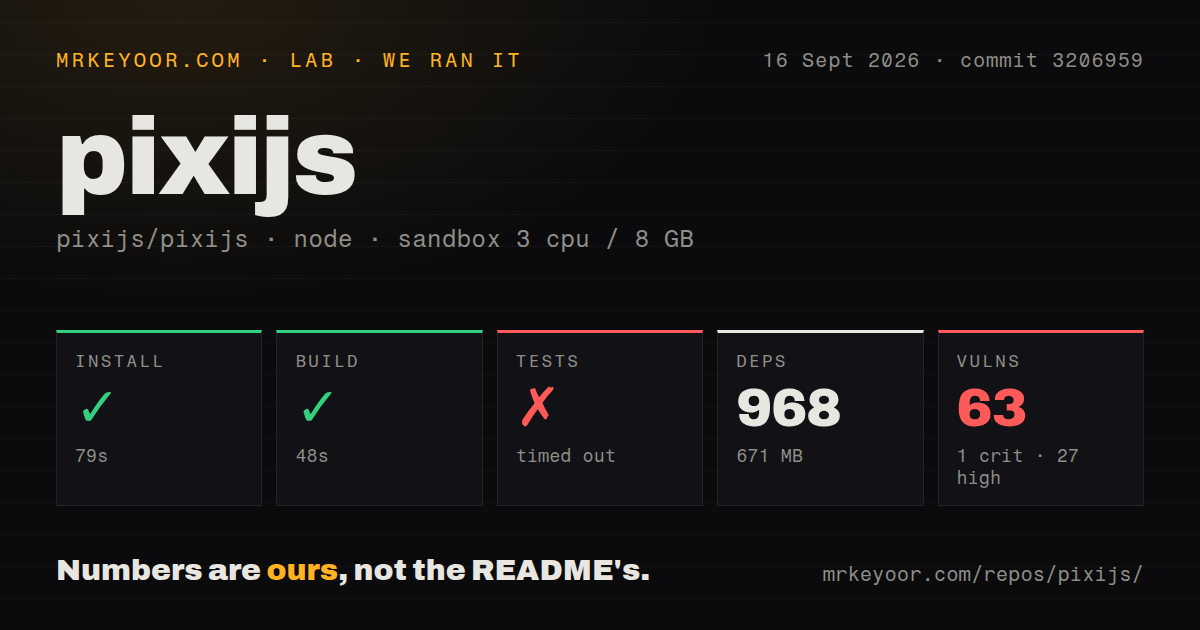

One package became 968 packages in our contributor checkout
Our source checkout installed 968 packages in 79 seconds and left 671 MB on disk. That is a different proposition from the README's npm install pixi.js consumer setup. We cloned commit 3206959, where the build passed but the complete test command did not finish within 900 seconds. The gap between easy consumption and expensive contribution is the most useful fact in this review. It tells you which side of the project you are evaluating.
The 44.3 MB checkout contains 3,700 files and about 202,969 lines of source. PixiJS 8.20.1 covers sprites, text, vector graphics, asset loading, pointer events, filters, masking, and texture work under an MIT license. Its Application wrapper supplies a renderer, scene root, resize behavior, and frame ticker. You can stay at that level for ordinary work or use the extension system to replace loaders and add rendering pipes. Its scope is much wider than a tiny canvas helper.
WebGL is the production default while WebGPU is still experimental
PixiJS 8.20.1 calls WebGL stable and recommended in the rendering guide for the measured commit. It labels both WebGPU and Canvas experimental, even though WebGPU is described as feature-complete. The stated reason is inconsistent browser behavior. That distinction matters: choosing WebGPU is also choosing a larger browser and driver test matrix than the default WebGL path.
Our measurement setup used 3 CPUs, 8 GB of RAM, Node 22, and an unprivileged Debian container. It checked repository installation, compilation, and the project test command. It did not open a browser, create a GPU context, load a production texture set, or measure frames per second. The README calls PixiJS the fastest lightweight 2D library, but our run produced no rendering benchmark that could confirm that comparison. Treat speed as a workload question, then profile your own scene.
What happened when we ran it
Our sandbox installed the repository in 79 seconds, pulled 968 packages, and used 671 MB. The build succeeded in 48 seconds. The checkout itself was 44.3 MB before that dependency install. Npm audit found 63 known vulnerabilities, split into 1 critical, 27 high, 31 moderate, and 4 low. Those audit results describe the development dependency tree at commit 3206959. They do not prove that every finding ships to browser users. They do require triage before treating the checkout as clean.
The test command timed out at 900 seconds. Its last visible lines showed successful lint, type checks for the build config, examples, and playground, followed by successful index and prune steps. The log then warned that installed TypeScript 5.9.3 had not been tested with ts-jest. It did not show a failed assertion, a test count, or a completed suite. We can say the command exceeded the limit. The excerpt does not establish why it kept running.
202,969 source lines leave performance choices with the application
The 202,969 source lines include sensible guidance about costs PixiJS cannot hide. Its performance notes say alternating sprites and graphics can double draw calls compared with grouping them. Culling is disabled by default because it can help a GPU-bound scene while hurting one limited by CPU work. Frequently changing text requires canvas drawing and a GPU upload, so bitmap text is the suggested route for rapidly changing labels.
The 44.3 MB source tree also exposes lower-level choices that make the library useful for demanding work. Applications can render to textures, control texture garbage collection, write custom filters, and add renderer extensions. That freedom creates cleanup duties. Assets and textures need planned lifetimes, complex SVGs have a parsing cost, and filters or masks can increase rendering work. PixiJS supplies the mechanisms. Your scene structure, asset policy, and profiling determine whether they stay fast.
Eleven CI workflows coexist with target-specific open bugs
The repository contains 11 CI workflow files, and GitHub recorded a push on September 16, 2026. It had 48,168 stars and 332 combined open issues and pull requests when fetched. The latest release, v8.20.1, shipped on August 26, 2026 with fixes for UBO offsets, SVG radial gradients, and shared text styles. Those dated signals point to active maintenance, while the combined open count shows a large project receiving a steady flow of reports and changes.
Those 11 workflows cannot reproduce every device path. An open WebGL1 fix targets blank output on some Adreno and ANGLE drivers. A Firefox masking report describes blank cached render textures. Separate KTX2 reports cover worker memory growth and default transcoder downloads from jsDelivr. These are reporter findings, not failures we reproduced. They are still good acceptance tests if your application depends on the same devices or compressed-texture paths.
PixiJS is the renderer layer inside a larger application
Our 671 MB contributor install is focused on rendering, while the finished product stack remains yours. Phaser is the closer alternative when browser game systems should arrive with the renderer. Konva fits editors, whiteboards, and interactive diagrams built around Canvas shapes. Three.js makes more sense when a 3D scene is central. PixiJS is the better fit when the core problem is arranging and animating many 2D objects while keeping control of the surrounding application.
The 48-second source build is reassuring. The 900-second test timeout and 63 audit findings stop short of a clean bill of health. Start with WebGL, make a device list, and run the asset patterns that matter, especially masking and KTX2 loading. If that trial passes, PixiJS gives you far more room than direct Canvas code. If your team does not want to own those rendering decisions, the 968-package contributor tree is the wrong place to spend its time.