You can keep the engine when the game outlives its vendor
Godot lets you ship a commercial game under the MIT license without owing engine royalties. That is a practical reason to choose it: if a project needs an engine change, you have the source and permission to make it. The README describes a shared editor for 2D and 3D games, with desktop, mobile, and web exports. A small studio gets an authoring environment without negotiating a runtime license.
Owning the source also means understanding how much source there is. Our checkout contained 14,228 files, roughly 4,488,004 source lines, and occupied 336.5 MB. Most game developers should start with the official editor download and export templates, which the README links separately from compilation instructions. Cloning the engine makes sense when you intend to inspect or change the engine itself. It is unnecessary homework for someone trying to finish a first game.
Scenes give you reusable pieces inside a visual editor
Godot organizes a game as scenes containing nodes. A character can combine a visible sprite with a collision shape, then become a reusable scene that you place elsewhere. The nodes and scenes tutorial walks through that composition in the editor. This is a useful fit for someone who wants to arrange a world visually while keeping behavior attached to identifiable objects. You can inspect the scene tree instead of reconstructing every relationship from code.
That convenience should be judged separately from repository size. The 336.5 MB checkout is the engine development tree, not a measured download size for your finished game. The README points to official demo projects and an editor-accessible class reference, which give you a sensible starting route: open a relevant demo, change a scene, and see whether the workflow fits your game. Our sandbox figures cannot tell you whether an artist will enjoy the editor or how your scene will render.
What happened when we ran it
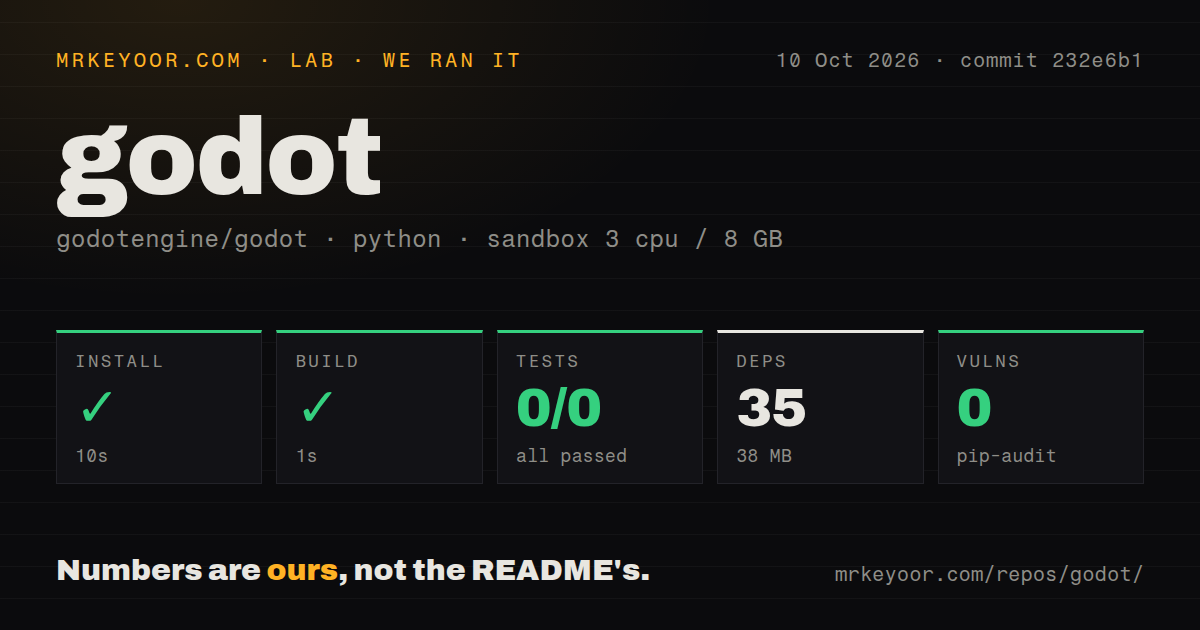
Our Godot run installed 35 Python packages in 10 seconds, using 38 MB on disk, and the recorded build step passed in 1 second. We ran commit 232e6b1 on October 10, 2026, in an unprivileged Debian container with 3 CPUs and 8 GB of RAM. The image was ghcr.io/astral-sh/uv:python3.12-bookworm. Those are results for the recorded Python path. They do not establish that the C++ engine was compiled or that the graphical editor launched.
The test command failed with exit code 5 after 2 seconds. Pytest reported 0 passed and 0 failed because it collected no tests. The log's entire explanation was no tests ran in 1.06s. That is an incomplete validation result, and the supplied log does not explain why collection found nothing. Calling it an engine regression would overstate the evidence. Calling the suite green would be worse.
Pip-audit reported 0 known vulnerabilities in that environment. The scan found 9 CI workflow files and a tests directory, with no Dockerfile. Neither the audit nor those repository signals repairs the missing execution evidence. The useful next check for an engine adopter is an actual game on its target devices. For an engine contributor, it is the documented native development path. Our short Python build result is insufficient evidence for either decision.
Console releases need a separate porting arrangement
The README's console link leads to a qualification that matters before you promise a launch platform. Godot's console support page says the Foundation does not maintain official console ports. Approved developers need the platform holder's SDKs and hardware, then private export templates or a porting provider. You can ship a console game made with Godot, but the public repository alone does not supply that entire route. Budget the provider relationship alongside the game.
A successful 1-second sandbox build step says nothing about console readiness. Neither does the MIT license remove platform approval or certification work. For a desktop-first indie project, this may be an acceptable future expense. For a studio with console delivery already in a publisher contract, obtain a concrete porting arrangement before adopting the engine. The relevant question is whether your team has a supported path to the required device.
C# browser games hit a documented export restriction
Godot's web export documentation says projects written in C# using Godot 4 cannot currently export to the web. That is a reason for a competent developer to walk away immediately if existing C# gameplay must run in a browser. Check this restriction before moving code into the editor. A desktop prototype cannot demonstrate that the browser deliverable is feasible with the same language choice.
Our 3-CPU container run did not exercise web export or browser behavior. Teams building for the web should prototype that deliverable early, using the language and hosting setup they actually intend to ship. The README's broad platform list is useful for shortlisting an engine. The platform-specific documentation decides whether the shortlist survives your requirements.
October activity supports continued evaluation
The last repository push was October 15, 2026, and issue and pull-request updates continued on October 16. GitHub listed 118,473 stars and 18,860 open issues and PRs combined. The latest release endpoint returned 4.7.2-stable, published August 18, with stability and usability fixes. The release date and current activity together show ongoing maintenance, while the large queue deserves inspection for your export targets. Choose Godot for its editor and source ownership after proving your required platform, not because our Python path finished quickly.