It makes model adaptation smaller, not model training automatic
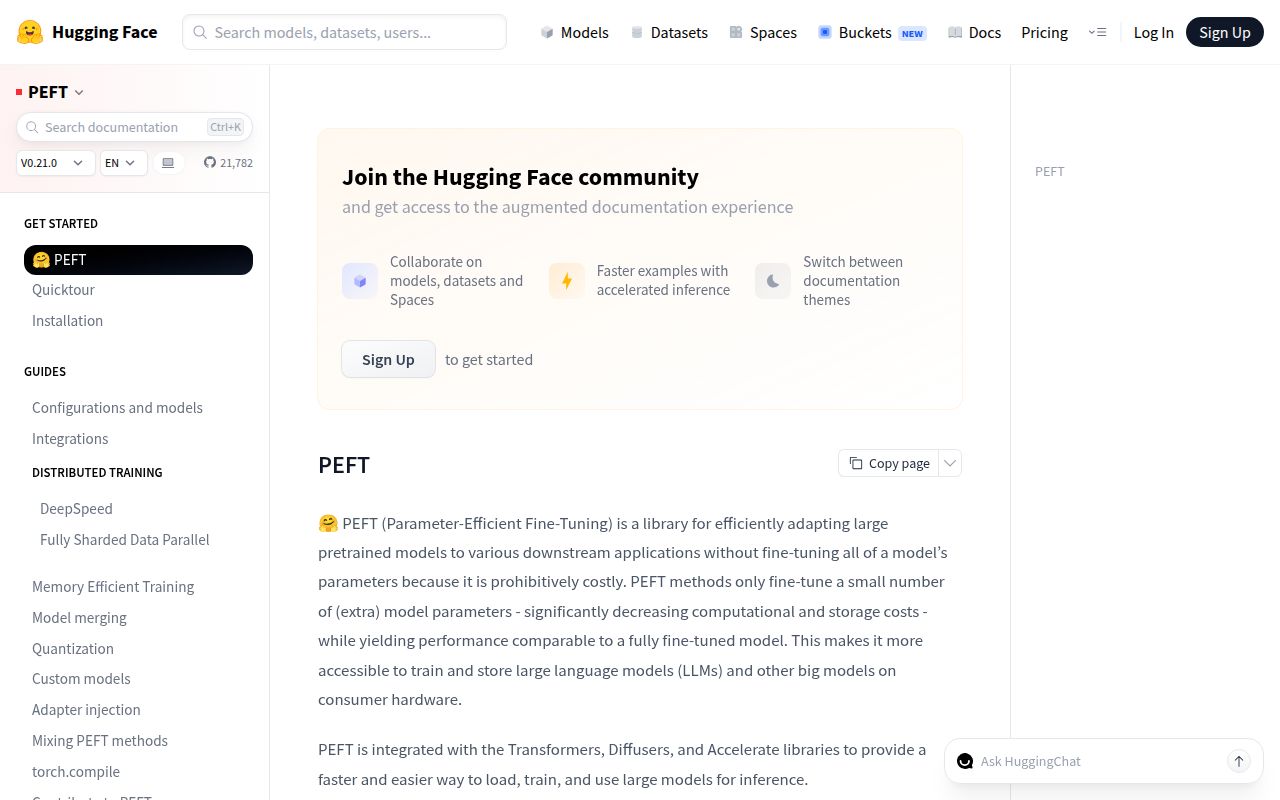
PEFT addresses a specific cost problem: changing a large pretrained model without updating and storing every parameter. Instead, it trains a relatively small set of extra parameters for a downstream task. In the README's Qwen/Qwen2.5-3B-Instruct example, LoRA makes 3,686,400 of 3,089,625,088 parameters trainable, or 0.1193%. That is a meaningful architectural difference, not a friendly wrapper around ordinary full fine-tuning. You still need a base model, data, a training loop, hardware, and judgment about configuration.
The project sits close to the center of the Hugging Face tooling stack. It integrates with Transformers for training and inference, Diffusers for adapter management, and Accelerate for distributed work on large models. Version v0.20.0 was released on July 28, 2026, and the repository was pushed again on September 7, 2026. That combination matters: the release is recent, while the same-day source activity shows development did not stop at the tag.
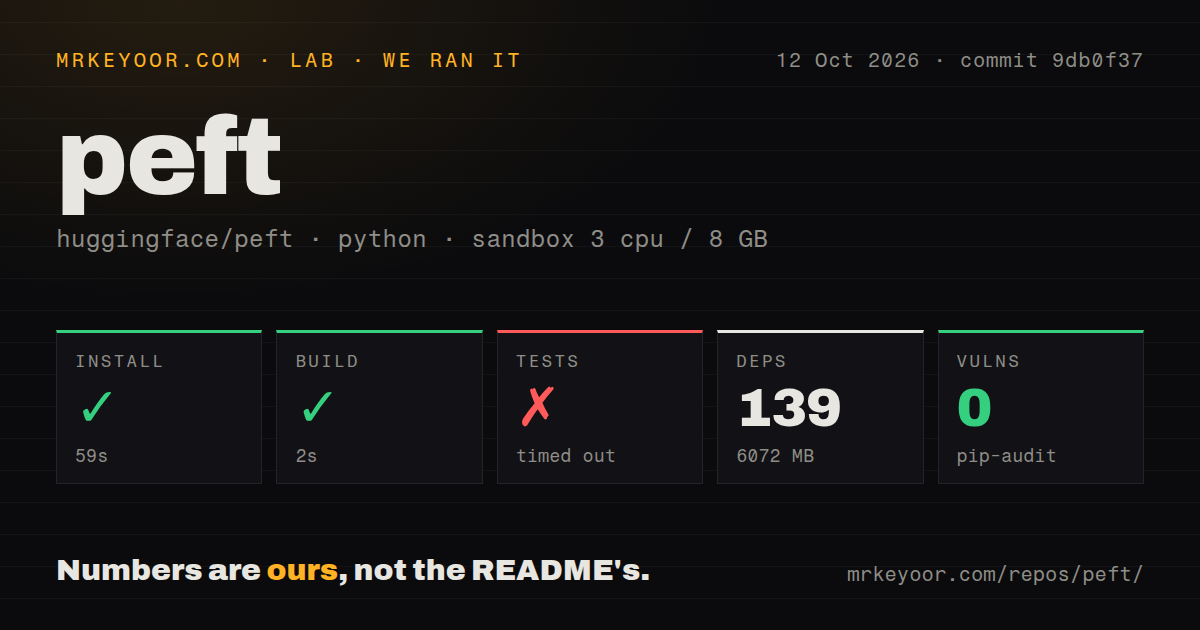
Our install worked, but verification did not finish in 900 seconds
On our box, a fresh clone at commit a4c223f installed successfully in 104 seconds. The environment pulled 136 packages and occupied 6050 MB on disk, which is substantial for something introduced by a single pip install peft line. The source build then completed successfully in 13 seconds. Pip-audit reported 0 known vulnerabilities, a useful result for dependency hygiene, though it is not a guarantee that the package or its dependencies are free of security bugs.
The full test command did not complete within our 900-second limit on 3 CPUs and 8 GB of RAM. When the cap stopped it, the log had reached roughly 26% and showed long runs of passing dots mixed with skips. It did not show an asserted test failure in the supplied tail. The honest conclusion is therefore a timeout, not a pass and not a broken suite. With 985 files and about 155,729 lines of source, maintainers and adopters should plan a more capable or longer-running CI job for full verification.
The repository contains 15 CI workflow files and a tests directory, but no Dockerfile. That is evidence of serious automation around development, yet it leaves environment reproduction to Python packaging, external images, or your own container definition. Our checkout itself was only 25.2 MB, so the large disk cost came from the installed environment rather than repository bulk. Teams that require pinned operating-system dependencies or an official container will need to add that layer.
The API keeps the core LoRA path understandable
The quickstart exposes a compact mental model: create a LoraConfig, wrap the base model with get_peft_model, train it, and save the adapter with save_pretrained. Loading reverses that pattern by constructing the base model and attaching the saved adapter through PeftModel.from_pretrained. The example also prints the trainable parameter count, which gives users an immediate check that the intended 0.1193% subset is actually being optimized. This is a good library boundary for engineers who want control without reimplementing adapter plumbing.
The documented savings are concrete, although readers should treat the README tables as project-provided examples rather than our benchmarks. For bigscience/T0_3B, the table lists 47.14 GB of GPU memory for full fine-tuning, 14.4 GB for PEFT-LoRA, and 9.8 GB with DeepSpeed CPU offloading. It also describes a 19 MB adapter checkpoint versus an 11 GB full checkpoint. Those figures explain why PEFT is attractive when one base model must serve many tasks.
Breadth is another strength. The documentation routes readers beyond LoRA to adapter methods, soft prompts, and IA3, while the examples span language, diffusion, and speech use cases. Quantization can be combined with PEFT, and the README points to a QLoRA workflow for Llama-2-7b-hf on a 16 GB GPU. This makes PEFT more useful as a shared adaptation layer than a project tied to a single model family or output type.
Efficiency claims do not remove training complexity
Parameter-efficient does not mean configuration-free. Users still choose target modules, rank, scaling, task type, quantization strategy, and training hyperparameters. The quickstart even leaves target_modules optional, which is convenient when defaults fit and a place for model-specific mistakes when they do not. The README's accuracy table also shows the tradeoff plainly: lora-t0-3b is listed at 0.863, compared with 0.892 for Flan-T5 and a 0.897 human baseline, while noting that the PEFT result was not optimized.
Disk and verification costs are the clearest practical rough edges from our run. A 6050 MB environment may be acceptable on a training server but awkward in small CI runners or frequently rebuilt development containers. The 900-second timeout also means teams cannot assume that installing the package and running everything will be a quick pre-merge check. Splitting fast checks from hardware-heavy coverage may be necessary, but the supplied evidence does not tell us which test groups consumed the time.
The project looks active, with issue triage still worth checking
The repository has 21,640 stars and 88 open issues, which signals wide adoption alongside a nontrivial support queue. We cannot infer response quality or closure speed from the open count alone. Health looks positive because the last push is dated September 7, 2026 and v0.20.0 arrived about 6 weeks earlier. One release snapshot is not enough to calculate a dependable cadence, but recent code and release activity together are much stronger evidence than stars by themselves.
It belongs inside an existing training stack
In production, PEFT should sit between model loading and your trainer, with Transformers supplying the base model, Accelerate or another runtime handling scale, and your data pipeline, evaluation, registry, and serving controls around it. The saved output can be a small adapter rather than another multi-GB model copy, which is especially useful when one approved base supports many tasks. Choose PEFT when you want this low-level composability. Choose a higher-level alternative when you need job configuration, data preparation, dashboards, or an end-to-end workflow included.