One project now covers local chat and model training
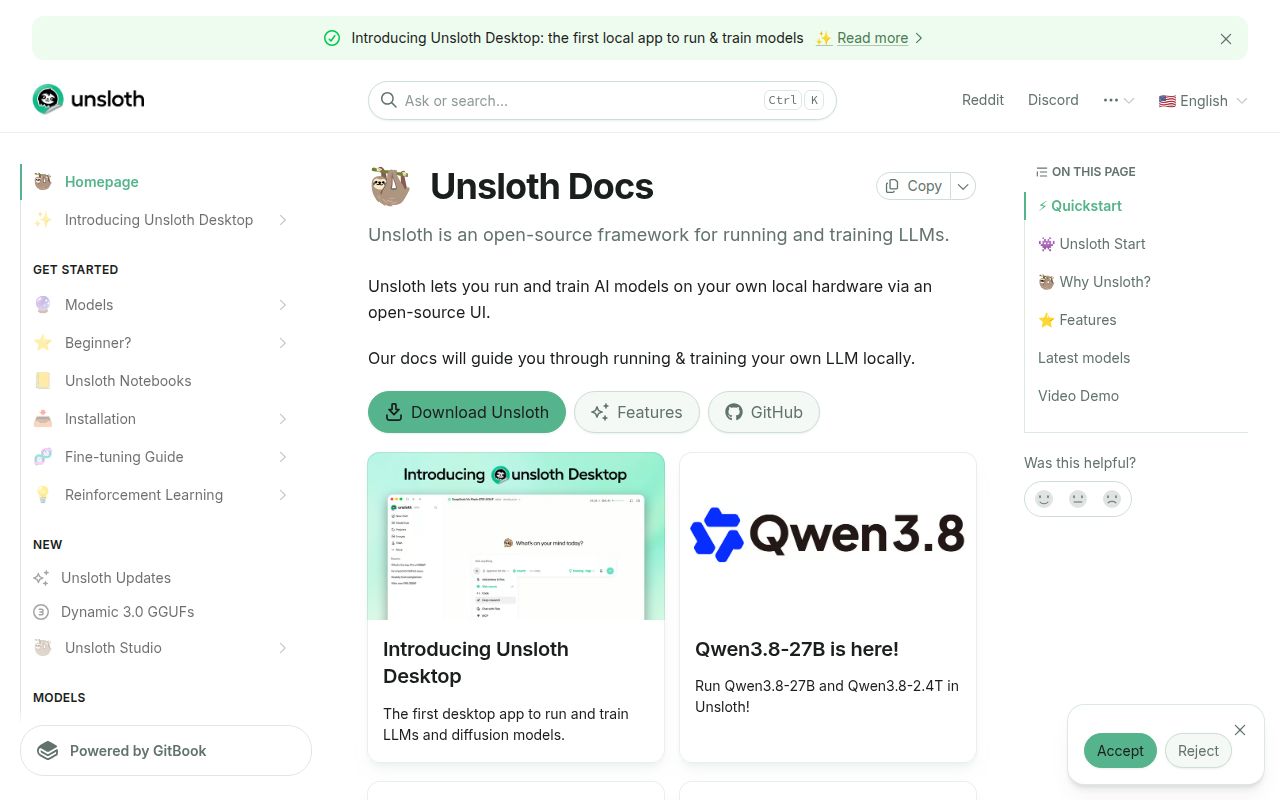
Unsloth began as a code-focused way to make fine-tuning open models less wasteful, but the current repository has a much wider job. Unsloth Core remains the Python package. Studio adds a web interface, and the beta desktop app packages that experience for Windows, macOS, and Linux. The UI can run language, diffusion, embedding, and audio models, prepare datasets from documents, fine-tune them, export results, and serve an OpenAI-compatible API. This breadth is useful, though it makes the name mean different things to different teams.
The checkout makes that expansion visible. commit 27e0ff1 contained 4,147 files and roughly 1,611,926 lines of source, occupying 112.6 MB. We found 41 CI workflow files and a tests directory, but no Dockerfile in the checkout even though the README points users to a published unsloth/unsloth image. A researcher using the Python package and a desktop user clicking through Studio share a repository, while their security, hardware, and maintenance concerns are quite different.
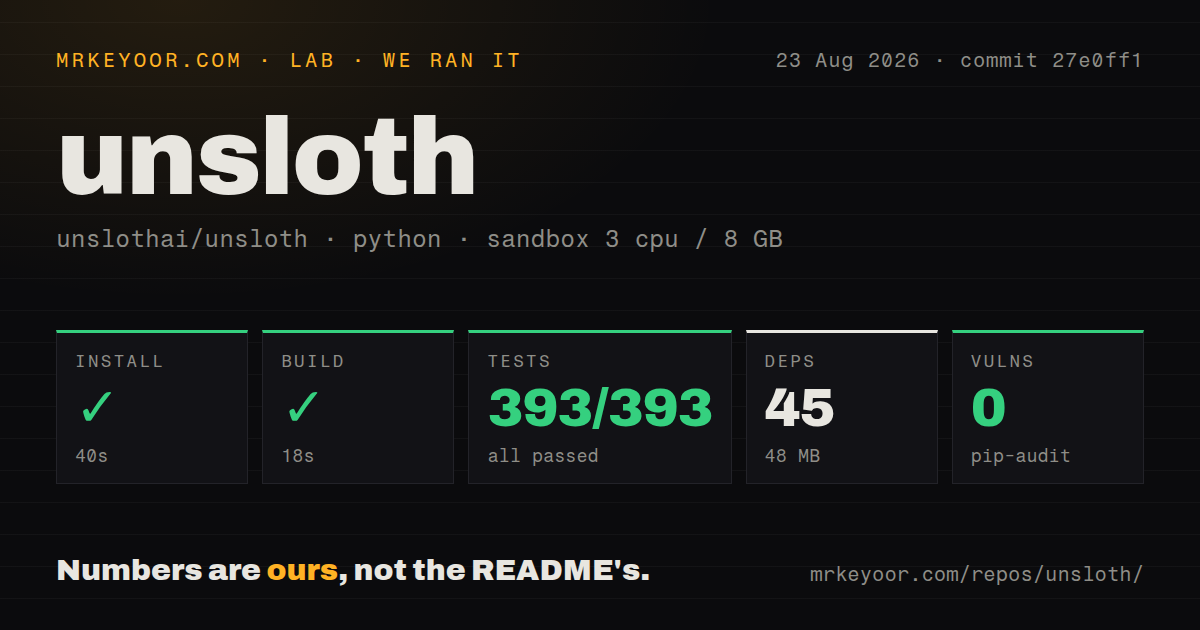
The 48 MB Python install is only the control layer
The simplest Core instructions create a Python 3.13 environment with uv and install Unsloth with automatic PyTorch backend selection. Desktop users receive platform installers, while Studio users can run a shell installer or Docker image. Free Colab and Kaggle notebooks give people without a prepared machine another route into training. Those entry points reduce setup work, especially for a first LoRA experiment.
Our installed environment used 48 MB after 45 packages, but that figure excludes model weights, datasets, generated checkpoints, and GPU runtime layers outside the measured package set. A 27B model or a long training corpus changes the storage and memory calculation far more than the Python wheel does. Unsloth documents routes for NVIDIA, AMD, Intel, Vulkan, CPU, Apple Silicon, and multiple GPUs. Each route should be treated as its own deployment target rather than proof that one environment file behaves identically everywhere.
What happened when we ran it
Our sandbox installed Unsloth in 40 seconds, adding 45 Python packages. The build completed in 18 seconds. Pytest then reported 393 passed, 0 failed, and 26 skipped in 49 seconds. Pip-audit found 0 known vulnerabilities in the installed dependency set. These results came from commit 27e0ff1 in a fresh unprivileged Debian container with 3 CPUs and 8 GB of RAM.
That clean run covers repository setup and the available CPU-side suite, not the product's larger performance claims. We did not train a model, load a GPU, compare VRAM use, or verify the README's speed claims. Skipped tests also mean some paths were not exercised in this environment. The evidence supports a narrower conclusion: the supplied Python project installed, built, and passed every test it executed on our box, with no advisory reported by the package audit.
Studio's enabled tools change the security decision
Unsloth Studio can listen on a LAN address or create a global HTTPS link through Cloudflare. The README warns that server-side tools are enabled by default, tells users to keep the password safe, and documents --disable-tools. Its Docker example maps ports 8888, 8000, and 2222 for the notebook, API, and SSH access. Those are useful capabilities on a trusted workstation. They are also a poor fit for casual exposure to an office network or the public internet.
The license boundary deserves the same care. The repository metadata identifies Apache-2.0, and the README explains that Unsloth Core remains under that license. Certain optional components, including the Studio UI, use AGPL-3.0. A company embedding Core into its training code faces a different obligation from one modifying and serving Studio. Decide which component is being adopted before legal review, image publication, or internal platform work begins.
Local agents and MCP can also execute code
Unsloth Start connects local models to Claude Code, Codex, Hermes Agent, OpenClaw, and OpenCode with one command. The README also documents MCP, tool calling, code execution, private web search, RAG, and rolling context compaction. For an agent developer, this is a convenient bridge: the same model workspace can expose an OpenAI-compatible endpoint and give an agent access to local tools.
Convenience raises the consequence of a bad boundary. An MCP server or coding agent can reach files, applications, databases, and commands according to the tools it receives. Pairing that with Studio's default server-side tools requires explicit network binding, authentication, restricted working directories, and a model you have tested for tool-call formatting. The 393 passing tests do not certify a model's judgment or make generated shell commands safe to run. Keep execution approval outside the model.
Beta desktop failures can erase expensive work
Release v0.1.803-beta arrived on August 25, 2026, with more than 170 merged pull requests according to its notes. It added preview LAN access and experimental auto compaction while fixing MLX, AMD, installer, chat, and Studio behavior. GitHub recorded 74,902 stars, 1,386 combined open issues and pull requests, and a last push on August 27. The project is plainly active, but the beta label matches the pace and volume of change.
Open issue 8911 gives a specific reason for caution on macOS. The reporter describes a display wake reloading the desktop UI, cancelling a 97-minute GGUF generation after about 18,235 output tokens, and leaving an empty assistant message. That report concerns one setup and an earlier beta, so it does not prove every long job is lost. It does justify saving training artifacts, testing sleep and reconnect behavior, and avoiding unattended desktop generations until the exact release survives those cases.
Unsloth is easiest to recommend when its scope is kept explicit. The 40-second Core install and 393 passing tests make the training library a credible experiment. Studio is a broader local AI workstation with tools, networking, and mixed licensing, while Desktop is still beta software. Pick the layer that solves the actual problem, then test the chosen model and accelerator rather than adopting the whole stack by default.