OpenMuse makes delegated work visible to its owner
OpenMuse lets you give an agent a job, inspect its plan, supply missing information, and review actions before they reach Gmail or Calendar. Its browser can be opened for manual takeover, and completed work leaves receipts and files. That makes the application interesting for someone building a personal assistant who wants to see what happened after leaving the chat. The README calls it an alpha for self-hosting and customization, which is the right expectation.
Our checkout was 14.1 MB across 226 files, with roughly 37,636 source lines. The workspace monorepo includes an Expo interface, a server, browser tooling, integrations, and shared request types. The same interface targets web and native devices, but that does not make this a downloadable assistant with everything preconfigured. Browser sessions, live account access, and conversation persistence each have their own operating requirements.
What happened when we ran it
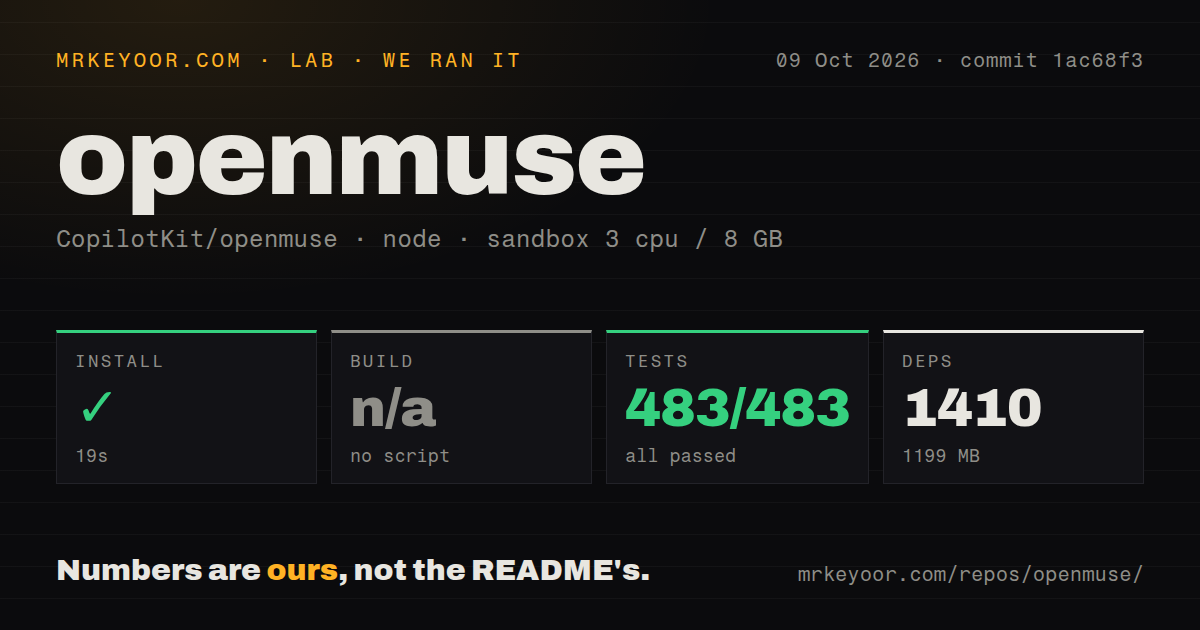
Our run installed 1,410 pnpm packages in 19 seconds and used 1,199 MB on disk. We cloned commit 1ac68f3 on October 9, 2026, into an unprivileged container with 3 CPUs and 8 GB of RAM, using the lab-node:22 image. The container had no secrets. The installation succeeded, and the measured dependency footprint is substantial for a personal application even though the source checkout itself is relatively small.
Node's test runner passed all 483 tests with 0 failures in 124 seconds. The harness found no build script or target, so it skipped the build. That is an unmeasured step, not a successful compilation. Our scan recorded 1 CI workflow file, a tests directory, monorepo workspaces, and no Dockerfile. The supplied measurements include no dependency vulnerability audit, so there is no audit result to attach to the successful suite.
The 483 passing tests support confidence in the exercised code at this commit. They cannot establish live mailbox access, provider-account acceptance, signed mobile binaries, or the quality of an agent's decisions. None of those outcomes appears in the supplied measurement block. Treat the green suite as a good reason to investigate the app, while reserving judgment on the integrations you will actually connect.
Self-hosting still requires CopilotKit Intelligence
The Rich Threads guide says every workspace mode needs a server-side CopilotKit Intelligence project key, and the API refuses to start without it. Intelligence stores conversations and replay outside the application's bundled MIT-licensed code. Even the fictional sample workspace requires that configuration. Someone choosing self-hosting to keep all conversation storage within their own deployment should stop here and evaluate this dependency before adopting the UI.
The 19-second package install did not create that account or prove its service works. The current README also specifies Node 24 LTS and pnpm, whereas our measured image used Node 22. For a fresh deployment, follow the documented runtime requirements and the named server and platform commands. Our skipped build remains a limit of the measured path. An open local-thread-store request seeks an alternative to Intelligence, but a proposed fork does not change upstream's requirement.
Live mail and durable work need a running, backed-up server
Live mode needs an access key, token-encryption configuration, model credentials, and Google OAuth setup for mail or calendar. Each external send or calendar change requires a stored review. Disconnecting an account invalidates pending account-bound work. The README also warns that cancellation can leave an already dispatched provider request running, and uncertain external writes are not silently retried. Those details are more useful than a promise that the agent can handle your inbox.
Our 1,199 MB environment excludes a demonstrated live Google workflow. Persistent application data includes the database, documents, and signing key, while browser profiles have their own disk location. The host must stay running for background work. Embedded PGlite cannot be shared across separate processes, so splitting out a task worker calls for PostgreSQL and shared configuration. Backing up application data matters even when a cloud conversation thread can still load after local files disappear.
The Linux computer has tighter limits than a desktop VM
The optional computer uses a nonroot Docker container with a persistent workspace volume. It omits host-directory mounts and credentials, and disables terminal networking. Public browsing uses a separate Chromium worker. The owner can edit files and move PDFs between the workspace and the app, but graphical desktops and autonomous checkout remain future work. This is an appropriate boundary for reviewing bounded jobs, and a poor fit for someone expecting unrestricted remote desktop automation.
Passing 483 tests in our container does not show that your Docker engine, Chromium installation, and worker token are configured. OpenMuse is also a single-owner deployment protected by a shared access key, rather than a team authentication system. The documentation excludes hostile-tenant isolation. Keep that ownership model intact when judging deployment suitability, especially if several people want to share the same agent computer.
Search and telemetry have separate data routes
The README enables Parallel's keyless Search MCP by default for the configured model path. It says generated queries and context can contain conversation or task information. Search can be disabled through configuration. The telemetry guide separately documents SDK runtime events and explicit opt-outs. Neither local hosting nor the MIT license determines how those external services handle the information they receive.
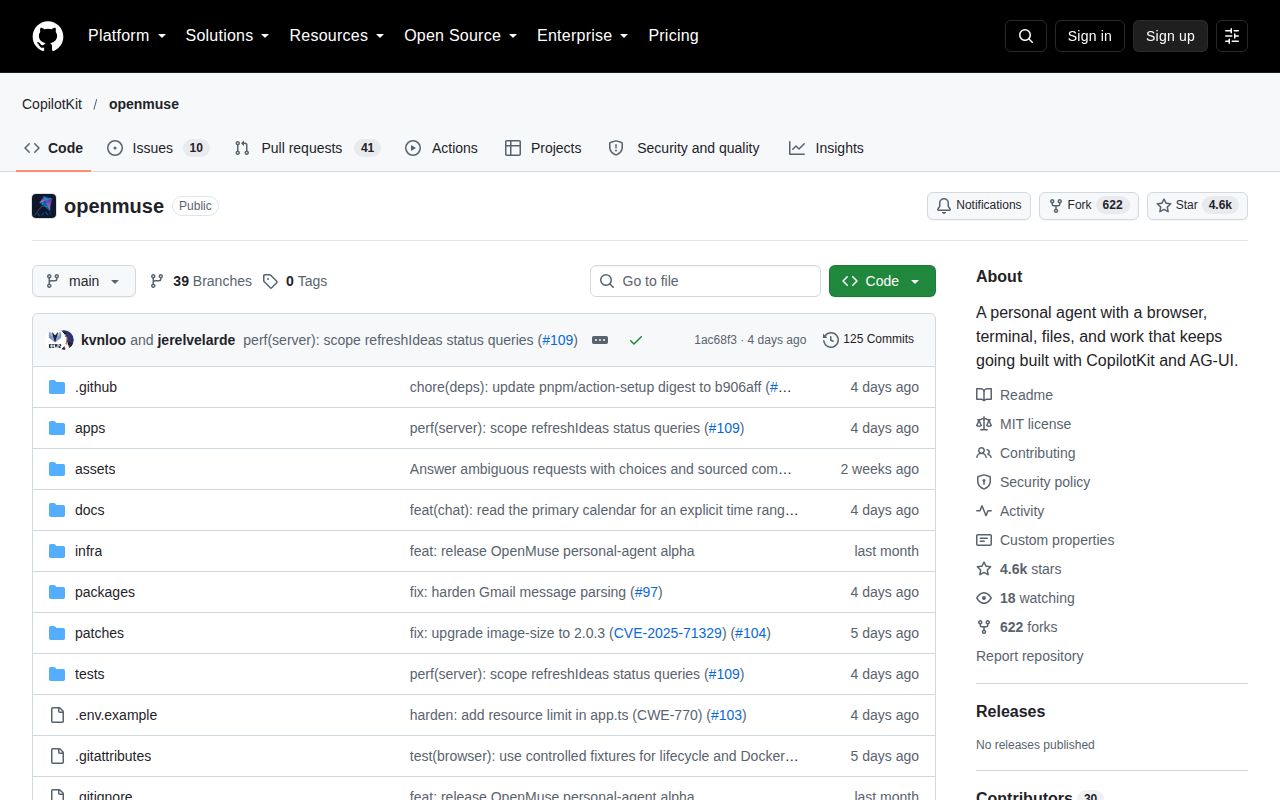
The last push was October 10, 2026, and GitHub listed 4,609 stars with 51 open issues and PRs. There was no latest release returned by the API. Current issue activity, including the local-persistence request, supports active development despite the missing release tag. Choose OpenHands Agent Canvas for a coding-agent control center, or Open WebUI for a model interface when delegated personal workflows are unnecessary. OpenMuse earns a trial when reviewed actions and durable jobs justify its service dependencies. Connect a fictional workflow first, then the account whose actions you can afford to supervise.