
A coding agent runs the studio instead of an application server
OpenMontage gives a coding assistant a production vocabulary and the tools to act on it. Pipeline manifests cover explainers, documentary montages, screen demos, localization, podcasts, talking heads, and several other formats. The agent reads the chosen manifest, follows stage instructions, calls Python tools, saves checkpoints, asks for approval, then hands composition to Remotion, HyperFrames, or FFmpeg. There is no central orchestrator in the usual sense. The README says the coding assistant itself fills that role.
That choice is both the appeal and the risk. More than 100 production tools and over 700 skill or production-knowledge files give an agent a lot of local context. They also make success depend on how faithfully that agent reads contracts and reacts to failed tools. OpenMontage is closer to an editable production operating manual than a desktop editor. A developer can inspect its YAML, Markdown, Python, and React pieces, but an editor cannot simply drag clips around a timeline.
Zero API keys still require Python, Node.js, and FFmpeg
The free path is more credible than the usual claim that free AI video means a slideshow. OpenMontage can retrieve motion footage from Archive.org, NASA, and Wikimedia Commons, index it for search, add Piper narration, and compose the result locally. Remotion handles React scenes, while HyperFrames handles HTML, CSS, and GSAP motion. Local GPU models are another option after running the separate GPU setup.
Zero keys does not mean zero setup. The README lists Python 3.10+, Node.js 18+, FFmpeg, and a compatible coding assistant before its three-command quick start. Our checkout contained 2,115 files, about 162,247 source lines, and 88.6 MB before installation. Cloud providers add their own credentials. The environment file includes routes for several image, video, speech, stock, and music services, so a useful configuration is a set of deliberate provider choices rather than one universal account.
What happened when we ran it
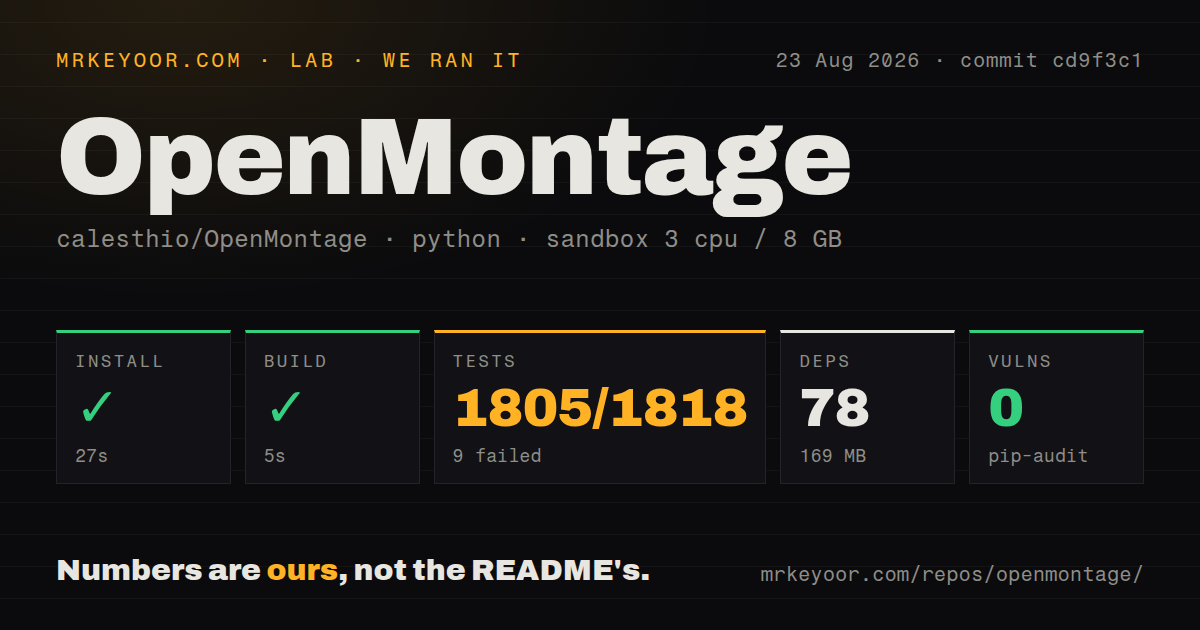
Our sandbox installed 78 Python packages in 27 seconds and used 169 MB on disk. The build then passed in 5 seconds. Pip-audit reported 0 known vulnerabilities. Those results came from commit cd9f3c1 in an unprivileged Debian container with 3 CPUs and 8 GB of RAM. The repository supplied a tests directory and one CI workflow, but no Dockerfile.
The full pytest command failed after 43 seconds. It reported 1,805 passed, 9 failed, 26 skipped, 3 xfailed, and 4 collection or setup errors. Several HyperFrames tests could not find npx; three runtime-review tests could not find ffmpeg. The four setup errors came from audio mixing, video composition, stitching, and end-to-end QA modules that also tried to invoke FFmpeg.
One other failure checked how an unavailable npm package is explained. The assertion said the reasons should include the actual npm-resolution failure instead of only a generic runtime message. The log tail does not prove whether installing the missing system executables would clear every failure. It proves the Python install and build are not enough to run the checked-in suite on a fresh Debian base, even though both FFmpeg and Node.js appear in the README prerequisites.
Approval records exist, but preflight can still approve an empty provider set
OpenMontage treats approval as stored state. Proposal, script, scene plan, generated assets, and publishing are documented as gates, and the checkpoint writer is meant to reject a completed gated stage without an approval record. Budget controls estimate and reserve spending, then reconcile the result. The default per-action approval threshold is $0.50, and the default total cap is $10. That is a sensible design for media APIs where one experimental prompt can fan out into several paid calls.
The enforcement layer still has holes. Open issue 542 reports that the cinematic pipeline can pass preflight with zero video, image, or music providers because those tools are marked optional while local composition tools satisfy the required check. Current pull requests also describe a ComfyUI workflow producing strobing stills that still passed structural checks, a video trimmer selecting the wrong range, and caption words losing spaces. These reports are specific enough to demand output inspection even when a pipeline reports success.
The provider catalog saves integration work and adds moving parts
The README groups more than 60 provider integrations behind scored selection. A request can move among cloud video APIs, local GPU models, stock libraries, speech engines, and two programmatic composition runtimes. The selector records task fit, quality, control, reliability, cost, latency, and continuity. That can save substantial adapter work for a team comparing providers, especially when a failed or expensive service needs a substitute.
Every extra route is another contract to verify. The 78 packages in our Python environment did not include the separate Remotion npm install described by the manual setup command. API keys can carry billing and content-policy consequences. Stock sources have their own licensing terms. Local generation needs GPU memory and model files. OpenMontage records selections and costs, but the operator still owns credentials, provider terms, source rights, and whether the exported clip matches the brief.
August activity is high, while a tagged release is absent
GitHub showed 51,397 stars and 247 open issues and pull requests when fetched. The default branch was last pushed on August 22, 2026, and open work was still receiving updates on August 26. GitHub's latest-release endpoint returned no tagged release. That combination looks like an actively changing main branch rather than a quiet packaged product, and the combined open count should not be read as 247 confirmed bugs.
OpenMontage is worth a sandbox for developers who find closed AI video sites too limiting. Its files expose more of the editorial and technical process than a prompt box does, and the 1,805 passing tests show meaningful coverage. The failed media checks also set the adoption condition: install the full system toolchain, pin the commit, run the relevant pipeline with your actual providers, and watch the rendered video before trusting the status board.