One application for the whole short-video assembly line
MoneyPrinterTurbo starts with a topic, keyword, or supplied script and aims to produce a finished short video. It can ask a language model for narration and search terms, collect local or stock footage, request generated clips, synthesize a voice, create styled subtitles, mix background music, and render a vertical or horizontal file. Users can run the flow from a Streamlit WebUI, an API, a CLI, or an agent skill.
The default README is written in Chinese, which reflects the project's primary audience and sponsor ecosystem. A maintained English README covers the same installation and feature paths, and Japanese documentation is also linked. The interface itself supports several locales. English-speaking developers can operate the project, though some provider guidance and community discussion will still be easiest for Chinese readers.
The scope is attractive because media automation usually requires several separate scripts. Here, model selection, stock search, speech, captions, presets, and rendering live in one configuration. The tradeoff is a large dependency and credential surface. A successful video may touch a model vendor, speech vendor, footage provider, generation API, and publishing service before it reaches a social account.
What happened when we ran it
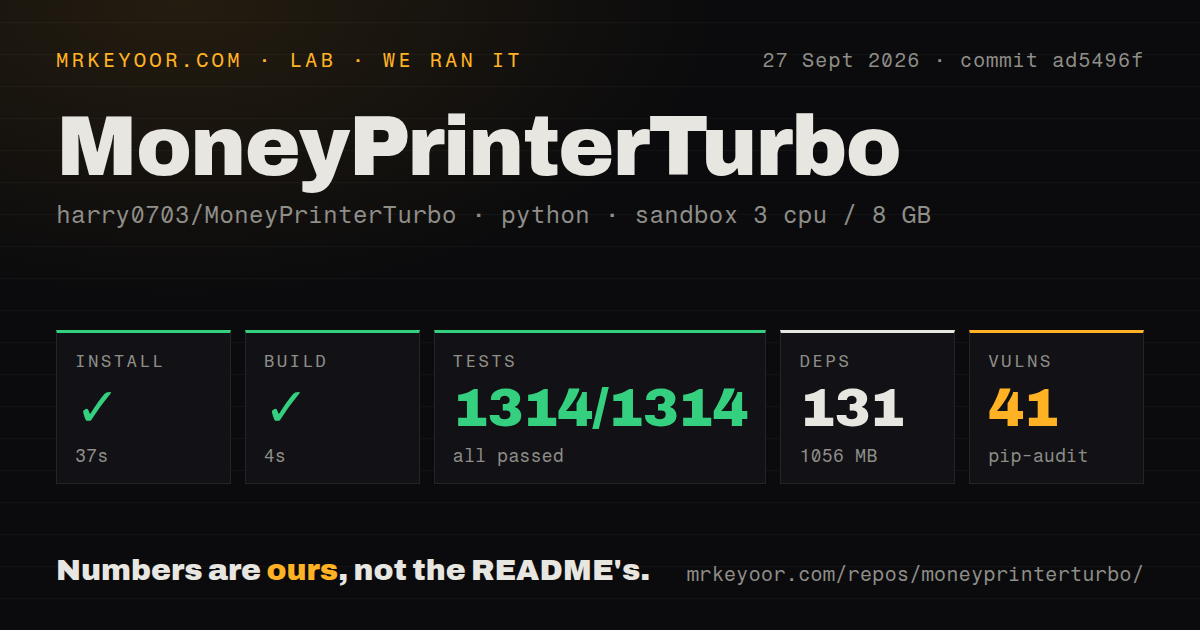
We cloned commit 5dde463 into a fresh, unprivileged Python 3.12 Bookworm container with three CPUs, 8 GB of RAM, and no secrets. The repository contained 199 files, about 42,045 lines of source, and occupied 210.7 MB.
Installation succeeded in 61 seconds, adding 130 packages and consuming 1,056 MB on disk. The build completed successfully in 9 seconds. The tests also succeeded and finished in 91 seconds. Two CI workflow files, a Dockerfile, a Compose file, and a tests directory are present.
The weak result was dependency security. pip-audit reported 28 known vulnerabilities. That number comes from the environment we installed at the measured commit, not from GitHub metadata. It does not say every finding is reachable through this application, but it is too large to wave away. An operator should capture the affected packages and advisories, update where compatible, rerun tests, and audit again before exposing the WebUI or API.
The first video still needs several services
The project recommends Python 3.11 or later and requires FFmpeg. Docker offers an isolated route, while Windows users can download a portable package. A first launch creates config.toml, and the WebUI can fill in the model, footage, speech, subtitle, and other settings. GPU hardware is optional for cloud-heavy use but can help with local transcription and video processing.
Script generation supports hosted language-model companies, compatible gateways, and local runtimes such as Ollama. Voice options range from Edge TTS, which does not need a key, to commercial speech services that do. Footage can come from local files, Pexels, Pixabay, Coverr, or a text-to-video provider. Local Whisper subtitle generation downloads a substantial model and adds processing time. Each choice changes cost, privacy, failure modes, and output rights.
This flexibility also makes configuration harder to reproduce. A preset can preserve generation settings, but v1.3.5 warns that exported presets may include API credentials when backup is enabled. Treat those files as secrets, keep them out of repositories and shared media folders, and prefer a secret store for team deployments.
Automation reaches publication
MoneyPrinterTurbo can send finished videos to TikTok, Instagram, and YouTube Shorts through Upload-Post. Enabling that path requires an account, API key, username, selected platforms, and an automatic-upload setting. YouTube privacy can be public, unlisted, or private. This is useful for a controlled content operation, but a generated draft should not go straight from topic to public feed.
Scripts can contain factual errors. Stock footage may be licensed for some uses but unsuitable for others. Generated footage can misrepresent people or events. The English README also notes that some bundled background music came from YouTube and tells users to delete it if copyright concerns arise. A publication queue should stop before upload for transcript review, source checking, media-rights review, caption inspection, and a watch-through of the rendered file.
The API needs an explicit lock
Release v1.3.5 added optional API-key authentication for /api/v1 and generated task files, plus path and filename checks for uploaded media, custom audio, symlinks, and request IDs. Those are worthwhile fixes for a system that reads local files and creates downloadable outputs. The compatibility choice matters: authentication remains off when app.api_key is empty.
A local-only WebUI behind a host firewall is different from a public container. Any shared deployment should set the API key, verify that protected routes reject missing credentials, restrict network exposure, separate task storage from sensitive directories, and rotate every provider secret that passed through old presets. The 28 dependency findings raise the urgency of that review.
Health and the decision
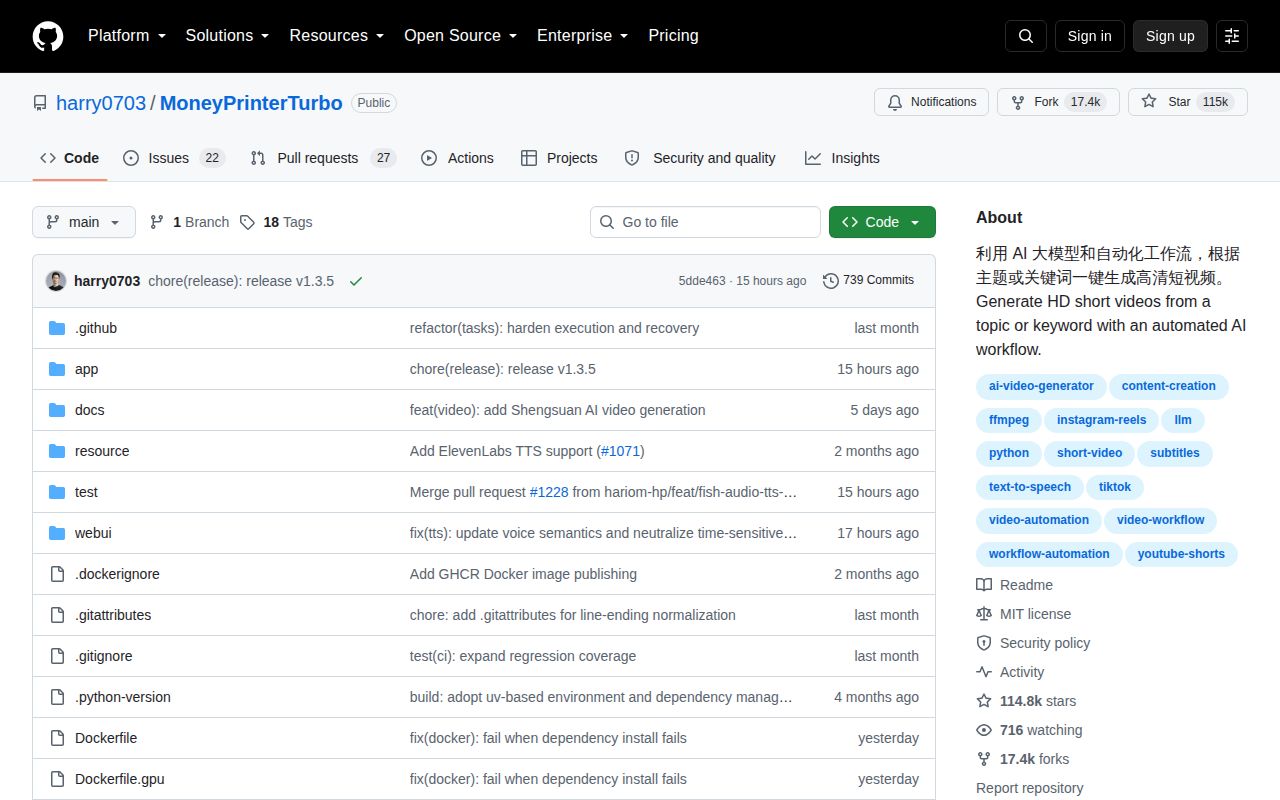
The repository was pushed on August 22, 2026, and v1.3.5 was released the same day. GitHub listed 49 open issues and pull requests. August activity included authentication, path controls, FFmpeg failure handling, localization, batch input, publishing controls, and subtitle fixes. That is active maintenance tied to real deployment problems.
MoneyPrinterTurbo is a capable production aid, not an autonomous publishing department. Its strongest use is generating a rough cut that a creator reviews and edits. The current audit result makes a private, isolated deployment the sensible starting point; public API hosting should wait until the vulnerable dependency set is understood and reduced.